Use only clean type “ACR” rigid copper
tubing that has been joined with high
temperature brazing alloy.
The pipe or line sizes must be selected to
meet the actual installation conditions and
NOT simply based on the connection sizes at
the condensing unit or air handler.
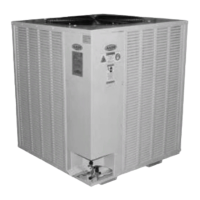
All CF Series condensing units are provided
with in-line shutoff valves on both the liquid
and suction lines. These must remain closed
until the system is ready for start-up after
installation.
Piping must conform to generally accepted
practices and codes.
Care must be taken not to cross the circuits
on multiple circuit systems.
Upon completion of piping connection, the
interconnecting piping and air handler MUST
BE evacuated to 500 microns or less; leak
checked and charged with refrigerant.
Determining Refrigerant Line Size
The piping between the condenser and low
side must ensure:
1. Minimum pressure drop, and
2. Continuous oil return, and
3. Prevention of liquid refrigerant slugging,
or carryover
Minimizing the refrigerant line size is
favorable from an economic perspective,
reducing installation costs, and reducing the
potential for leakage. However, as pipe
diameters decrease, pressure drop increases.
Excessive suction line pressure drop causes
loss of compressor capacity and increased
power usage resulting in reduced system
efficiency. Excessive pressure drops in the
liquid line can cause the liquid refrigerant to
flash, resulting in faulty TXV operation and
improper system performance. In order to
operate efficiently and cost effectively, while
avoiding malfunction, refrigeration systems
must be designed to minimize both cost and
pressure loss.
Equivalent Line Length
All line lengths discussed in this manual,
unless specifically stated otherwise, are
Equivalent Line Lengths. The frictional
pressure drop through valves, fittings, and
accessories is determined by establishing the
equivalent length of straight pipe of the same
diameter. Always use equivalent line
lengths when calculating pressure drop.
Special piping provisions must be taken
when lines are up vertical risers or in
excessively long line runs. Do not run
underground refrigerant lines.
Liquid Line
When sizing the liquid line, it is important to
minimize the refrigerant charge to reduce
installation costs and improve system
reliability. This can be achieved by
minimizing the liquid line diameter.
However, reducing the pipe diameter will
increase the velocity of the liquid refrigerant
which increases the frictional pressure drop
in the liquid line, and causes other
undesirable effects such as noise.
Maintaining the pressure in the liquid line is
critical to ensuring sufficient saturation
temperature, avoiding flashing upstream of
the TXV, and maintaining system efficiency.
Pressure losses through the liquid line due to
frictional contact, installed accessories, and
vertical risers are inevitable. Maintaining
adequate sub-cooling at the condenser to
overcome these losses is the only method to
ensure that liquid refrigerant reaches the
TXV.


 To Next Page