7
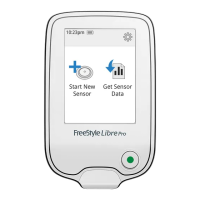
• The Reader’s built-in meter is not for use on neonates, in critically-ill
patients, or for diagnosis or screening of diabetes.
• See Using the Reader’s Built-in meter section of the User’s Manual for
additional important information on the use of the Reader’s built-in
meter.
What to know about charging your Reader:
• Always use the Abbott provided power adapter and yellow USB cable
that came with your Reader to minimize the risk of re or burns. Take
care when plugging and unplugging your USB cable. Do not force or
bend the end of the USB cable into the Reader’s USB port.
• Choose a location for charging where you can easily access the
power adapter and quickly disconnect to prevent the potential risk of
electrical shock.
• The maximum surface temperature of the Reader and/or the power
adapter could go as warm as 111°F when it’s charging or 117°F
during normal use. Under these conditions, do not hold the Reader
or the power adapter for ve minutes or more. People with disorders
of peripheral circulation or sensation should use caution at this
temperature.
• Do NOT expose the USB cable or power adapter to water or other
liquids as this may cause them to not function properly and may lead
to risk of re or burns.
Interfering Substances:
Taking ascorbic acid (vitamin C) supplements while wearing the Sensor
may falsely raise Sensor glucose readings. Taking more than 500 mg of
ascorbic acid per day may aect the Sensor readings which could cause
you to miss a severe low glucose event. Ascorbic acid can be found in
supplements including multivitamins. Some supplements, including cold
remedies such as Airborne® and Emergen-C®, may contain high doses of
1000 mg of ascorbic acid and should not be taken while using the Sensor.
See your health care professional to understand how long ascorbic acid is
active in your body.






 To Next Page