Need help?
Do you have a question about the Accuphase E-600 and is the answer not in the manual?
Compares E-600's LED bar graph meters to E-560's needle meters.
Volume sensor taken from C-2820 and improved with CNC machining.
AAVA achieves low noise via paralleled V-I converters, reducing noise by 5dB.
Achieves higher damping factor (500 vs 200) using new components and techniques.
Technique for lower output impedance by sensing speaker terminals and GND lines.
Balanced remote-sensing improves damping factor, THD, and IM distortion.
Replaces mechanical relays with MOS-FET switches for reliability and sound quality.
Uses coils with extremely low DC-resistance for stable power amplifier operation.
Ready for new DAC-40 option board, displays sampling frequency.
Equipped with balanced Pre-Output and Power-Input terminals.
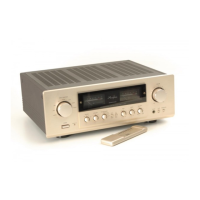
Features an elegant and high-quality remote commander.
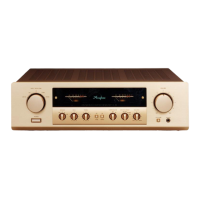
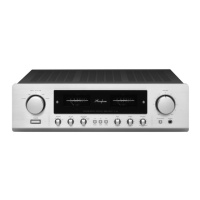
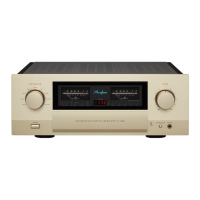
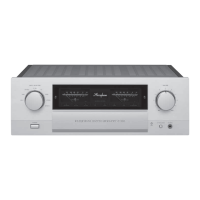
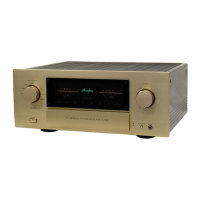
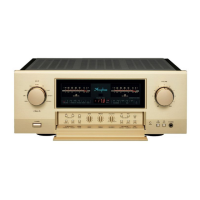
The Accuphase E-600 is a Class-A integrated stereo amplifier, serving as the flagship model and successor to the E-560. The "E-600" designation signifies a substantial leap in progress beyond a mere model change.
The E-600 is designed to amplify audio signals for high-fidelity sound reproduction. It integrates a pre-amplifier and power amplifier into a single unit, offering a comprehensive solution for audio enthusiasts. Its core function is to deliver a clean, powerful, and accurate audio signal to speakers, ensuring an immersive listening experience.
LED Bar Graph Meters: A significant visual and functional upgrade from its predecessor, the E-600 features up-to-date LED bar graph meters instead of traditional needle meters. This provides a modern aesthetic and potentially more precise visual feedback on signal levels.
Advanced Volume Sensor Mechanism: The E-600 incorporates a precise and well-designed volume sensor mechanism, inherited and improved from the C-2820 pre-amplifier. This mechanism is constructed with a CNC-machined aluminum block and an extra-thick 8mm diameter shaft, ensuring durability and smooth operation. High-precision rotary mechanisms contribute to the tactile quality of the volume knob, offering a very smooth touch and feel. Furthermore, the drive sound produced when adjusting the volume via a remote commander is notably more silent than previous models, enhancing the user experience.
Re-designed AAVA for Low Noise: The Accuphase Analog Vari-gain Amplifier (AAVA) in the E-600 has been re-designed specifically for low-noise performance. This is achieved through the use of paralleled buffer amplifiers and a paralleled V-I converter in larger two units. This design results in a 5dB lower noise floor compared to the E-560. Consequently, the input stage of the power amplifier is also low-noised, leading to an overall noise reduction of 56% (-5dB) compared to the E-560. This meticulous engineering ensures a cleaner audio signal with minimal unwanted interference.
Higher Damping Factor: The E-600 boasts a significantly higher damping factor, an index of its speaker driving ability. While the E-560 had a damping factor of 200, the E-600 achieves a remarkable 500, representing a 2.5 times improvement. This enhanced damping factor is achieved through several key features:
Ready for New Option Board DAC-40: The E-600 is designed to accommodate the new digital input board, DAC-40. When installed, the front panel display can show the sampling frequency of the music signal input into the DAC-40, providing useful information to the user.
Balanced Pre-Output and Power-Input: The amplifier is additionally equipped with balanced-type input and output connections for both Pre-Output and Power-Input. This allows for high-quality, low-noise connections with other balanced audio components.
High-Quality Remote Controller: The E-600 comes with an elegant and high-quality remote commander, enhancing convenience and user interaction.
While the manual doesn't explicitly detail user-level maintenance, the design choices in the E-600 inherently contribute to its longevity and reliability, reducing the need for frequent maintenance. The use of a MOS-FET switch for speaker protection, for instance, offers greater long-term reliability compared to mechanical relays, which can degrade over time. The robust construction of the volume sensor mechanism with CNC-machined aluminum and an extra-thick shaft also suggests a durable component designed for extended use.

 To Next Page
 General