EasyManua.ls Logo

Acer V70MA - User Manual

Acer V70MA
28 pages
Print Icon
To Next Page IconTo Next Page
Loading...
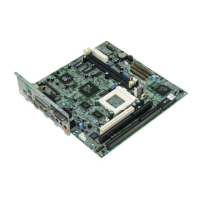
V70MA System Board
V70MA System Board 1
The V70MA is an all-in-one, high-performance system board that
supports the Intel Pentium processor with MMX (MultiMedia
eXtensions) technology. The MMX feature enables the system to
handle multimedia functions and enhance the performance of 32-bit
applications.
The system memory is upgradable to 256 MB via the onboard two
168-pin DIMM (Double In-line Memory Module) sockets. These
sockets accommodate 8-, 16-, 32-, 64- and 128-MB DIMMs. The
system board also comes with 512-KB second-level cache already
integrated in the CPU.
To fully support multimedia functions, the board incorporates a high-
performance 3-D video controller with AGP (Accelerated Graphics
Port) feature, 2- or 4-MB SGRAM (Synchronous Graphics Random
Access Memory), and a 3-D audio controller.
Onboard I/O (input/output) interfaces are comprised of two UART
(Universal Asynchronous Receiver-Transmitter) 16C550 serial
interfaces (one port and one connector), a parallel port with SPP
(Standard Parallel Port)/ECP (Extended Capabilities Port)/EPP
(Enhanced Parallel Port) support, and PS/2 keyboard and mouse
ports. Two USB (Universal Serial Bus) ports, one VGA (Video
Graphics Accelerator) port, one Feature connector, one Microphone-in
port, one Line-in port, one Line-out port, and one Game/MIDI (Musical
Instrument Digital Interface) port are also added to the board design to
enable the system to support additional peripherals.
For expansion, the board comes with two ISA (Industry Standard
Architecture) slots and one PCI (Peripheral Component Interface) slot.
Special features such as PnP (Plug-and-Play) support, Power
Management, Wireless Communication, Hardware Monitoring, Wake-
on Ring, and Wake-on LAN (Local Area Network) functions are also
supported. These functions are individually discussed in this chapter.

Question and Answer IconNeed help?

Do you have a question about the Acer V70MA and is the answer not in the manual?

Overview

The V70MA is an all-in-one, high-performance system board designed to support Intel Pentium processors with MMX (MultiMedia eXtensions) technology. The MMX feature enhances the system's ability to handle multimedia functions and improves the performance of 32-bit applications.

Major Components and Specifications:

  • CPU Socket: Features a Zero Insertion Force (ZIF) CPU socket compatible with Intel, AMD, or Cyrix/IBM Pentium CPUs with MMX technology, supporting speeds of 233, 250, 266, 300, 333, or 350 MHz.
  • Memory:
    • Two 168-pin DIMM (Double In-line Memory Module) sockets for memory expansion up to 256 MB.
    • Supports 8-, 16-, 32-, 64-, and 128-MB Standard DRAMs, including SDRAMs (Synchronous Direct Random Access Memory) and EDO (Extended Data Out) DRAMs.
    • Memory modules should have a 60 ns (nanoseconds) or less access time and support Parity Check or Error Correction Code (ECC).
    • Memory Configurations:
      • Single DIMM (DIMM1 or DIMM2): 8 MB, 16 MB, 32 MB, 64 MB, 128 MB.
      • Dual DIMM (DIMM1 + DIMM2):
  • 8 MB + 16 MB = 24 MB
  • 16 MB + 32 MB = 48 MB
  • 32 MB + 64 MB = 96 MB
  • 64 MB + 128 MB = 192 MB
  • 8 MB + 8 MB = 16 MB
  • 16 MB + 16 MB = 32 MB
  • 32 MB + 32 MB = 64 MB
  • 64 MB + 64 MB = 128 MB
  • 128 MB + 128 MB = 256 MB
  • Cache: Integrated 512-KB second-level cache within the CPU. The board may also come with either 256-KB or 512-KB pipelined-burst second-level cache, or a cacheless design.
    • Cache Configurations (12 ns):
      • 256 KB: 32K x 32 x 2 pcs. Data RAM (U23, U26) with 32K x 8 x 1 pc Tag RAM (U22) (external) for 256 MB cacheable memory.
      • 256 KB: 32K x 32 x 2 pcs. Data RAM (U23, U26) with 16 x 10 x 1 pc Tag RAM (U22) (internal) for 256 MB cacheable memory.
      • 512 KB: 64K x 32 x 2 pcs. Data RAM (U23, U26) with 32K x 8 x 1 pc Tag RAM (U22) (external) for 128 MB cacheable memory.
      • 512 KB: 64K x 32 x 2 pcs. Data RAM (U23, U26) with 16 x 10 x 1 pc Tag RAM (U22) (internal) for 256 MB cacheable memory.
  • Video:
    • High-performance 3-D video controller with AGP (Accelerated Graphics Port) feature.
    • 2- or 4-MB SGRAM (Synchronous Graphics Random Access Memory).
    • AGP offers greater bandwidth for speeding up the VGA bus to meet 3-D application requirements.
    • Supported Video Resolutions: A wide range of resolutions from 640 x 480 up to 1600 x 1200 with various refresh rates (Hz), horizontal frequencies (KHz), and pixel clocks (MHz). For example, 640x480 at 60Hz (31.4KHz, 25.2MHz) up to 1600x1200 at 85Hz (106.2KHz, 229.5MHz).
  • Audio:
    • 3-D audio controller.
    • Audio interfaces include Microphone-in port, Line-in port, Line-out port, Game/MIDI port, and CD-in connector.
  • IDE Controller:
    • PCI local bus IDE (Integrated Device Electronics) controller.
    • Supports PIO mode 4 and Ultra DMA (Direct Memory Access) mode data transfers.
    • Two PCI enhanced IDE interfaces, supporting up to four IDE devices (hard disks, CD-ROM drives).
    • IDE Hard Disk Configuration:
      • IDE 1 (CN11): Master (Hard disk 0), Slave (Hard disk 1).
      • IDE 2 (CN10): Master (Hard disk 2/IDE CD-ROM drive), Slave (Hard disk 3).
  • I/O Interfaces:
    • Two UART (Universal Asynchronous Receiver-Transmitter) 16C550 serial interfaces (one port and one connector).
    • Parallel port with SPP (Standard Parallel Port)/ECP (Extended Capabilities Port)/EPP (Enhanced Parallel Port) support.
    • PS/2 keyboard and mouse ports.
    • Two USB (Universal Serial Bus) ports (CN1).
    • One VGA (Video Graphics Accelerator) port.
    • One Feature connector.
    • One Game/MIDI (Musical Instrument Digital Interface) port.
    • One IrDA (InfraRed Data Association) connector for Wireless Communication support (CN2).
    • One Wake-on LAN connector (CN7).
    • One Modem ring-in connector (CN9).
    • One CD-in connector (CN15).
    • One PCI audio upgrade connector.
    • One Voice Modem connector.
  • Expansion Slots:
    • Two ISA (Industry Standard Architecture) slots.
    • One PCI (Peripheral Component Interface) slot (one PCI-/ISA-shared).

Usage Features:

  • Compatibility: Fully compatible with MS-DOS V6.X, OS/2, SCO UNIX, Windows NT, and Windows 95/98 operating systems.
  • Plug-and-Play (PnP) Support: Simplifies the installation and configuration of expansion cards.
  • Power Management: Includes features for efficient power usage.
  • Wireless Communication: Onboard infrared interface (IrDA-compliant) for communication with SIR (Serial InfraRed)-aware peripherals at 115.2 Kbps up to one meter.
  • Hardware Monitoring: Allows checking system resources locally or over a network using software like Intel LDCM (LAN Desk Client Manager) or ADM.
  • Wake-on Ring-in: Enables the system to resume from suspend mode upon detecting a signal or activity from the fax/modem (or similar device) connected to the Modem ring-in connector (CN9).
  • Wake-on LAN: Allows the system to be activated via a network connection (CN7) for remote access, file sharing, etc.

Installation and Maintenance Features:

  • ESD Precautions: Emphasizes the importance of wearing a wrist grounding strap and handling components carefully to prevent electrostatic discharge damage.
  • Pre-installation Instructions: Guides users to turn off power, open the system, follow ESD precautions, and remove obstructing components before installation.
  • Post-installation Instructions: Reminds users to ensure components are installed correctly, jumpers are set, expansion boards are replaced, the system cover is reattached, and cables are connected.
  • DIMM Installation/Removal: Step-by-step instructions for installing DIMMs by opening clips, aligning, and pressing into the socket, and for removal by pressing holding clips and gently pulling. The system automatically detects memory changes, requiring Setup to view the new value.
  • CPU Installation/Removal: Detailed steps for removing a CPU by detaching the fan cable, pulling up the socket lever, and detaching the CPU. For installation, users are instructed to pull up the socket lever, insert the CPU (aligning pin 1), pull down the lever, and attach the heatsink and fan.
  • PCI Card Installation: Instructions for locating slots, removing brackets, inserting the card, and securing it with a screw. BIOS automatically detects and assigns resources to PCI devices.
  • ISA Card Installation: Guidelines for installing both PnP and non-PnP ISA cards, emphasizing the need to avoid IRQ conflicts with PCI devices. Users are advised to install non-PnP cards first, use Windows 95 or ICU to assign IRQs, then install PnP cards, allowing PnP BIOS to configure available resources.
  • Jumper Settings: A comprehensive table (Table 1) detailing various jumper settings for functions like VGA Interrupt, Wake-on LAN, Audio Line-in Source, CPU Type, Hardware Monitor, Bus Frequency (MHz) (for CY2283-1 and ICS9148-16 chipsets), CPU Core Clock Multiplier (for K6, M2, P55C CPU types), CPU Core Voltage, AMD K6S-300 Voltage Select, Password Checking, and M1542 Bus Frequency.
  • Onboard Connector Functions: A table (Table 2) listing all onboard connectors (CN1-CN17, FN1-FN2) and their respective functions, such as USB port, Power/HDD/Reset/Power/Suspend LED/IrDA/Turbo LED connectors, PS/2 mouse/keyboard port, ATX power connector, ATI AMC feature connector, Parallel/VGA/COM2 ports, Wake-on LAN, COM1, Modem ring-in, IDE1/IDE2, Floppy disk drive, Game/MIDI, Microphone-in, Stereo line-in/out, Fax/voice, CD-in, Volume control, External CS4610, and CPU fan connectors.
  • Error Messages and Corrective Actions: A detailed table (Table 7) providing common system error messages (e.g., Memory Error, Keyboard Error, Pointing Device Error, IDE Drive Error, Floppy Disk Controller Error, CPU Clock Mismatch, Serial/Parallel Port Conflict, CMOS Battery Bad, NVRAM Checksum Error, On Board xxx Conflict(s), PCI Device Error, System Resource Conflict, IRQ Setting Error, Expansion ROM Allocation Fail) and their corresponding corrective actions (e.g., replace DRAM chips/DIMMs, check/replace keyboard/pointing device, reconnect/replace disk drive/controller, check cable connections/CMOS setup, enter SETUP, replace lithium battery, run Setup again, try to reassign/disable onboard devices, replace PCI card, reconfigure system, change I/O expansion ROM address).
  • Correcting Error Conditions: General advice for troubleshooting, including running Setup with correct configuration values, checking system board and expansion board seating, and ensuring all connectors and boards are secure. Notes that if a new hard disk cannot be accessed, it may need physical formatting using FDISK and FORMAT commands. Suggests contacting an authorized service center if issues persist after troubleshooting.

Acer V70MA Specifications

General IconGeneral
BrandAcer
ModelV70MA
CategoryMotherboard
LanguageEnglish

Related product manuals