4.4 Thresholding (Zero-Suppress - ZS1 option)
Acqiris SA220P User's Manual 55
The number of gated-records after each trigger can differ between triggers. Reading the marker
stream allows to unpack the gated-records.
The reading can start before the gate is completed.
The maximum amount of data that can be streamed in a single CST acquisition (with or without
using the zero suppress) is: 2
48
-* 64 bytes
For example, if acquiring and streaming in zero suppress mode at 64 MBytes/s:
500 Hz x 1000 gates x 64 samples x 2 Bytes ≈ 281M seconds, i.e 3'257 days.
This limitation can be bypassed. Please refer to the software example for details.
For each record, the marker stream contains at least a trigger marker and a record-stop marker.
Gate markers are present only if a gate is detected.
Marker stream and data format
All the trigger and gate markers are consecutively stored in the dedicated stream.
The specific header allows to distinguish the various type and size of markers.
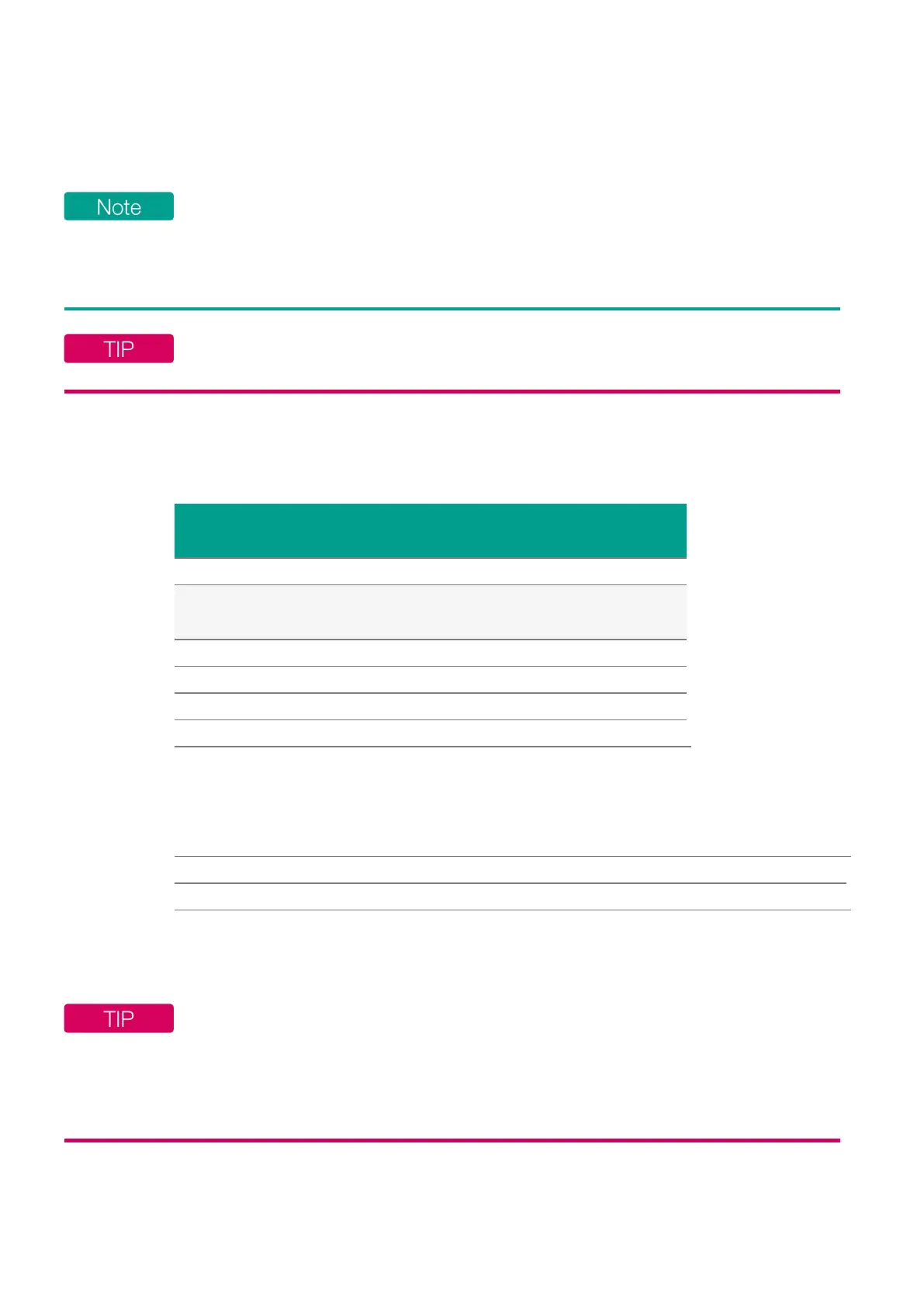
Marker Header Marker Type
Marker
Size
0x01 Trigger marker 512-bit
0x03
Trigger marker with extended format
(Incl. Zero-Suppress fields) - Not yet implemented
512-bit
0x04 Gate-start marker 64-bit
0x05 Gate-stop marker 64-bit
0x08 Dummy Gate marker 64-bit
0x0A Record-stop marker 64-bit
Table 4.3 - Marker header type.
Trigger marker
The trigger marker is encoded in 512 bits, as described below.
511 96 95 32 31 8 7 0
Reserved for future use Trigger position Trigger index
0x01
Table 4.4 - Trigger marker fields.
The trigger index corresponds to the trigger number.
The 64-bit trigger position field contains two fields: The left-aligned 58-bit contains the trigger
sample position in sample unit. The 8 least significant bits are reporting the sub-sample position
as in 1/256
th
of the sample period. The InitialXOffset and InitialXTime (in seconds) are
given for the SA220P by:
InitialXOffset = -500.10
-12
* TriggerPosition[0..7] / 256 + TriggerDelayInSeconds
InitialXTime = TriggerPosition[8..64] * 500 ps10
-12
Start Gate marker
The start gate markers are encoded in 64-bit, as described below.



 To Next Page