
 Need help?
Do you have a question about the ACR Electronics BIVY STICK and is the answer not in the manual?
Turn on the Bivy Stick and connect it to your phone via Bluetooth.
Follow the app prompts to activate the Bivy Stick with contact and payment information.
Compose and send messages to recipients, optionally including your current GPS location.
Set up pre-written messages with GPS coordinates and a map link for recipients.
Establish two-way communication with Global Rescue through the app for emergency assistance.
Confirm SOS request on the Stick by typing 'SOS' to send GPS coordinates to Global Rescue.
Lift the flap and press/hold the SOS button for 5 seconds to initiate an emergency alert.
Charge the device using a USB-C cable; indicator light shows charging status.
Explains the power light's function for device status and battery life indication.
Describes signal light colors for satellite visibility and GPS lock acquisition status.
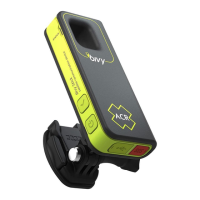
The Bivy Stick is a compact satellite communication device designed for outdoor enthusiasts, enabling communication and tracking in areas without cellular service. It functions by connecting to the Iridium satellite network, providing global coverage for messaging, SOS, weather reports, and location sharing.
The primary function of the Bivy Stick is to provide reliable two-way satellite communication when off-grid. Users can send and receive text messages, share their GPS location, access weather forecasts, and initiate an SOS call in emergencies. The device pairs with a smartphone via Bluetooth, allowing users to manage its features through the Bivy app (available for iOS and Android). While the app offers enhanced functionality, essential features like Check-In messages and SOS can also be activated directly on the device without a phone.
To begin, users download the Bivy app and create an account. The Bivy Stick is turned on by pressing the power button for 2 seconds, which illuminates the power indicator light. Within the app, users select "STICK" from the menu and tap "CONNECT" to pair the device with their phone via Bluetooth. This process takes only a few seconds, after which battery life and signal strength are displayed. If connection issues occur, a brief press of the power button on the Bivy Stick re-attempts the Bluetooth connection.
Once connected, users select "ACTIVATE" in the app to complete the setup. This involves inputting emergency contact information and credit card details. During activation, users also choose a data plan, which utilizes the Iridium satellite network. A four-month commitment is required for the initial activation, but plans can be changed afterward. If allotted credits are exhausted, the Stick can still be used at an overage rate. Users can also opt to purchase a Global Rescue membership for additional emergency coverage.
SOS monitoring and dispatch services are provided by Global Rescue as part of the monthly service fee. A Global Rescue membership offers additional services. In an emergency, users can hit the SOS button on the app to establish two-way communication with Global Rescue. Alternatively, the SOS can be activated directly from a button on the Bivy Stick (located under a red flap on the bottom of the device, requiring a 5-second press and hold). Using the app for SOS allows for direct communication, enabling Global Rescue to dispatch and manage necessary emergency resources worldwide.
To confirm an SOS request via the app, users will be prompted to type "SOS." Once confirmed, an emergency text with GPS coordinates is sent to Global Rescue. It's crucial to keep the Bivy Stick visible to the sky for satellite connectivity. A confirmation text will be received, and the Bivy Stick will automatically send location updates to Global Rescue once per minute for 10 minutes, then every 10 minutes thereafter. Users can communicate details via text, and Global Rescue will provide updates on the rescue plan. An SOS call can be canceled via the app by touching the cancel SOS button, which sends a cancellation message to Global Rescue. The SOS service should be treated with seriousness and used only in real emergencies, as users may be responsible for costs depending on location and needs.
To send messages, users ensure the Bivy Stick is connected via Bluetooth and navigate to the "MESSAGES" screen in the app. The app may prompt to sync contacts, which can take up to 5 minutes. A "New Message" button initiates a text chain. Users can type in a name, number, or email address to send messages. While multiple recipients can be selected, each message is sent individually, and replies appear in separate threads, unlike standard group messaging. Messages are limited to 160 characters. A "Location" button next to the message field automatically adds GPS coordinates and a map link for recipients.
When a message is being sent, the app displays "Sending," and the Status light on the Stick flashes yellow. Upon successful delivery, the Status light stops flashing, and the app's status changes to a timestamp.
Preset Check-In messages can be created via the "Check-In Setup" option on the STICK screen. Users can add up to five recipients (phone numbers or email addresses) and enter a message text (up to 160 characters). When a Check-In is sent, it includes GPS coordinates and a URL link for recipients to view the location on a map. The "Check-In" button on the Stick sends a Check-In using the device's GPS data.
The "Mailbox Check" button sends a request to pull down any waiting messages from the satellite. This is useful for urgent matters, allowing immediate message retrieval. Six Mailbox Checks consume 1 credit. The Bivy Stick automatically listens for incoming messages for 15 minutes after sending or receiving a message, then sleeps to conserve battery. It wakes every 15 minutes to check for messages. When the Signal light is on, the Stick is listening; when off, it's sleeping. Users can manually wake the Stick to listen for messages for 3 minutes with a brief press of the Power button.
Weather reports are accessed from the "Weather" screen on the STICK screen. If in cell/WiFi service, a weather report can be updated for free. Off-grid, tapping the "Refresh" button in the top right corner of the Weather screen retrieves the latest report. Two options are available: a Standard 3-day, 3-hour-increment forecast for 1 credit, or a Premium 7-day, 2-hour-increment forecast for 2 credits. Unlimited plans default to the Premium forecast. Forecasts take a few minutes to update based on satellite signal strength, and users receive a push notification when ready. Forecasts are based on the current location.
Location can be shared by tapping the "Share Location" button on the PROFILE or STICK screen, or by sending a Check-In message. This sends a message with GPS coordinates and a private URL that directs recipients to a map displaying the current location or track. The location updates based on the interval selected on the STICK screen, and recipients need to refresh the webpage to see updates. Tracking through the app uses the phone's GPS, consuming more battery but providing a more detailed track than using the Bivy Stick alone. The shared URL is valid for 7 days. To track using the app and send live location to a private URL, Bluetooth connection is required.
On the MAP screen, users push the "TRACK" button and choose an activity type. The app will ask to "Enable Bivy Stick Tracking." To stop tracking, users push the "PAUSE" button and then the Check button. Distance, speed, calories burned, and other stats are recorded and saved to the user's profile. Tracks can be named or uploaded to the Bivy database.
The Bivy Stick can be used independently of a phone for essential features, though two-way communication is limited to preset outgoing messages.
The Bivy Stick is compatible with any GoPro® mounting system. It includes a 1¼" – 20, 2-prong GoPro® mount adapter that threads into the back of the device. For external mounting on vehicles or in high-wind conditions, a secondary tether is recommended to prevent loss or damage.
The Bivy Stick charges using a USB-C cable and can be connected to any USB charge port. The power indicator light flashes during charging and becomes solid when fully charged (if the device is on) or turns off (if the device is off). Charging time ranges from 2–4 hours, or approximately 1.5 hours with a USB-C charger and USB-C to USB-C cable.
 General
| Product Type | Satellite Communicator |
|---|---|
| Location Sharing | Yes |
| Check-in | Yes |
| Weather Forecasts | Yes |
| Waterproof Rating | IPX7 |
| Battery Type | Rechargeable Lithium-ion |
| GPS | Yes |
| Mobile App Compatibility | iOS and Android |
| Tracking | Yes |
| Subscription Required | Yes |
| Satellite Connectivity | Iridium |
| Messaging | Two-way |
| SOS Alert | Yes |
| Battery Life | Up to 120 hours |
| Operating Temperatures | -20°C to 55°C |
| Display | No display |

 To Next Page