Lesson 17 Flame Sensor
Introduction
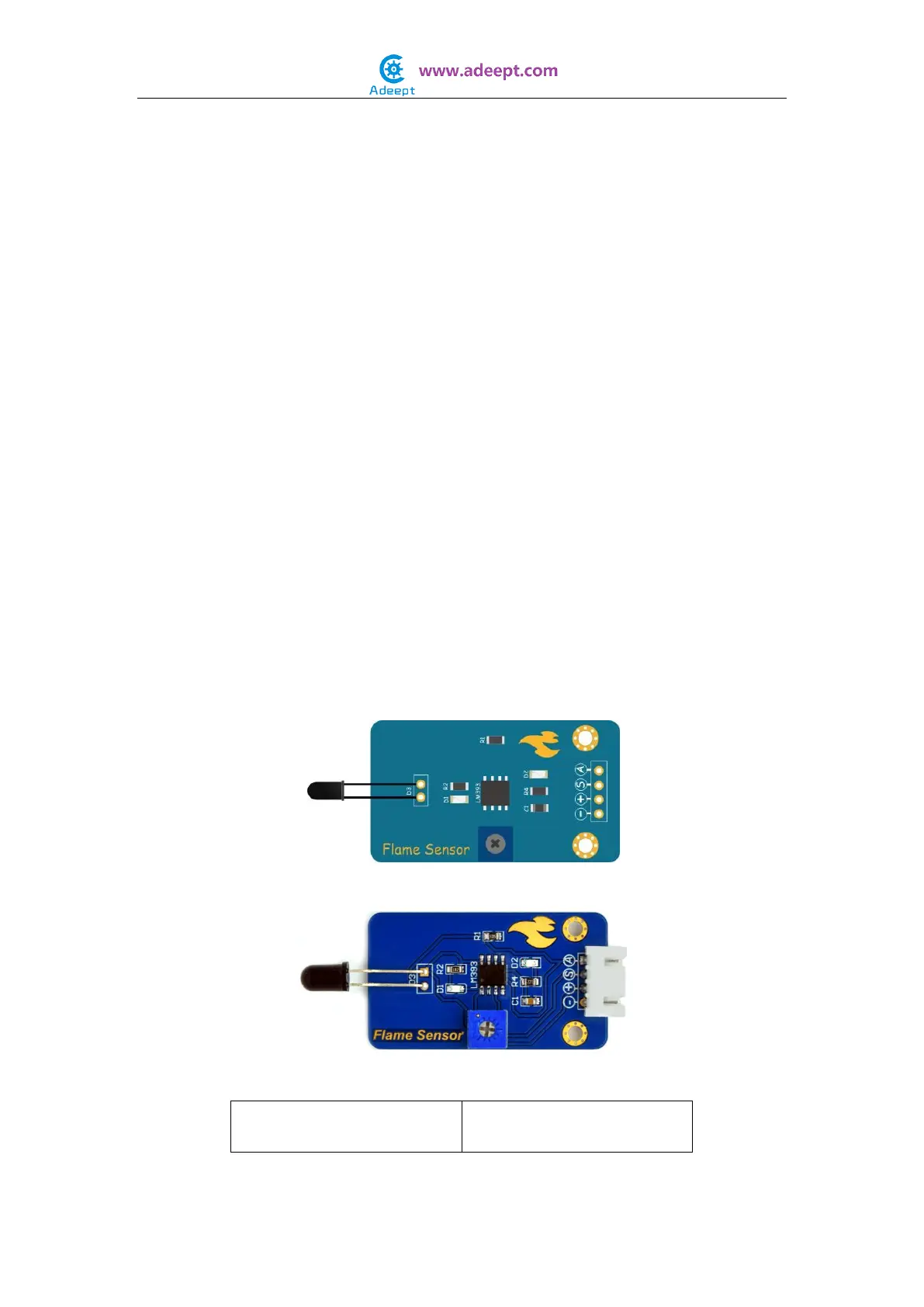
The Flame Sensor detects flames by the special infrared receiver to capture the infrared
rays of a specific wavelength in the flames. It supports a detection angle of as high as 60
degrees and works within -25 - 85℃. When in use, you need to pay attention and do not
place the probe of the sensor too close to the flames in case of damages. Besides, the sensor
can be used to detect light intensity. It can detect a light source with a wavelength of 760
- 1100nm. Pin A outputs the analog data collected by the sensor. You can adjust the
potentiometer on the module to set the alarm threshold of the sensor. So when the value
reaches the threshold, pin S will switch between High and Low.
Components
- 1 * Raspberry Pi
- 1 * GPIO Extension Board
- 1 * 40-Pin GPIO Cable
- 1 * Breadboard
- 1 * ADC0832 Module
- 1 * Flame Sensor Moule
- 1 * 3-Pin Wires
- 1 * 4-Pin Wires
- 1 * 5-Pin Wires
Experimental Principle
The Fritzing image:
The Physical picture:
Pin definition:


 To Next Page