8
DMX SET UP
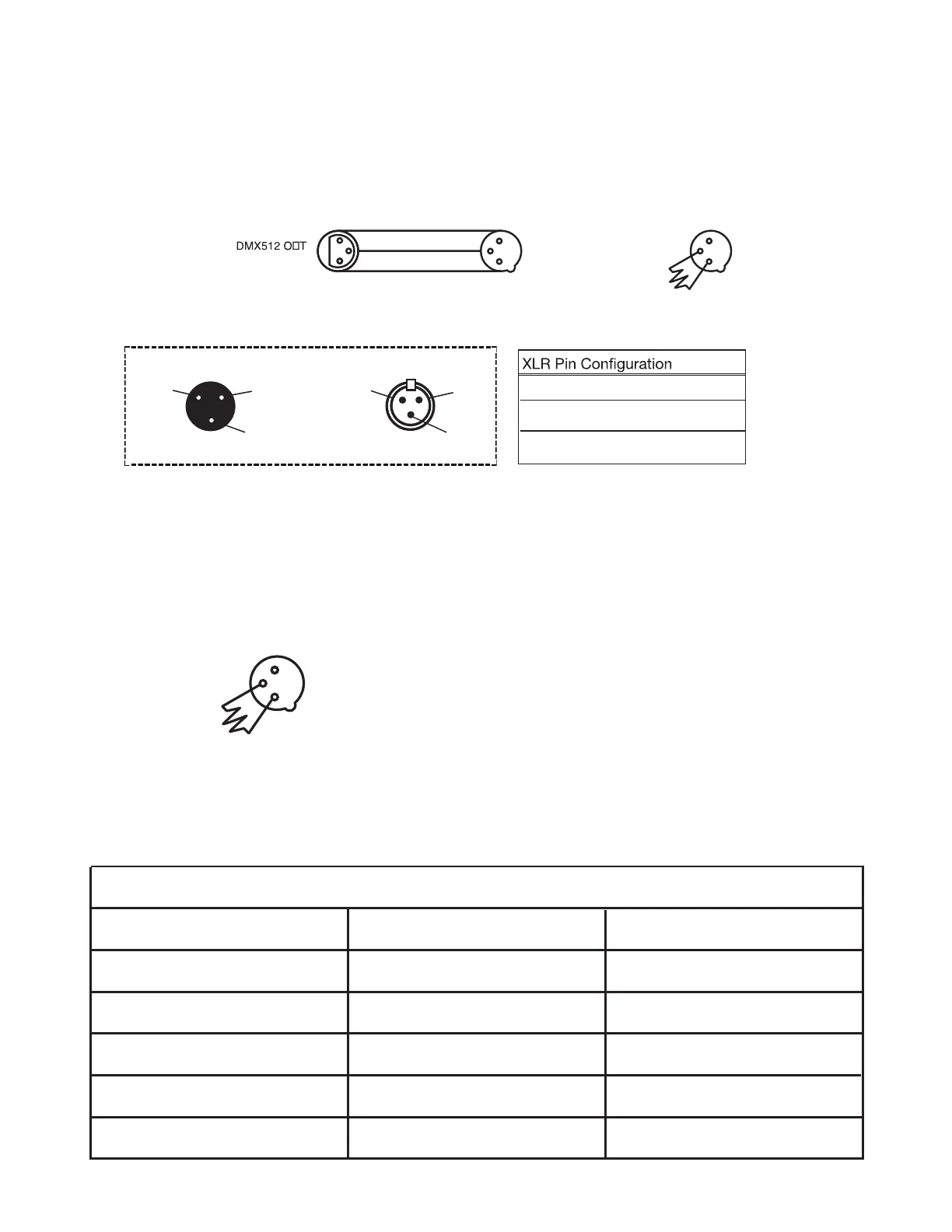
Notice: Be sure to follow gures 2 and 3 when making your own cables. Do not use the ground lug
on the XLR connector. Do not connect the cable’s shield conductor to the ground lug or allow the
shield conductor to come into contact with the XLR’s outer casing. Ground the shield could cause a
short circuit, resulting in erratic behavior.
DMX512 IN
3-PIN XLR
1
2
3
Termination
avoids
and
to connect
120
and
1
2
3
1
2
3
DMX +
DMX -
COMMON
3-PIN XLR
Figure 2
Figure 3
1 Ground
1 Ground
XLR Male Socket
3 Hot
2 Cold
2 Cold
3 Hot
XLR Female Socket
Pin 3 = Data True (positive)
Pin 2 = Data Compliment (negative)
Pin 1 = Ground
Special Note: Line Termination. When longer runs of cable are used, you may need to use a ter-
minator on the last unit to avoid erratic behavior. A terminator is a 110-120 ohm 1/4 watt resistor
which is connected between pins 2 and 3 of the male XLR connector (DATA+ and DATA-). This unit is
inserted in the female XLR connector of the last unit in your daisy chain to terminate the line. Using a
cable terminator (ADJ part number Z-DMX/T) will decrease the possibilities of erratic behavior.
5-Pin XLR DMX Connectors. Some manufacturers use 5-pin DMX-512 data cables for DATA trans-
mission in place of 3-pin. 5-pin DMX xtures may be implemented in a 3-pin DMX line by using a
cable adaptor. These adaptors are readily available at most electronics stores. The chart below de-
tails a proper cable conversion.
Conductor 5-Pin XLR Male (In)3-Pin XLR Female (Out)
Pin 1
Pin 5 - Do Not Use
Pin 4 - Do Not Use
Pin 3
Pin 2
Pin 1
Pin 3
Pin 2
Not Used
Not Used
Data True (+ signal)
Data Compliment (- signal)
Ground/Shield
3-Pin XLR to 5-Pin XLR Conversion
1
2
3
Termination reduces signal errors and
avoids signal transmission problems
and interference. It is always advisable
to connect a DMX terminal, (Resistance
120 Ohm 1/4 W) between PIN 2 (DMX-)
and PIN 3 (DMX +) of the last fixture.
Figure 4



 To Next Page