Physical Specifications
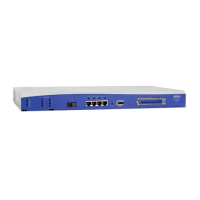
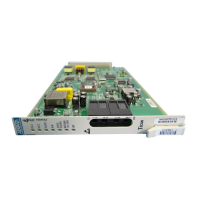
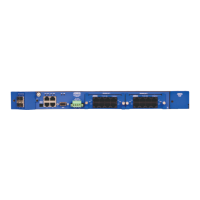
Front Panel Interfaces
■
Four 10/100/1000 BaseT Ethernet interface via RJ-45
■
Four Gigabit Ethernet interface via SFP cages,
angled to reduce overall product depth and
improve cable management
■
All Ethernet ports may be used for either network
WAN or customer-side LAN connections
■
100BaseX SFP also supported to allow Fast Ethernet
fiber lease
■
Ethernet faceplate ports support either 1Gbps or
2.5 Gbps ITU-T G.8032 Ethernet Ring Protection
Switching (ERPS)
■
Optional ERPS optical bypass switch connector
provided to protect ring from NetVanta 8044M NTE
power failure. (future hardware)
■
DB9 local craft port for support of RS-232 interface
for local management
■
Two expansion access/service module slots
(see next sub-sections for options)
■
Field replaceable fan module (may be required to
support future expansion modules)
Physical Dimensions
■
Desk, rack and wall mountable
■
Rack mountable solution in 19” or 23” wide
telecom racks
■
Height: 1.7 inches (44mm) (1 RU)
■
Width: 17.2 inches (437mm) or 19.0 inches (483mm)
(with mounting brackets)
■
Depth: 10.7 inches (273 mm) IEC compliant with fiber
bend radius included
■
Weight: 6 lbs (2.7 kg) with empty slots 8 lbs (3.6 kg)
with both module slots and fan tray installed
Power Supply, Power Consumption,
Heat Dissipation
■
Redundant, Dual A and B fed +/- 24/-48 VDC version
(P/N 1174801G1)
■
Ground/Earth provided via Post and Lug type connector
■
Typical power consumption is 31W maximum without
additional modules nor fan tray installed
■
Maximum power consumption is 37W without
additional modules nor fan tray installed
Operations and Maintenance
Environmental Hardening
■
Operating Temperature: -40°C to 65 °C
■
Storage Temperature: -40°C to 85 °C
■
Relative Humidity: GR-63-CORE 5% to 95%,
non-condensing
■
Operating altitude range
o
At 30°C: -197 to 13000 feet (-60 to 4000 meters)
o
At 40°C: -197 to 6000 feet (-60 to 1800 meters)
■
Metallic interface voltage surge protection
and isolation
Ethernet Services Support
■
Classification of Traffic based on:
o
Per UNI port, CE VLAN ID (C-Tag) and/or CE VLAN
P-bits, Soure and/or destination MAC address,
DSCP fields
■
Single stack VLAN and double stack VLANs (Q-in-Q)
o
Manipulation based on 802.1p and DSCP fields
o
STAG TPID provisioning supports 802.1ad and
802.1Q standards
o
Port based service support
■
Services Scale and Flexibility
o
MEF 9, 14 compliant EPL, EVPL, ELAN, ETREE
o
8 Queues, Strict Priority and/or Weighted
Fair Schedulers
o
Configurable EtherType and TPID for
service flexibility
o
VLAN IDs 0 – 4095; EVC configurable in the
range of 2–4094
o
Configurable MTU from 1500 to 10k Jumbo
frame in four bytes increments
o
16k active MAC address; Ability to disable
MAC learning (32k support future software)
o
Ingress policers (tr3CM), CIR and EIR settings
to 64 kbps granularity, Configurable Burst through
EBS, CBS settings
o
Egress shaping per port (per port per queue
and per up to 16 VLAN groups in future)
Fault and Performance Management
■
IEEE 802.3ah Link OAM
■
IEEE 802.1ag Connectivity Fault Management (CFM)
■
IETF TWAMP Layer 3 Performance Monitoring (PM)
(reflector)
■
ITU-T Y.1731 Layer 2 Performance Monitoring
(sender and responder PM measurements are
accurate to sub millisecond levels)
■
Supports customer viewable PM/SLA statistics
via Web portal
Security
■
TACACS+ Authentication, Authorization
■
RADUIS Authentication, Authorization
■
SSHv1/v2 and SFTP
■
SNMPv1/v2 (today), SNMPv3 (future software)
Carrier Ethernet Network Termination
NetVanta 8044M


 To Next Page
 Loading...