EasyManua.ls Logo

Akai 1722W - Dismantling of Unit

Akai 1722W
46 pages
Print Icon
To Next Page IconTo Next Page
To Previous Page IconTo Previous Page
Loading...
H.
MEASURING
METHOD
1.
TAPE
SPEED
DEVIATION
3.
FREQUENCY
RESPONSE
a
Line
Audio
1722w
(Output
Input
Frequency
Frequency
Counter
Oscillator
Fig.
1
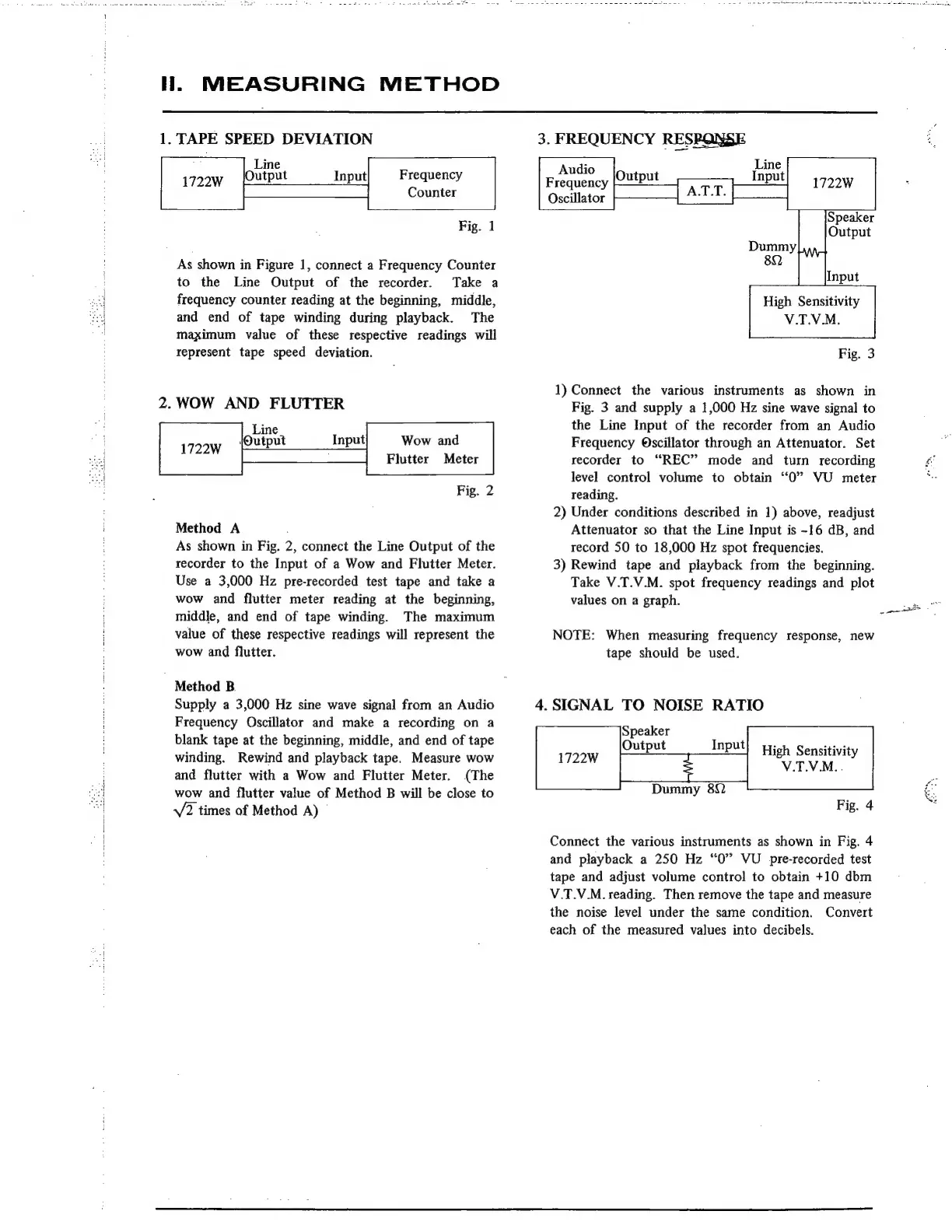
As
shown
in
Figure
1,
connect
a
Frequency
Counter
to
the
Line
Output
of
the
recorder.
Take
a
frequency
counter
reading
at
the
beginning,
middle,
and end
of
tape
winding
during
playback.
The
maximum
value
of
these
respective
readings
will
represent
tape
speed
deviation.
Fig.
3
High
Sensitivity
V.T.VM.
1)
Connect
the
various
instruments
as
shown
in
2.WOW
AND
FLUTTER
Fig.
3
and
supply
a
1,000
Hz
sine
wave
signal
to
the
Line
Input
of
the
recorder
from
an
Audio
Wow
and
Frequency
Oscillator
through
an
Attenuator.
Set
Flutter
Meter
recorder
to
“REC”
mode
and
turn
recording
level
control
volume
to
obtain
“O”
VU
meter
Fig.
2
reading.
2)
Under
conditions
described
in
1)
above,
readjust
Method
A
Attenuator
so
that
the
Line
Input
is
-16
dB,
and
As
shown
in
Fig.
2,
connect
the
Line
Output
of
the
record
50
to
18,000
Hz
spot
frequencies.
recorder
to
the
Input
of
a
Wow
and
Flutter
Meter.
3)
Rewind
tape
and
playback
from
the
beginning.
Use
a
3,000
Hz
pre-recorded
test
tape
and
take
a
Take
V.T.V.M.
spot
frequency
readings
and
plot
wow
and
flutter
meter
reading
at
the
beginning,
values
on
a
graph.
fogs
middle,
and
end
of
tape
winding.
The
maximum
ope,
value
of
these
respective
readings
will
represent
the
NOTE:
When
measuring
frequency
response,
new
wow
and
flutter.
tape
should
be
used.
Method
B
Supply
a
3,000
Hz
sine
wave
signal
from
an
Audio
4.
SIGNAL
TO
NOISE
RATIO
Frequency
Oscillator
and
make
a
recording
on
a
Speaker
blank
tape
at
the
beginning,
middle,
and
end
of
tape
Output
Input
.
rae
‘ >
pu
npu
winding.
Rewind
and
playback
tape.
Measure
wow
1722W
ee
eed
a
ae
and
flutter
with
a
Wow
and
Flutter
Meter.
(The
aches
Fig.
4
ad
wow
and
flutter
value
of
Method
B
will
be
close
to
|
2
times
of
Method
A)
Connect
the
various
instruments
as
shown
in
Fig.
4
and
playback
a
250
Hz
“0”
VU
pre-recorded
test
tape
and
adjust
volume
control
to
obtain
+10
dbm
V.T.V.M.
reading.
Then
remove
the
tape
and
measure
the
noise
level
under
the
same
condition.
Convert
each
of
the
measured
values
into
decibels.