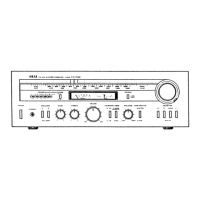
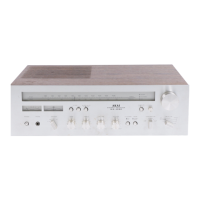
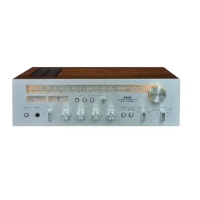
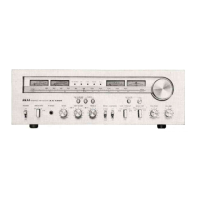
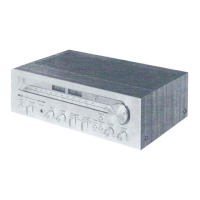
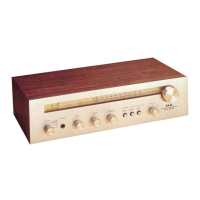
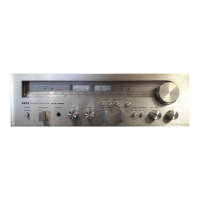
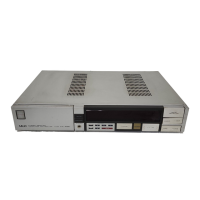
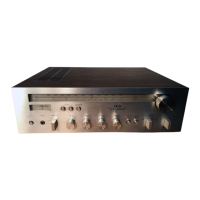
This document is a service manual for the AKAI Computer Controlled Stereo Receiver models AA-A25/Y1 and AA-A25L.
Function Description:
The AKAI AA-A25/Y1 and AA-A25L are computer-controlled stereo receivers designed to provide high-quality audio reproduction and tuning capabilities. The receiver integrates an amplifier and a tuner, allowing users to listen to various audio sources and radio broadcasts. Key features include a fluorescent display (FLD) for visual feedback, a computer-controlled system for precise operation, and a range of input/output options for connecting external audio components. The unit supports both AM and FM radio reception, with specific models supporting Long Wave (LW) as well. The amplifier section is designed to deliver robust power output, while the tuner section offers good sensitivity and selectivity for clear radio reception.
Important Technical Specifications:
FM Tuner Section:
- Tuning Frequency Range: 87.5MHz to 108.0MHz
- Usable Sensitivity (IHF): 1.1µV (Mono), 20µV (Stereo)
- 50dB Quieting Sensitivity (IHF): 1.6µV (Mono), 20µV (Stereo)
- Capture Ratio: 1.5dB
- Selectivity (IHF): 60dB (400kHz)
- Image Rejection: 85dB
- IF Rejection: 90dB
- Spurious Rejection: 90dB
- AM Suppression: 60dB
- S/N (IHF): 80dB (Mono), 65dB (Stereo)
- Harmonic Distortion: 0.1% (Mono), 0.3% (Stereo)
- Stereo Separation: 45dB (1kHz)
- Antenna: 75 ohms (unbalanced)
LW Tuner Section (AA-A25L Only):
- Tuning Frequency Range: 146kHz to 353kHz
- Usable Sensitivity (IHF): 800µV/m
- Selectivity (IHF): 30dB
- Image Rejection: 40dB
- IF Rejection: 55dB
- S/N: 35dB
- T.H.D.: 1.0%
- Antenna: Loop antenna
AM Tuner Section (MW for AA-A25L):
- Tuning Frequency Range: 530kHz to 1610kHz (USA and Canada), 531kHz to 1602kHz (other countries)
- Usable Sensitivity (IHF): 300µV/m
- Selectivity (IHF): 25dB
- Image Rejection: 40dB
- IF Rejection: 55dB
- S/N: 40dB
- T.H.D.: 1.0%
- Antenna: Loop antenna
Amplifier Section:
- Rated Power Output: 20W x 2 (8 ohms, 20Hz to 20kHz, 0.05% T.H.D.)
- Music Power: 60W
- Power Bandwidth (IHF, -3dB, 8ohms): 5Hz to 60kHz (0.1% T.H.D.)
- S/N: 95dB (Phono), 98dB (AUX)
- Residual Noise (8 ohms): 0.5mV
- Channel Separation (IHF): 60dB (1kHz)
- Damping Factor (1kHz, 8 ohms): 50
- Output: Speakers A or B (4 to 16 ohms), A + B (8 to 16 ohms), Headphone (8 to 16 ohms)
- Input Sensitivity/Impedance: Phono (2.5mV/100kohms), CD/AUX (150mV/47kohms), Tape (150mV/47kohms)
- Output Level/Impedance: Tape REC (150mV/1kohms)
- Frequency Response: Phono (RIAA) (±0.5dB, 30Hz to 15kHz), AUX/CD/Tape (5Hz to 100kHz, +0dB, -3dB)
- Tone Control: Bass (±8dB, 100Hz), Treble (±8dB, 10kHz)
- Phono Max. Input (MM): 120mV (1kHz)
Power Requirements:
- 120V, 60Hz (USA & Canada)
- 240V, 50Hz (Europe, UK)
- 240V, 50Hz (Australia)
- 220V/240V, 50Hz/60Hz switchable (other countries)
Dimensions: 440(W) x 80(H) x 318(D) mm
Weight: 6.2kg
Usage Features:
The receiver is designed for user-friendly operation with a computer-controlled interface.
- Preset Station Memory: Up to 16 FM and 16 AM/MW/LW stations can be stored and recalled.
- Auto Tuning: The unit features an auto-tuning mode that scans for broadcast stations. The scanning speed is approximately 100 msec per step, with specific steps for LW (9 kHz).
- Input Selection: Users can select various input sources such as Phono, CD/AUX, Tape 1, and Tape 2. The input selector is controlled by the microcomputer, which also mutes the electronic potentiometer during switching to prevent noise leakage.
- Volume Control: The volume can be adjusted with a fade-in/fade-out effect at 2 dB per 60 msec. The display instantly updates to show the touched position.
- Balance Control: Balance can be adjusted, with data transferred to offset Lch and Rch levels. Continuous depression varies the setting at 2 dB per 150 msec, with a linger at the center position.
- Safety Level: A safety feature allows users to set a maximum volume level. When engaged, the Safety indicator flashes, and the selected volume becomes the new safety limit.
- Tone Controls (Bass/Treble): Separate controls for bass and treble allow for sound customization. Adjustments are made at 2 dB per 150 msec when continuously depressed, with a linger at the center position. A "DEFEAT" function restores tone controls to their center positions.
- Acoustic Memo: This feature allows users to store preferred Bass/Treble positions (A1 and A2) in memory for quick recall.
- Tuner Output Muting: The tuner signal is muted during band changes, PLL data changes, or mode changes to prevent noise. This muting sequence includes a "pre-muting" (50 msec) and "after-muting" (450 msec) phase.
- Non-Active Mode: When the amplifier's input selector is set to a source other than TUNER, the tuner enters a non-active mode, extinguishing the frequency display and showing bars instead. In this mode, only BAND, UP/DOWN, and Preset CH keys are accepted.
Maintenance Features:
The service manual provides detailed instructions for maintenance and repair.
- Dismantling of Unit: Step-by-step photographic instructions are provided for disassembling the unit, starting with the upper cover and proceeding to internal components. Reassembly is done in reverse order.
- Safety Instructions: Emphasizes the importance of using specified parts (marked with a triangle symbol) for safety-critical components and adherence to regulations for spurious radiation. It also highlights the use of specified internal wiring and insulating materials.
- Safety Check After Servicing: Requires confirmation of insulation resistance between power cord prongs and exposed parts, specifying values greater than 10 Mohms (or 2.2 Mohms for certain terminals).
- Voltage Conversion: Instructions are given for converting the operating voltage (110V, 120V, 220V, 240V) using a VOLTAGE SELECTOR on the rear panel, though some models may not have this facility.
- Tuner Adjustment: Comprehensive procedures for adjusting the FM, LW, and AM (MW) sections are included, with detailed steps, adjustment points (e.g., L6, T1, VC1), expected results, and remarks. This includes adjustments for FM OSC, sensitivity (low/high range), FM center voltage, distortion, MPX free running frequency, and stereo separation.
- Instrument Connections: Diagrams illustrate how to connect test equipment (SSG, AC voltmeter, frequency counter, distortion meter) for tuner adjustments.
- PC Board Titles and Identification Numbers: A list of PC boards with their corresponding numbers and remarks (e.g., model compatibility) is provided for easy identification during servicing.
- Parts List: A detailed parts list is included, categorized by block (Tuner, Front End, Pre Amp, Main Amp, Control, Assembly, Final Assembly), with reference numbers, part numbers, and descriptions. Recommended spare parts are also listed.
- Schematic Diagrams: Block diagrams and detailed schematic diagrams are provided for various sections of the receiver, including Control (A), Tuner, Pre Amp, and Front End, to aid in troubleshooting and repair.
- Location of Components: Diagrams showing the physical location of components on PC boards are included.
- Voltage Measurements: Schematic diagrams often include typical voltage measurements at various test points, which are crucial for diagnosing circuit issues.

 Need help?
 General

 To Next Page