Need help?
Do you have a question about the AKG c4000 and is the answer not in the manual?
Guide to connecting phantom power to balanced input stages using center-tap transformers.
Instructions for connecting phantom power to unbalanced amplifier inputs, with or without transformers.
Instructions for cleaning the microphone body using a soft, damp cloth.
Guidance on washing the foam windscreen with soap suds and allowing it to dry.
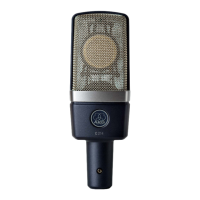
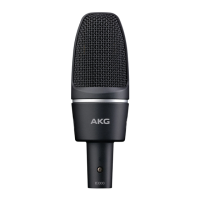
The C4000 is a large-diaphragm condenser microphone designed for professional audio recording. It builds upon the legacy of renowned AKG models like the C12, C414 B, and C3000, incorporating advanced and reliable components to meet the rigorous demands of studio environments and withstand prolonged, robust handling.
At its core, the C4000 utilizes a dual-diaphragm transducer, a proven design that enables the selection of various polar patterns. The diaphragms themselves are crafted from a plastic foil, gold-sputtered on one side. This gold-sputtering technique is crucial as it prevents localized shorts to the back electrode, even when the microphone is subjected to extremely high sound pressure levels. This ensures consistent performance and reliability in demanding recording scenarios.
The microphone is equipped with a switchable preattenuation pad, which significantly enhances its maximum SPL (Sound Pressure Level) capability by 10 dB. This feature is particularly useful for achieving distortion-free close-in recordings. Many mixing console input stages, especially those with smaller transformers, can be susceptible to overload, particularly at lower frequencies. The C4000's preattenuation pad effectively mitigates such overloads, protecting the input stage and preserving audio integrity.
Furthermore, the C4000 incorporates a switchable bass cut filter directly on its body. This filter is designed to reduce low-end distortion that can arise from uncontrolled rumble or wind noise. With a 12 dB/octave slope starting at 100 Hz, it effectively cleans up the low-frequency spectrum, resulting in clearer and more focused recordings.
The microphone's construction features an all-metal die-cast body. This robust housing provides highly effective shielding against RF (Radio Frequency) interference. This is a critical advantage when the microphone is used in proximity to radio transmitters, wireless microphones, or other communication systems, ensuring that unwanted external signals do not compromise the audio quality.
The C4000 is engineered for versatility, boasting high SPL capability, minimal distortion, and remarkable resistance to extreme temperatures and high humidity. These characteristics make it a truly universal microphone, suitable for a wide array of recording applications and environments. A recessed switch on the microphone body allows users to easily select between three different polar patterns, catering to diverse recording situations. A key design principle behind these polar patterns is their virtual frequency independence. This means that reflected sound, often a challenge in acoustic spaces, is reproduced accurately and without coloration, contributing to a natural and transparent sound capture.
The C4000 offers flexibility in its application, primarily through its selectable polar patterns. Most engineers will find the cardioid polar pattern (the center position on the selector) to be the go-to choice for a majority of applications. This is considered a standard setting for recording and consistently delivers excellent results across various voices and a wide range of instruments. It provides a focused pickup pattern, ideal for isolating a sound source while minimizing ambient noise.
For situations requiring higher channel separation, such as miking closely spaced instruments individually, the hypercardioid polar pattern (the right-hand position on the selector) is recommended. This pattern offers a tighter pickup than cardioid, making it an excellent choice for concert sound applications. It is particularly effective at rejecting regenerated signals from monitor loudspeakers, which are typically positioned slightly to the sides of the artist, thereby improving stage monitoring and overall sound clarity.
When a broader sound capture is desired, the omnidirectional polar pattern (the left-hand position on the selector) comes into play. This setting is ideal for "all around the mic" recording, capturing high-quality ambience (such as audience sound), or for far-field recording in acoustically favorable large or small rooms. The omnidirectional pattern picks up sound equally from all directions, providing a natural and open soundstage.
While the microphone capsule itself is internally shock-mounted, the C4000 comes with a supplied H85 "spider" suspension. This accessory further reduces vibrational noise that might be transmitted from the microphone stand or other sources. When using the spider suspension, it's important to route the microphone cable into one of the two grooves at the rear end of the outer ring. This provides strain relief, preventing mechanical pull on the connector and further reducing the transmission of vibrational noise through the cable.
The C4000 also includes a W4000 foam windscreen. This accessory serves a dual purpose: it acts as a windscreen for outdoor recording, effectively mitigating wind noise, and can also be used as an additional pop screen for vocal recording, helping to reduce plosive sounds. The design of the wind/pop screen ensures that it causes almost no discernible change in the microphone's frequency response. Users are encouraged to conduct a careful, subjective comparative listening test to determine whether to use the windscreen based on their specific recording needs and desired sound.
Maintaining the C4000 is straightforward, focusing on keeping the microphone body and windscreen clean to ensure optimal performance and longevity.
For cleaning the microphone body, it is recommended to use a soft cloth. This cloth should be moistened with water. Gently wipe the surface of the microphone body to remove dust, fingerprints, or other superficial dirt. Avoid using harsh chemicals or abrasive materials, as these could damage the microphone's finish or internal components.
The foam windscreen, the W4000, requires a slightly different cleaning approach. It can be washed in soap suds. After washing, it is crucial to ensure that the windscreen is completely dry before reattaching it to the microphone or using it. Using a damp windscreen could potentially introduce moisture into the microphone, which could lead to damage. Allowing it to air dry thoroughly will prevent any issues.
For information on optional accessories that can enhance the C4000's functionality or suit specific recording needs, users are directed to refer to the current AKG catalog or folder. Alternatively, the AKG website (www.akg.com) provides up-to-date information, and authorized dealers are available to offer assistance and guidance on selecting suitable accessories.
 General
| Type | Condenser |
|---|---|
| Voltage | 48 V |
| Polar Pattern | Cardioid |
| Frequency Response | 20 Hz to 20 kHz |
| Impedance | 200 ohms |
| Connector | XLR |
| Preattenuation Pad | -10 dB |
| Recommended Load Impedance | 1000 ohms |
| Power Requirements | Phantom Power |

 To Next Page