22
6. Safety instructions and hazard information when using the e-pilot
CAUTION RISK OF TOPPLING!
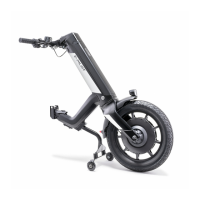
Your wheelchair with connected e-pilot represents a three-wheeled means of transport.
Particularly when turning corners, when crossing obstacles and when travelling perpendicular to slopes (these
must never be travelled on in this way!) a three-wheel vehicle tends to tip over more easily than a four-wheel
vehicle. Adjust your driving behaviour and your speed accordingly.
6.1 General instructions
• Before the e-pilot is loaded or lifted, it has to be switched off.
• If you wish to raise the e-pilot – to transport it, for example – you must never reach into the wheel rim.
• The maximum gradeability of the e-pilot is 10% (5.71°). If the device travels on steeper inclines, the possibility of the e-pilot and
wheelchair slipping backwards cannot be ruled out. In this event, apply the
parking brakes on the wheelchair and cease travel.
Inclines and gradients with a grade exceeding 15% must not be travelled on with the e-pilot.
•
The e-pilot has a brake lever [7] on both the left and right sides of the handle.
The locking mechanism [6] can be used to continuously apply the brake lever on the left side of the handle, which makes one of the
brakes [19] continuously block the wheel [21]. In addition, you also have to apply the parking brakes on your wheelchair in order to
prevent inadvertent rolling, for example when you stop on slopes.
• The e-pilot is controlled using the control elements on the handlebar (see chapter 2.3 onward). When the system is switched on, each
actuation of the throttle handle [1] is converted into a drive command (forwards travel).
• Floor surfaces may be soiled by abrasion from the tyres – this is particularly true if you apply the brakes fully.
• We recommend that you have a short driver training session when you first receive your e-pilot. This enables you to become familiar
with the device and all its possibilities.
6.2 Driver training
• The safety and well-being of the driver is the top priority. To ensure this, it is essential to understand the e-pilot’s driving characterist-
ics. Your specialist dealer or Alber agent will help you in this regard with a complimentary device training session.
• Observe the information, safety instructions and hazard information from your wheelchair manufacturer. This also applies to driving with
the e-pilot.
• Start your first driving attempts with caution and start your driving training on level ground.
• Take your driver training in areas without obstacles.
• Always adapt your speed to external conditions so that you are able to drive around any obstacles that suddenly appear or to stop your
wheelchair, for example.
• Never turn the throttle handle [1] as far as it will go when starting up. This may result in the e-pilot moving uncontrollably (risk of
accident).
• Move the throttle handle [1] gently and without sudden movements. Avoid suddenly applying the throttle handle as far as it will go,
particularly during potentially hazardous situations that you wish to avoid. Brake the e-pilot carefully in advance until it stops.
• When you release the throttle handle [1], the wheel of the e-pilot automatically switches to freewheeling and the wheel is not braked!
Brake using both brake levers [7a/7b].
• If the preset maximum speed is exceeded, the wheel automatically switches to freewheeling. For this reason, never exceed the maximum
speed.
• If the wheel is in freewheeling mode because the maximum speed has been exceeded, you have to reduce the speed of the e-pilot until
you are travelling below the maximum speed. The throttle handle [1] can only be used again once this has happened.
• Only brake the e-pilot using the two brake levers [7a/7b]. Never grip the push rims on the wheelchair “for support”.
• Before using the e-pilot to travel on a slope, practice operating the device on level ground.
• Always travel on slopes with a fully charged battery pack.
• You should exercise particular caution when travelling on slopes of any kind.
• Travel on slopes at reduced speed so that you are able to avoid any obstacles that appear suddenly or stop the e-pilot in time. Never
travel on slopes in freewheeling mode.
• Never travel across steep slopes or similar conditions. Unintentionally shifting the centre of gravity could result in the wheelchair tip-
ping over on its side.
• The e-pilot can traverse obstacles such as kerbs with a maximum height of five centimetres.
Obstacles with a height of more than five centimetres must not be traversed as there is a risk of the stand [18] catching and being
damaged.
• When driving on inclined kerbs or in similar circumstances, you may need to countersteer a little. Never travel over minor obstacles such
as kerbs by driving parallel to them, drive at a right angle to the respective obstacle. This means:
The obstacle is first traversed by the wheel of the e-pilot. Then the two wheels of your wheelchair travel over the obstacle at the same
time, not one after the other. Use a low speed that is appropriate for the obstacle.
• Check the air pressure of the wheel [21] of the e-pilot at regular intervals and the air pressure of the wheels of your wheelchair. Both
factors influence the driving and braking performance and the range of the e-pilot.


 To Next Page