Residential HRV/ERV
35
Balancing in a VentZone® system
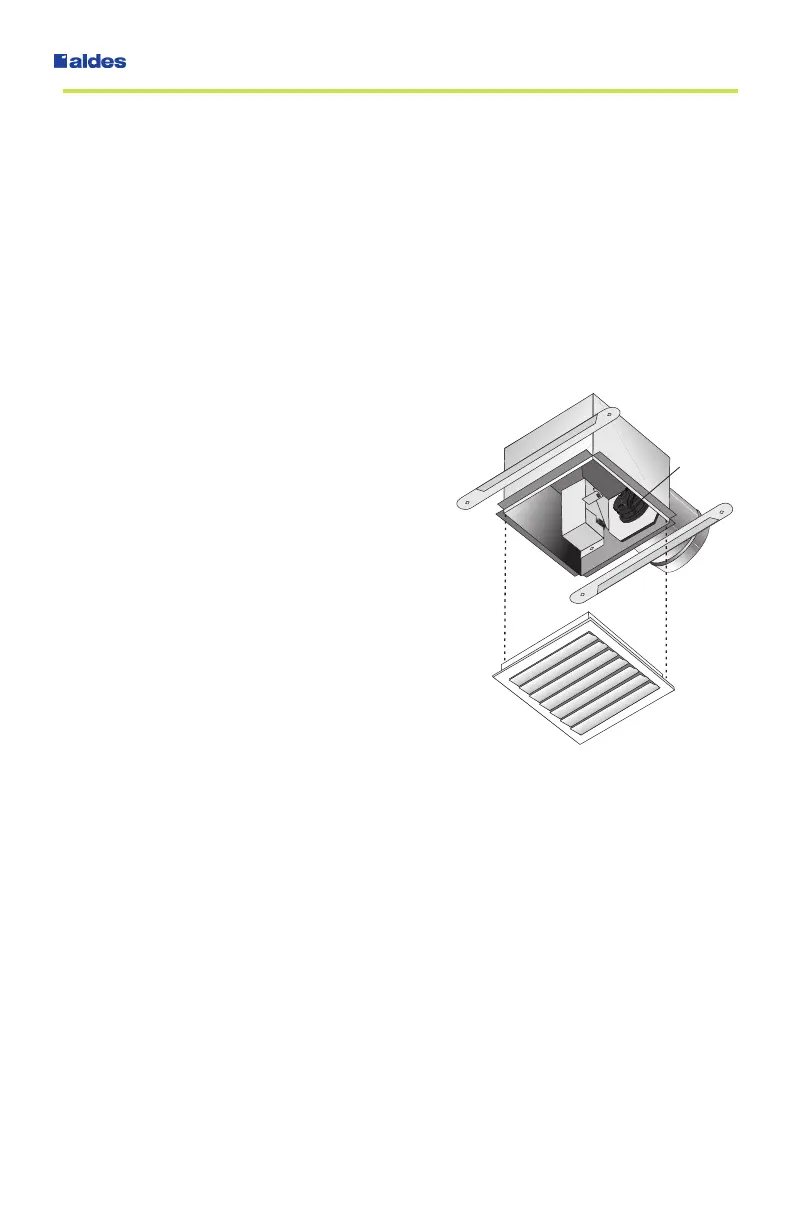
The ZRT-2 models are equipped with Aldes Constant Airow Regulators to automatically
regulate airow from each terminal while the ventilator is on and the ZRT is unpowered.
When the ZRT is powered open, the damper opens and the high speed mode is enabled at
the ventilator. This will boost airow at the powered ZRT, while the self-balancing regulators
maintain the set ow rate at the unpowered ZRTs.
Balancing the System
1. Finish sealing the ductwork system.
2. Set all ZRTs to desired ow rate. Start
by determining the required minimum
ventilation rate for each ZRT. Larger areas,
or areas frequently used, may require
additional airow in order for the system to
perform as desired.
a. Select the desired Airow
Range: The CAR3-L (low-
pressure) is designed for systems
with pressures between 0.12
and 1.2 in. w.g. (30 to 300
Pa). CAR3 4” Low-Pressure
Range 15-85 CFM (25-144
m3/h) and CAR3 6” Low-Pressure Range 45-260 CFM
(76-442 m3/h).
3. Make sure all HRV/ERV components are in place and functioning properly. All ZRTs
should be OFF and in the closed position.
4. Prepare the HRV/ERV and select the operating speed. VentZone® Systems typically
balance in LOW SPEED
Note: Due to the use of the constant airflow regulators, some effort needs to be
taken to balance the exhaust air rate to the operating point of the regulators.
5. LOW SPEED can be activated by pressing the Mode Indicator button until the light
is solidly illuminated.
Note: The light will be solid when any accessories are attached or controlling the
HRV/ERV. To avoid this, disconnect the Accessories Terminal Block.
6. Locate the 4 ports on the door of the HRV/ERV and remove the plugs.
7. Refer to the drawings on page 30 and connect the tubing from the pressure gauge
to the respective door ports for the indoor air and exhaust air connections. See
“Measuring Exhaust Airow” on page 30.
nearly a full-scale reading when the HRV/ERV is operating at high speed. Follow
the instructions supplied with the sensing units regarding proximity to elbows,
dampers, etc.
1. Hot-wire thermal anemometers provide a direct air velocity reading.
CAR3
ZRT-2



 To Next Page