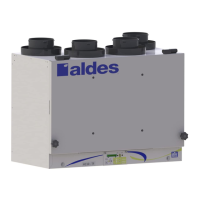
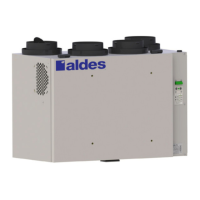
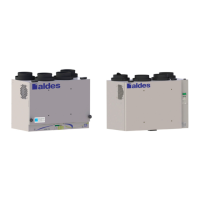
The document describes the Aldes Residential Heat Recovery Ventilators (HRV) and Energy Recovery Ventilators (ERV), which are ventilation devices designed to improve indoor air quality and recover energy.
Function Description:
HRVs and ERVs are ventilation devices that consist of two fans and a heat recovery module. They provide balanced supply of fresh air from outside and exhaust stale indoor air without mixing the two airstreams. ERVs are similar to HRVs but also transfer humidity from the more humid airstream to the less humid airstream, which can improve comfort in overly dry homes. In heating seasons, these units draw fresh air from outside, distribute it throughout the home via a dedicated-duct system or forced-air heating/air conditioning system, and exhaust stale, humid air from moisture- and pollutant-producing rooms (kitchens, bathrooms, laundry rooms) to the outside. During this process, fresh air is tempered with heat recovered from the exhaust air. In cooling seasons, fresh outdoor air is cooled by the air-conditioned exhaust air, and if the outgoing air is drier, the ERV transfers moisture to the outgoing air, reducing the humidity load on the air conditioning system. The units are not dehumidifiers themselves but assist air conditioners by removing latent heat (water vapor) from incoming fresh air.
Important Technical Specifications:
The devices meet standards C22.2 no 113 and UL 1812. They are ENERGY STAR certified for high efficiency.
The units are designed for residential use, conforming to the International Residential, Building, and Mechanical Codes, NFPA 90B for the United States and the National Building Code of Canada.
They require a standard 120V power outlet with ground and come with a 3' cord. A separate 15 amp/120 volt circuit is recommended for further wiring.
The HRV/ERV models covered are H/E95, H/E110, H/E150, H/E190, and H/E240.
The heat exchanger warranty depends on the core type: Polypropylene (HRV) has a Limited Lifetime warranty, and High-Latent-Transfer Material (ERV) has a Limited 2-year warranty. All other covered components have a Limited 5-year warranty.
Usage Features:
- Ducting Configurations: The manual outlines four duct configurations: Fully Ducted System (best configuration, suited for homes without forced-air systems), Partially Ducted System (common in commercial installations, but not always recommended for residences due to potential airflow imbalance and drafts), Indirect Configuration (fresh air supplied to large-volume rooms, drawn into AHU return grilles, and distributed throughout the house), and Fully Integrated System (draws stale air from and supplies fresh air to the return ducting of a forced-air heating and cooling system).
- Air Exchanger Location: The unit must be located in an area where the temperature is always above freezing. Short ducts with minimal elbows are recommended for optimal function.
- Recirculation Using Fifth Ports (Optional): Can be ducted to an area with clean indoor air (requires a fifth collar) or non-ducted (recirculates air surrounding the unit, requires unit to be in an area with clean and fresh air, no fifth collar needed).
- Ducting Materials: Metal ducting is recommended for concealed spaces, while 5 to 10 feet of insulated flexible duct should be used between the HRV/ERV and interior registers to reduce fan noise. All ducts through unheated areas must be insulated and covered with a vapor barrier.
- Vent Hood Locations: Wall hoods should be located at least 6 feet (2 meters) from exhaust/intake hoods, dryer vents, furnace exhaust, driveways, oil fill pipes, gas meters, or garbage containers. They should be at least 18 inches (457 mm) above ground/expected snow accumulation and 3 feet (1 meter) from building corners. They should not be in garages, attics, or crawl spaces.
- Exhaust Air Grilles/Registers: Placed where humidity is high (bathrooms, laundry rooms, kitchens), but not in areas of extreme humidity (steam showers, jacuzzi rooms, indoor pools, solariums). Not to be connected to range hoods or installed in cooking areas (within a 45-degree angle from cooking elements).
- Supply Air Grilles/Diffusers: Installed in hallways, near primary return for forced-air systems, or large common areas. Not directly to bedrooms. High on walls or ceilings for better air mixing.
- Zone Register Terminals (ZRT®): Aldes patented ZRTs provide flexibility and on-demand control for central ventilation systems, regulating ventilation zonally without individual fans. ZRT-1 provides on-off control for on-demand ventilation, while ZRT-2 allows for combination low-flow indoor air quality ventilation and on-demand high-flow spot ventilation.
- Humidity Control: The HRV/ERV reduces indoor humidity when outdoor air is drier. Recommended relative humidity levels are provided based on outdoor temperatures to prevent condensation. Aldes offers wall controls with dehumidistat functions.
- Installation: Units can be suspended from a structure using chains and springs or mounted against a wall using a wall-mount bracket (P/N 608575, not for H/E190 and H/E240 models).
- Drain Connections (HRV Models): HRV models require plumbing for condensate drainage. The unit must be installed level, and a P-Trap must be constructed using the plastic tee connector and drain hose. ERV models do not require plumbing.
- Interlocking with Air-Handler/Furnace Blower: The HRV/ERV can interlock with external equipment to ensure proper distribution of fresh air.
- Unit Wiring (Master/Slave Mode):
- Master Mode: Default configuration, allows HRV/ERV to activate the blower in the air handling unit. Recommended for partially or fully integrated systems. Default operation is low speed recirculation.
- Slave Mode: An external device or switch dictates operation. Used for VentZone® Systems, third-party thermostats, or external switches. Recirculation function is replaced with standby/OFF in slave mode.
- Controls:
- Digital Multifunction Controller (P/N 611242-FC): Advanced wall control with an Automatic mode using a high-accuracy humidity sensor.
- Humidity Control (P/N 611224): Mechanical control that activates high-speed air exchange when humidity exceeds a setpoint.
- 20/40/60 Minute Timer (P/N 611228): Provides high-speed exterior exchange for set durations (20, 40, or 60 minutes).
- Speed Control (P/N 611229): Offers intermittent, low-speed exterior exchange, high-speed exterior exchange, and stop/recirculation modes.
- Mode Control (P/N 611230): Offers recirculation, low-speed exterior exchange, high-speed exterior exchange, and stop modes. (Not compatible with H/E110-TF models).
- Airflow Balancing: The installer must measure and balance supply and exhaust airflows to within 10% of the maximum airflow. This can be done via Door-Port Balancing (measuring static pressure loss across the core with a differential pressure gauge or digital manometer) or In-Duct Balancing (finding average velocity in the duct using pitot tubes, airflow stations, or hot-wire thermal anemometers).
- VentZone® System Balancing: ZRT-2 models with Constant Airflow Regulators automatically regulate airflow. Balancing involves setting ZRTs to desired flow rates and adjusting the HRV/ERV's FAN OUT dial to match the exhaust air rate to the regulators' operating point, typically in LOW SPEED.
Maintenance Features:
- General Maintenance (WARNING: Always unplug the device before performing maintenance):
- Exterior Wall Hoods: Inspect at least once a month for blockages (leaves, grass, snow, ice).
- Air Filters: Remove and clean/replace. MERV 6 filters should be replaced each season. Carbon filters should be replaced spring and fall. Aluminum filters should be cleaned 2-3 times/year with water and mild detergent. High-Efficiency (MERV 13 Equivalent) filters should be replaced each season.
- Recovery Core: Remove filters, then gently pull out the core. Polypropylene and High-Latent-Transfer Material cores should be gently vacuumed.
- Condensate Drain (HRV Models): Clean once a year. Inspect drain line, spout, and P-Trap for blockages, mold, or kinks. Flush with warm, soapy water. Replace if worn or bent.
- Duct Work: Wipe and vacuum once a year. Contact a company specializing in duct cleaning if preferred.
- Cabinet: Wipe the inside of the cabinet with a damp cloth (water only, no solvents or household cleaning products) twice a year.
- Motors and Fans: No maintenance needed.
- Troubleshooting Guide: Provides solutions for common issues such as the HRV not powering up, not responding to a wall control, producing excessive vibrations, poor airflows, supply air feeling cold, wall dehumidistat not working, indoor air being too humid/condensation, frost forming on HRV/ducts, water accumulating in the HRV, and HRV staying in high speed after timer cycle completion.
- Warranty Claim: Before removing a defective product, contact Aldes for technical assistance. Obtain a Return Materials Authorization (RMA) before returning defective parts.

 Need help?


 To Next Page
 General