Residential HRV/ERV
18
Interlocking the HRV/ERV to an Air-Handler/Furnace Blower
Installations sharing duct with air-handling units or furnaces operate most effectively when
those units are powered on to properly distribute the fresh air provided by the ventilator
throughout the home. The HRV/ERV has the ability to interlock with external equipment, such
as an air-handler or furnace blower, to activate or deactivate that equipment as necessary.
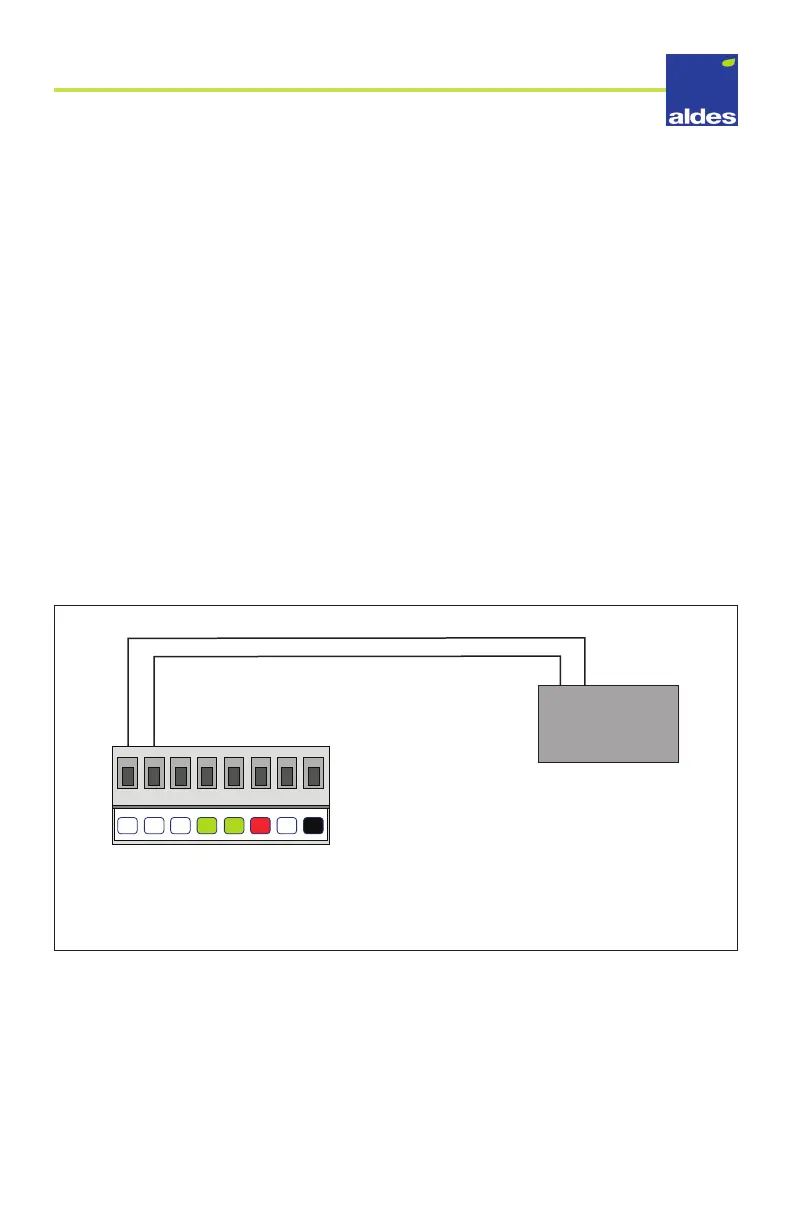
The unit’s terminal strip has two fan interlock options via connections 6, 7, and 8 on the
terminal strip. Connection 6 is NORMALLY CLOSED, and connection 8 is NORMALLY OPEN.
Connection 7 is the common connection for both 6 and 8.
For the HRV/ERV to operate only in conjunction with the Air-Handler/Furnace, do the
following:
1. Connect the HRV/ERV as illustrated below. Refer to the AHU Owner’s Manual/Wiring
Diagram for instructions on connecting to the fan start relay.
Note: It is the same process as connecting the fan control on a thermostat.
2. Ensure the air-handler/furnace blower motor is operating whenever the HRV/ERV is
ventilating.
Note: Consideration must be given to competing airows when connecting the HRV/ERV in
conjunction with an Air-Handler/Furnace Blower system.
Connecting the HRV/ERV
Unit Wiring
The HRV/ERV has the ability to operate in either master or slave mode depending on how the
unit is going to be used.
Master mode is the default configuration for the unit. In master mode, the HRV/ERV can be
used to activate the blower in the air handling unit. This method of control is recommended
with partially or fully integrated systems (see pages 8 and 10) to ensure proper distribution
of fresh air through the HVAC system. In Master mode, the default mode of operation is low
speed recirculation. This is desirable when no central system is present, and continuous
ventilation is not required.
TERMINAL BLOCK
8
7 6
2
1
345
HVAC AHU
START
COM
NC
GRN
GRN
RED
BLK
NO
WHT




 To Next Page