EasyManua.ls Logo

Amana AIR COMMAND 80 - BURNER OPERATION AND FLAME CHECK; GAS SUPPLY AND PIPING MANAGEMENT; Natural Gas Piping Installation

Amana AIR COMMAND 80
14 pages
Print Icon
To Next Page IconTo Next Page
To Previous Page IconTo Previous Page
Loading...
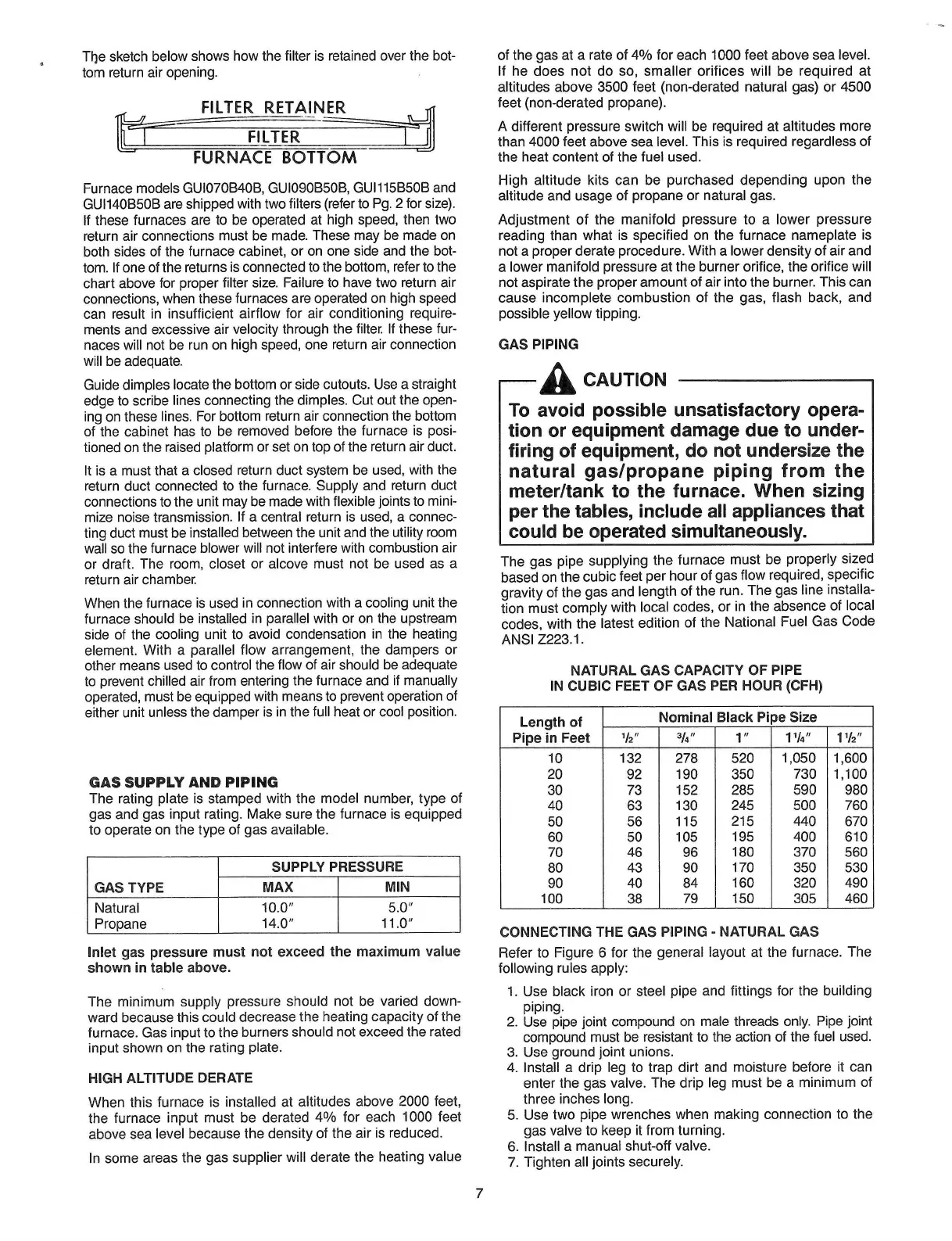
Tqe
sketch
below
shows
how
the
filter
is
retained
over
the
bot-
tom
return
air
opening.
FILTER
RETAINER
FILTER
FURNACE
BOTTOM
Furnace
models
GU1070B40B, GU1090B50B,
GU1115B50B
and
GUI140B50B
are
shipped
with
two
filters
(refer
to
Pg.
2
for
size).
If
these
furnaces
are
to
be
operated
at
high
speed,
then
two
return
air
connections
must
be
made.
These
may
be
made
on
both
sides
of
the
furnace
cabinet,
or
on
one
side
and
the
bot-
tom.
If
one
of
the
returns
is
connected
to
the
bottom,
refer
to
the
chart
above
for
proper
filter
size.
Failure
to
have
two
return
air
connections,
when
these
furnaces
are
operated
on
high
speed
can
result
in
insufficient
airflow
for
air
conditioning
require-
ments
and
excessive
air
velocity
through
the
filter.
If
these
fur-
naces
will
not
be
run
on
high
speed,
one
return
air
connection
will
be
adequate.
Guide
dimples
locate
the
bottom
or
side
cutouts.
Use
a
straight
edge
to
scribe
lines
connecting
the
dimples.
Cut
out
the
open-
ing
on
these
lines.
For
bottom
return
air
connection
the
bottom
of
the
cabinet
has
to
be
removed
before
the
furnace
is
posi-
tioned
on
the
raised
platform
or
set
on
top
of
the
return
air
duct.
It
is
a
must
that
a
closed
return
duct
system
be
used,
with
the
return
duct
connected
to
the
furnace.
Supply
and
return
duct
connections
to
the
unit
may
be
made
with
flexible
joints
to
mini-
mize
noise
transmission.
If
a
central
return
is
used,
a
connec-
ting
duct
must
be
installed
between
the
unit
and
the
utility
room
wall
so
the
furnace
blower
will
not
interfere
with
combustion
air
or
draft.
The
room,
closet
or
alcove
must
not
be
used
as
a
return
air
chamber.
When
the
furnace
is
used
in
connection
with
a
cooling
unit
the
furnace
should
be
installed
in
parallel
with
or
on
the
upstream
side
of
the
cooling
unit
to
avoid
condensation
in
the
heating
element.
With
a
parallel
flow
arrangement,
the
dampers
or
other
means
used
to
control
the
flow
of
air
should
be
adequate
to
prevent
chilled
air
from
entering
the
furnace
and
if
manually
operated,
must
be
equipped
with
means
to
prevent
operation
of
either
unit
unless
the
damper
is
in
the
full
heat
or
cool
position.
GAS
SUPPLY
AND
PIPING
The
rating
plate
is
stamped
with
the
model
number,
type
of
gas
and
gas
input
rating.
Make
sure
the
furnace
is
equipped
to
operate
on
the
type
of
gas
available.
GAS
TYPE
SUPPLY
PRESSURE
MAX
MIN
Natural
Propane
10.0"
14.0"
5.0"
11.0"
Inlet
gas
pressure
must
not
exceed
the
maximum
value
shown
in
table
above.
The
minimum
supply
pressure
should
not
be
varied
down-
ward
because
this
could
decrease
the
heating
capacity
of
the
furnace.
Gas
input
to
the
burners
should
not
exceed
the
rated
input
shown
on
the
rating
plate.
HIGH
ALTITUDE
DEBATE
When
this
furnace
is
installed
at
altitudes
above
2000
feet,
the
furnace
input
must
be
derated
4%
for
each
1000
feet
above
sea
level
because
the
density
of
the
air
is
reduced.
In
some
areas
the
gas
supplier
will
derate
the
heating
value
of
the
gas
at
a
rate
of
4%
for
each
1000
feet
above
sea
level.
If
he
does
not
do
so,
smaller
orifices
will
be
required
at
altitudes
above
3500
feet
(non-derated
natural
gas)
or
4500
feet
(non-derated
propane).
A
different
pressure
switch
will
be
required
at
altitudes
more
than
4000
feet
above
sea
level.
This
is
required
regardless
of
the
heat
content
of
the
fuel
used.
High
altitude
kits
can
be
purchased
depending
upon
the
altitude
and
usage
of
propane
or
natural
gas.
Adjustment
of
the
manifold
pressure
to
a
lower
pressure
reading
than
what
is
specified
on
the
furnace
nameplate
is
not
a
proper
derate
procedure.
With
a
lower
density
of
air
and
a
lower
manifold
pressure
at
the
burner
orifice,
the
orifice
will
not
aspirate
the
proper
amount
of
air
into
the
burner.
This
can
cause
incomplete
combustion
of
the
gas,
flash
back,
and
possible
yellow
tipping.
GAS
PIPING
®
CAUTION
To
avoid
possible
unsatisfactory
opera-
tion
or
equipment
damage
due
to
under
-
firing
of
equipment,
do
not
undersize
the
natural
gas/propane
piping
from
the
meter/tank
to
the
furnace.
When
sizing
per
the
tables,
include
all
appliances
that
could
be
operated
simultaneously.
The
gas
pipe
supplying
the
furnace
must
be
properly
sized
based
on
the
cubic
feet
per
hour
of
gas
flow
required,
specific
gravity
of
the
gas
and
length
of
the
run.
The
gas
line
installa-
tion
must
comply
with
local
codes,
or
in
the
absence
of
local
codes,
with
the
latest
edition
of
the
National
Fuel
Gas
Code
ANSI
Z223.1.
NATURAL
GAS
CAPACITY
OF
PIPE
IN
CUBIC
FEET
OF
GAS
PER
HOUR
(CFH)
Length
of
Pipe
in
Feet
Nominal
Black
Pipe
Size
'/2
"
3
/
4
"
1"
1'/4"
1'/2
"
10
132
278
520
1,050
1,600
20 92
190
350
730
1,100
30
73
152
285
590
980
40
63
130
245
500
760
50
56
115
215 440
670
60
50
105
195
400
610
70
46
96
180
370
560
80
43
90
170
350
530
90
40
84
160
320
490
100
38
79
150
305
460
CONNECTING
THE
GAS
PIPING
-
NATURAL
GAS
Refer
to
Figure
6
for
the
general
layout
at
the
furnace.
The
following
rules
apply:
1.
Use
black
iron
or
steel
pipe
and
fittings
for
the
building
piping.
2.
Use
pipe
joint
compound
on
male
threads
only.
Pipe
joint
compound
must
be
resistant
to
the
action
of
the
fuel
used.
3.
Use
ground
joint
unions.
4.
Install
a
drip
leg
to
trap
dirt
and
moisture
before
it
can
enter
the
gas
valve.
The
drip
leg
must
be
a
minimum
of
three
inches
long.
5.
Use
two
pipe
wrenches
when
making
connection
to
the
gas
valve
to
keep
it
from
turning.
6.
Install
a
manual
shut-off
valve.
7.
Tighten
all
joints
securely.
7

Related product manuals