Need help?
Do you have a question about the Amana AIR COMMAND 80 and is the answer not in the manual?
Critical safety precautions for installation and operation, including fire and gas leak risks.
Data relating airflow (CFM) and temperature rise to external static pressure.
Guidelines for furnace placement, combustion air, and ventilation.
Minimum clearances to combustible surfaces and accessibility needs for servicing.
Critical information on providing adequate air for combustion and ventilation, including safety warnings.
Instructions and safety warnings related to furnace venting and common venting issues.
Guidelines and requirements for installing natural gas piping to the furnace.
Procedures for checking manifold pressure and gas input rate.
Essential safety warnings regarding proper wiring polarity and grounding.
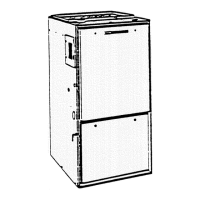
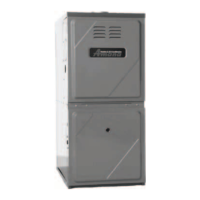
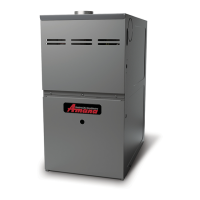
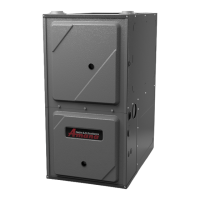
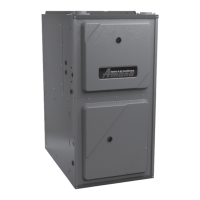
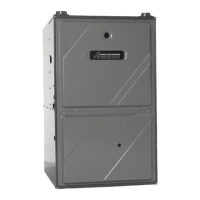
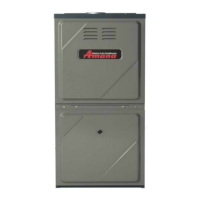
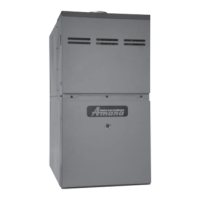
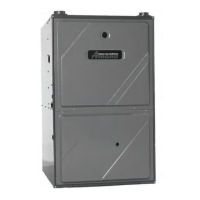
This document describes the Amana AIR COMMAND 80 Model GUI (Upflow) Gas Fired Warm Air Furnace, providing installation, operation, and maintenance instructions.
The Amana AIR COMMAND 80 Model GUI (Upflow) is a gas-fired warm air furnace designed for residential heating applications. It is equipped with an induced draft blower to draw combustion air into the heat exchanger and a self-diagnostic electronic ignition control that lights the burners. The furnace is designed to provide warm air for heating and can also be integrated with cooling equipment, as it includes a 40VA transformer and an auxiliary fan relay. It operates by drawing in air, heating it using natural or propane gas, and then distributing the warm air throughout the building via a duct system. A key safety feature is an interlock switch that prevents furnace operation if the blower access door is not in place. The furnace also incorporates a flame roll-out protection device that will shut off the furnace if flames are not properly drawn into the heat exchanger.
The furnace is designed for upflow installation in basements, closets, or utility rooms. It requires a level floor and adequate clearances from combustible surfaces and for servicing. Proper combustion and ventilation air supply is crucial, especially in tightly constructed homes, often requiring outside air to be ducted into the furnace area. The furnace's operation is controlled by a room thermostat, which should be set to the desired temperature. There is a one-minute delay between thermostat energizing and burner firing. In case of ignition failure after three tries, the electronic ignition module can be reset by turning the thermostat below room temperature for thirty seconds or by disengaging the electric disconnect switch for thirty seconds.
The furnace uses a multi-speed motor for the blower, allowing for easy selection of heating and cooling airflow speeds. It is important to set the blower speed correctly to achieve the specified temperature rise through the unit, as indicated on the rating plate. A higher blower speed will lower the temperature rise, while a slower speed will increase it. When using the furnace with a cooling unit, it should be installed in parallel with or upstream of the cooling unit to prevent condensation in the heating element. Dampers or other means used to control airflow should be adequate to prevent chilled air from entering the furnace and, if manually operated, must be equipped with means to prevent operation of either unit unless the damper is in the full heat or cool position.
For propane models, a warning device is recommended in basements or confined spaces to alert users to gas leaks, as propane gas is heavier than air and can settle in low areas, posing an explosion or fire hazard. The gas piping must be properly sized and installed according to local codes and the National Fuel Gas Code, including a drip leg to trap dirt and moisture and a manual shut-off valve. Manifold pressure must be checked and adjusted with a "U Tube" manometer to ensure proper gas input and prevent underfiring or overfiring.
Regular maintenance is essential for safe and efficient operation. The furnace should be checked at least once a year by a qualified servicer, preferably before the heating season, to ensure adequate combustion air, proper vent system function, and to inspect the chimney flue and vent pipe for blockages or rust.
The furnace is equipped with permanent type washable high-velocity filters. These filters should be inspected and cleaned every two months, or as required, by washing and spraying with an adhesive. Operating the furnace without a filter can lead to dust and lint buildup on internal parts, reducing efficiency, damaging equipment, and posing a fire risk.
The vent blower motor requires annual oiling with 6 drops of Anderoil 465 oil (3 drops in each oil port). Some blower motors are permanently lubricated and do not require oiling. The blower compartment and wheel should be cleaned monthly during heating and cooling seasons to remove accumulated dirt and lint.
Flue passages should be inspected and cleaned at the start of each heating season by a qualified serviceman. This involves shutting off power and gas, removing the burner assembly, induced draft blower, and collector box, and then cleaning the primary heat exchanger tubes with a round wire brush attached to a spring cable and a variable speed reversible drill.
Periodically, a visual check of the burner flames should be performed. Flames should be stable, soft, and blue (orange tips due to dust are acceptable, but not yellow), extending directly outward from the burner ports without curling downward, floating, or lifting off. Any abnormal flame appearance should prompt immediate contact with a qualified service agent. The self-diagnostic ignition control includes a red indicator light that helps diagnose potential service problems; a continuously lit light indicates a faulty control, while a flashing light suggests a lock-out condition. If the light is off and the furnace is not operating, the problem likely lies elsewhere.
 General
| Model | AIR COMMAND 80 |
|---|---|
| Category | Furnace |
| Efficiency | 80% AFUE |
| Stages | Single-Stage |
| Filter Type | Standard |
| Fuel Type | Natural gas |
| Heating Capacity | 40, 000 to 120, 000 BTU/h |
| Ignition Type | Hot surface |
| Warranty | 10-year limited warranty |
| Vent Type | Atmospheric venting |

 To Next Page