EasyManua.ls Logo

Amana AIR COMMAND 80 - PROPANE GAS SYSTEM INSTALLATION; Propane Gas System Warnings

Amana AIR COMMAND 80
14 pages
Print Icon
To Next Page IconTo Next Page
To Previous Page IconTo Previous Page
Loading...
8.
The
furnace
shall
be
connected
to
the
building
piping
by
one
of
the
following:
a.
Rigid
metallic
pipe
and
fittings.
b.
Semirigid
metallic
tubing
and
metallic
fittings.
Alumi-
num
alloy
tubing
shall
not
be
used
in
exterior
locations.
c.
Listed
gas
appliance
connectors
used
in
accordance
with
the
terms
of
their
listing
that
are
completely
in
the
same
room
as
the
equipment.
d.
In
"b"
and
"c"
above,
the
connector
or
tubing
shall
be
installed
so
as
to
be
protected
against
physical
and
thermal
damage.
Aluminum
-alloy
tubing
and
connec-
tors
shall
be
coated
to
protect
against
external
corro-
sion
where
they
are
in
contact
with
masonry,
plaster,
or
insulation
or
are
subject
to
repeated
wettings
by
such
liquids
as
water
(except
rain
water),
detergents
or
sewage.
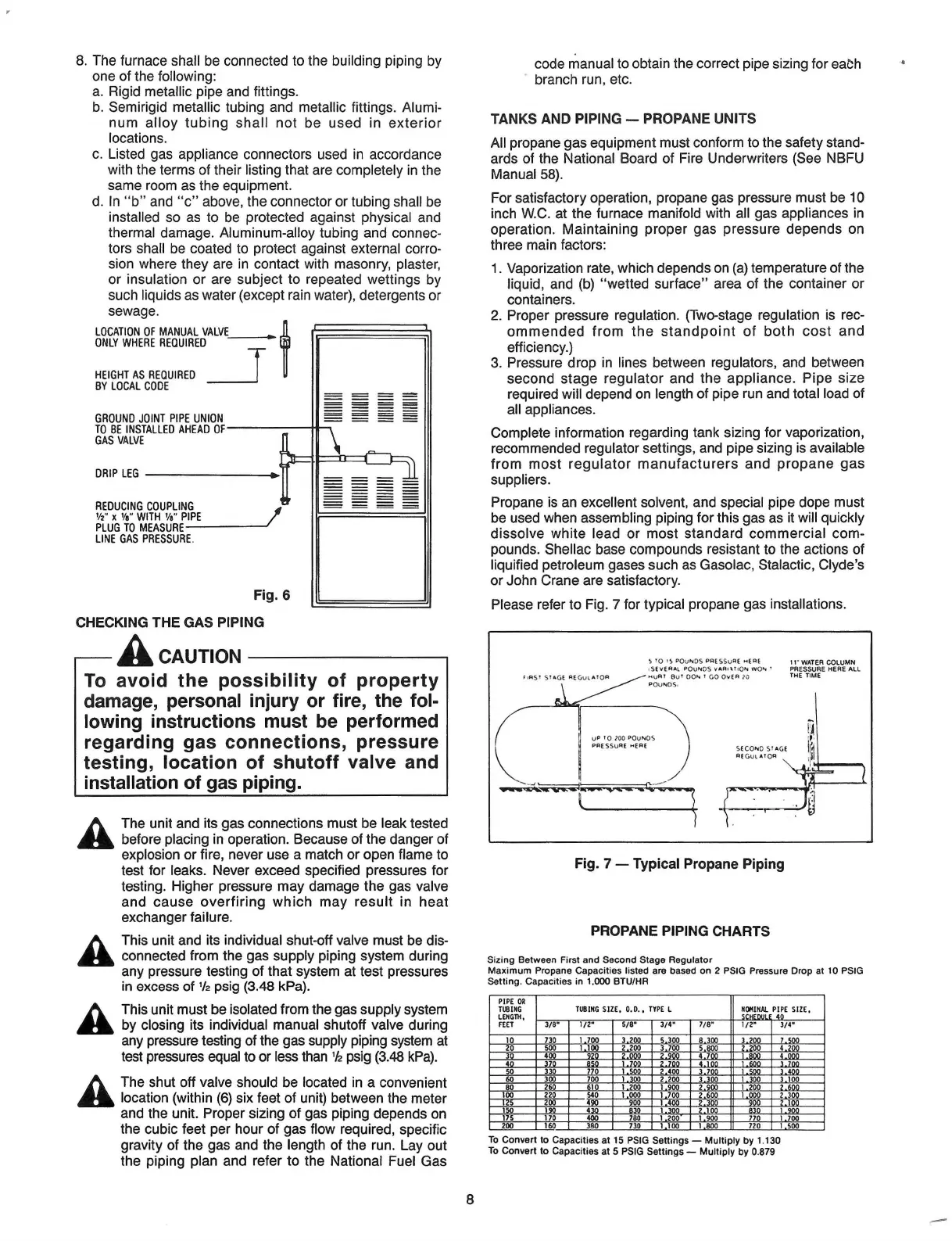
LOCATION
OF
MANUAL
VALVE
ONLY
WHERE
REQUIRED
HEIGHT
AS
REQUIRED
BY
LOCAL
CODE
GROUND
JOINT
PIPE
UNION
TO
BE
INSTALLED
AHEAD
OF
GAS
VALVE
DRIP
LEG
REDUCING
COUPLING
1
/
2
"
x
1
/~"
WITH
Ye"
PIPE
PLUG
TO
MEASURE
LINE
GAS
PRESSURE.
Fig.
6
CHECKING
THE
GAS
PIPING
A
CAUTION
To
avoid
the
possibility
of
property
damage,
personal
injury
or
fire,
the
fol-
lowing
instructions
must
be
performed
regarding
gas
connections,
pressure
testing,
location
of
shutoff
valve
and
installation
of
gas
piping.
A
A
A
A
The
unit
and
its
gas
connections
must
be
leak
tested
before
placing
in
operation.
Because
of
the
danger
of
explosion
or
fire,
never
use
a
match
or
open
flame
to
test
for
leaks.
Never
exceed
specified
pressures
for
testing.
Higher
pressure
may
damage
the
gas
valve
and
cause
overfiring
which
may
result
in
heat
exchanger
failure.
This
unit
and
its
individual
shut-off
valve
must
be
dis-
connected
from
the
gas
supply
piping
system
during
any
pressure
testing
of
that
system
at
test
pressures
in
excess
of
psig
(3.48
kPa).
This
unit
must
be
isolated
from
the
gas
supply
system
by
closing
its
individual
manual
shutoff
valve
during
any
pressure
testing
of
the
gas
supply
piping
system
at
test
pressures
equal
to
or
less
than
'h
psig
(3.48
kPa).
The
shut
off
valve
should
be
located
in
a
convenient
location
(within
(6)
six
feet
of
unit)
between
the
meter
and
the
unit.
Proper
sizing
of
gas
piping
depends
on
the
cubic
feet
per
hour
of
gas
flow
required,
specific
gravity
of
the
gas
and
the
length
of
the
run.
Lay
out
the
piping
plan
and
refer
to
the
National
Fuel
Gas
code
manual
to
obtain
the
correct
pipe
sizing
for
each
branch
run,
etc.
TANKS
AND
PIPING
-
PROPANE
UNITS
All
propane
gas
equipment
must
conform
to
the
safety
stand-
ards
of
the
National
Board
of
Fire
Underwriters
(See
NBFU
Manual
58).
For
satisfactory
operation,
propane
gas
pressure
must
be
10
inch
W.C.
at
the
furnace
manifold
with
all
gas
appliances
in
operation.
Maintaining
proper
gas
pressure
depends
on
three
main
factors:
1.
Vaporization
rate,
which
depends
on
(a)
temperature
of
the
liquid,
and
(b)
"wetted
surface"
area
of
the
container
or
containers.
2.
Proper
pressure
regulation.
(Two
-stage
regulation
is
rec-
ommended
from
the
standpoint
of
both
cost
and
efficiency.)
3.
Pressure
drop
in
lines
between
regulators,
and
between
second
stage
regulator
and
the
appliance.
Pipe
size
required
will
depend
on
length
of
pipe
run
and
total
load
of
all
appliances.
Complete
information
regarding
tank
sizing
for
vaporization,
recommended
regulator
settings,
and
pipe
sizing
is
available
from
most
regulator
manufacturers
and
propane
gas
suppliers.
Propane
is
an
excellent
solvent,
and
special
pipe
dope
must
be
used
when
assembling
piping
for
this
gas
as
it
will
quickly
dissolve
white
lead
or
most
standard
commercial
com-
pounds.
Shellac
base
compounds
resistant
to
the
actions
of
liquified
petroleum
gases
such
as
Gasolac,
Stalactic,
Clyde's
or
John
Crane
are
satisfactory.
Please
refer
to
Fig.
7
for
typical
propane
gas
installations.
Fig.
7—
Typical
Propane
Piping
S
'
O
'S
POUNDS
PRESSURE
..E
RE
SEVER.1
POUNDS
v.R,%r,ON
WON'
NURf
BU'
DON'
oo
OVER
]0
POUNDS
PROPANE
PIPING
CHARTS
Sizing
Between
First
and
Second
Stage
Regulator
Maximum
Propane
Capacities
listed
are
based
on
2
PSIG
Pressure
Drop
at
10
PSIG
Setting.
Capacities
in
1,000
BTU/HR
PIPE
OR
TUBING
LENGTH
FEET
TUBING
SIZE.
O.D..
TYPE
L
9001601.
5000051.0
1/2'
PIPE
SIZE.
40
3/4•
3/8'
l/2"
5/8
3/4'
7/8'
10
730
1.700
3.200
5.300
8.300
1.200
7.500
2
500
1.100
2.200
3.700
5.800
2.200
4.200
30
400
920
2.000
7.900
4.700
1.800
4
000
40
370
850
1.700
7.700
4.100
1.600
3
100
50
330
770
1.500
2.400
3.700
1.500
3.400
60
300
700
1.300
2.200
3.300
1
300
3.100
80
260
610
1.200 1.900
2.900
1.200
2.600
100
220
540
1.000
1700
2.600
1.000
2.300
125
200
490
900
1.400
2.300
900
2.100
150
190
430
630
1.30O
2.100
830
1.900
75
170
400
780
1.250
1.900
770
1.700
200
160
360
730
1.100 1.800
720
1.500
To
Conver
to
Capacities
at
15
PSIG
Settings
—
Multiply
by
1.130
To
Convert
to
Capacities
at
5
PSIG
Settings
—
Multiply
by
0.879
8

Related product manuals