EasyManua.ls Logo

Amana GCCA115AX50 - User Manual

Amana GCCA115AX50
78 pages
Print Icon
To Next Page IconTo Next Page
Loading...
Service
Instructions
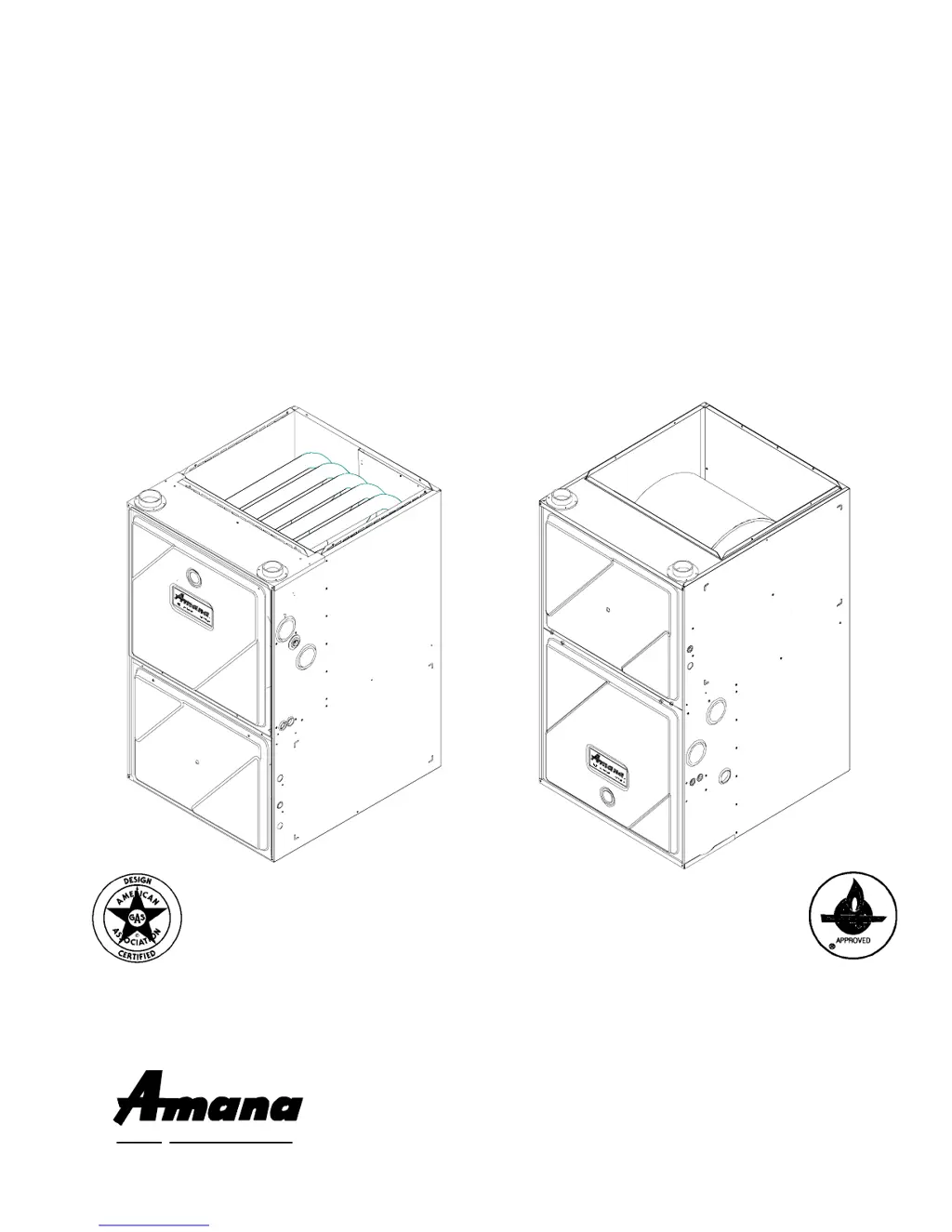
40" 90% Condensing Gas Furnaces
GUCA, GCCA & Accessories
This manual is to be used by qualified HVAC
technicians only. Amana does not assume
any responsibility for property damage or
personal injury for improper service proce-
dures done by an unqualified person.
RS6610002
Revision 0
October 1998
A
higher standard of comfor
t
Heating
n
Air Conditioning
®
Model and Manufacturing
numbers listed on page 4.

Questions and Answers

  • M
    Mary CookAug 8, 2025
    What to do if the limit circuit opens repeatedly in my Amana Furnace?
    • G
      Gloria RuizAug 8, 2025
      If the limit circuit in your Amana Furnace (either primary or auxiliary) opens five times during a single call for heat, it indicates a problem with overheating. This could be due to insufficient conditioned air flowing over the heat exchanger. Check your filters and ductwork for any blockages and clean the filters or remove any obstructions. Also, check for loose or misconnected wiring and correct it.
  • T
    Travis FullerAug 15, 2025
    What to do if the pressure switch circuit opens repeatedly in my Amana Furnace?
    • R
      Ronald ChanAug 15, 2025
      If the pressure switch circuit in your Amana Furnace opens five times during a single call for heat, several issues could be the cause. First, check the pressure switch hose for any blockages, pinches, or misconnections and correct as needed. Also, check the flue and/or inlet air piping for blockages, proper length, elbows, and termination. Inspect the drain system and verify the proper pressure switch set point and contact motion. Finally, check for loose or misconnected wiring and correct it.
  • R
    Rhonda WrightAug 23, 2025
    How to fix a low flame sense signal on an Amana GCCA115AX50 Furnace?
    • J
      Jason BryanAug 23, 2025
      A low flame sense micro-amp signal in your Amana Furnace can be caused by a few things. The flame sensor might be coated or oxidized; if so, sand the flame sensor. Also, inspect the sensor for proper alignment. It could also be caused by a lazy burner flame due to improper gas pressure, so check for proper gas pressures. The flame sensor might also be incorrectly positioned in the burner flame. Check the inlet air piping for blockage, proper length, elbows, and termination.
  • B
    Brianna NelsonAug 30, 2025
    What causes an Amana GCCA115AX50 Furnace to sense flame with no call for heat?
    • C
      Cory PageAug 30, 2025
      If your Amana Furnace senses a flame even when there's no call for heat, it's likely due to a short to ground in the flame sense circuit. Correct the short at the flame sensor or in the flame sensor wiring.

Summary

Service Instructions

Model and Manufacturing Number Identification

Details on identifying furnace models and manufacturing numbers for parts.

Important Information

Important Notices and Safety Symbols

Key warnings, cautions, and explanations of safety symbols for proper handling.

Product Identification

Model Number Breakdown

Explains the coding system for furnace model numbers and their components.

Furnace Dimensions and Clearances

Provides detailed diagrams and minimum clearance requirements for installation.

Component Identification

Illustrates and lists the various components within the furnace assembly.

Furnace Accessories

Details available accessories like floor bases, filter racks, and vent kits.

Furnace Specifications

GUCA Series Furnace Specifications

Technical specifications for GUCA model furnaces including input, output, and electrical data.

GCCA Series Furnace Specifications

Technical specifications for GCCA model furnaces including input, output, and electrical data.

Blower Performance Specifications

GUCA Blower Performance Data

Charts detailing blower performance at various static pressures and speeds for GUCA models.

GCCA Blower Performance Data

Charts detailing blower performance at various static pressures and speeds for GCCA models.

Combustion and Ventilation Air

Air Requirements and General Guidelines

Explains air needs for combustion, ventilation, and dilution of flue gases per code.

Equipment Location and Airflow Methods

Illustrates airflow requirements for equipment in confined and unconfined spaces.

Venting and Piping Practices

Covers general rules for vent/flue pipes, materials, and special installation conditions.

Vent Termination Locations

Specifies requirements for vent pipe termination locations and Canadian regulations.

Furnace Connections and Piping

Details standard and alternate connections for vent/flue and combustion air piping.

Vent;Flue Pipe Installation Details

Provides steps for installing vent/flue pipes and alternate locations.

Non-Direct Vent Piping and Terminations

Covers single-pipe installation, alternate intake, and termination rules.

Direct Vent Piping and Terminations

Details dual-pipe installation, length limits, and termination requirements.

Concentric Vent Termination

Explains the use of concentric vent kits for through-wall or through-roof terminations.

Condensate Drain Lines and Drain Trap

General Installation and Warnings

Discusses condensate generation, routing, and installation warnings for drain systems.

Upright Installation Drain Connections

Details standard and alternate drain hose connections for upright installations.

Horizontal Installation Drain Connections

Explains drain hose connections and trap mounting for horizontal installations.

Product Design

Safety Warnings and Product Application

Covers critical safety warnings, ESD precautions, and intended product use.

Installation and Location Considerations

Discusses furnace placement, clearances, environmental factors, and installation specifics.

Furnace Installation Specifics

Details furnace suspension, horizontal application considerations, and confined space ventilation.

Electrical and Gas System Requirements

Details electrical wiring, gas supply, piping, and conversion requirements for safe operation.

Ductwork and Filter Design

Covers airflow design, filter specifications, and installation requirements for duct systems.

Furnace Operation and Control Adjustments

Explains operation controls, blower speed adjustment, and heat anticipator settings.

System Operation

Normal Operating Sequences

Describes the step-by-step operation sequences for heating, cooling, and fan-only modes.

Troubleshooting and Lockout Reset

Guides for diagnosing operational issues and resetting the furnace from lockout conditions.

Polarization and Phasing

Checking Power Polarization and Phasing

Explains how to check incoming power polarization and transformer phasing for electronic controls.

Maintenance

Annual Inspection and Filter Service

Outlines annual inspection checks and procedures for filter removal and replacement.

Component Cleaning and Inspection

Details cleaning procedures for flue passages, burners, and flame sensors.

Servicing

Test Equipment and Performance Tests

Lists essential test equipment and procedures for heating performance testing.

Troubleshooting Chart

A comprehensive chart linking symptoms to possible causes, tests, and remedies.

Component Servicing Procedures

Detailed instructions for checking electrical components, controls, gas systems, and safety devices.

Heat Exchanger Assembly Service

Procedures for removal and replacement of the heat exchanger assembly.

Wiring Diagrams

GUCA Model Wiring Diagram

Provides the electrical wiring diagram for GUCA series furnaces.

GCCA Model Wiring Diagram

Provides the electrical wiring diagram for GCCA series furnaces.

Schematics

Integrated Ignition Control Schematic

Illustrates the typical schematic for the integrated ignition control module.

Furnace Twinning Kit Schematic

Shows the schematic for the furnace twinning kit (FTK03A) for multi-furnace installations.

Amana GCCA115AX50 Specifications

General IconGeneral
BrandAmana
ModelGCCA115AX50
CategoryFurnace
LanguageEnglish

Related product manuals