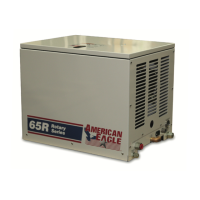
This document is the Owner's Manual for the American Eagle Model SRS-65RP rotary screw compressor, covering safety, installation, maintenance, and operation.
Function Description:
The American Eagle SRS-65RP is a rotary screw compressor designed to provide safe and dependable service for various operations. It is intended to supply compressed air for a variety of applications, with its operation driven by a hydraulic system, often in conjunction with a PTO (Power Take-Off) on a vehicle. The compressor system includes a hydraulic circuit, an air compression circuit, and an electrical control system to manage its functions. It is designed for continuous operation, providing a steady supply of compressed air.
Important Technical Specifications:
Compressor System Description:
- Hydraulic System: 18 GPM
- Pressure Relief Setting: 3500 PSI
- Plumbing: All Steel Plumbing W/ JIC Fittings
- Cooler Fan: 2070 CFM, 12 Volt
- Drive: Belt Drive
- Compressor RPM (small sprocket): 7500-8000 RPM
- System Pressure: 2800 PSI
- Solenoid Control Valve: 12 VDC
- Manifold: 6061 Aluminum Manifold
- Air Pressure Control: Air Pressure Control Valve
- Max. Air Pressure: 150 PSI
- Compressor Running @ 8000 RPM @ 20 GPM: 65 CFM @ 100 PSI
- Model: SRS-65RP
- Weight: 313 lbs.
- Cylinders: (Not specified, but implied by rotary screw design)
- Delivery: 65 CFM @ 100 PSI
- Maximum Working Pressure: 150 PSI
- Relief: 3500 PSI
- Maximum Compressor Speed: 8000 RPM
- Delivery (7000-7500 RPM): 65 CFM @ 100 PSI
- Dimensions: 29"L x 23"W x 22"H
- Electrical: 12 VDC
- Crankcase Oil Capacity: 5 Quarts
- Oil Reservoir Capacity: Minimum: 26 Gallon Reservoir
Oil Requirements:
- High aging stability
- High disperse capacity
- Low emulsification tendency
- Flash point: above 400°F/ 200°C
- Pour-point: 5° below lowest ambient temperature minimum
- Minimum foaming
- High corrosion protection
- Hydraulic or turbine oil
- Basic oil: solvate
- Operating temperature: up to 230°F / 110°C
- Viscosity class: ISO VG 68
- Viscosity at 104°F / 40°C: ca. 42-50 mm2/s (cST)
Minimum Pressure Valve:
- Relief valve setting: 64psi (factory setting)
Usage Features:
The SRS-65RP is designed for integration into a hydraulic system, typically on a vehicle equipped with a PTO.
- Operation: The compressor is activated by engaging the hydraulic system. A pressure switch controls the hydraulic solenoid valve, which directs hydraulic oil to the compressor motor. The system includes an air pressure switch that opens at 150 PSI and closes at 115 PSI, controlling the compressor's load and unload cycles.
- Break-in Period: The compressor undergoes factory testing for proper break-in and operation. Users should follow specific procedures for initial use, including checking oil levels and air intake filters.
- Safety: The manual emphasizes safety precautions, including wearing safety equipment, ensuring proper ventilation, and understanding the risks associated with high temperatures, flammable fumes, and high-pressure air. It warns against operating the compressor without proper training or if damaged.
- Hydraulic System Integration: The compressor relies on a robust hydraulic system for power. The manual provides typical hydraulic circuit diagrams for single-stage and tandem pumps with multiple components, as well as a circuit for an auxiliary cooler. Proper hydraulic flow and pressure are critical for the compressor's performance.
- Electrical Installation: The unit requires a 12VDC electrical connection. The manual includes a detailed wiring diagram for the SRS-65 electrical installation, showing connections for the pressure gauge, solenoid valve, cooling fan, and pressure switch.
- Temperature Gauge Installation: Specific instructions are provided for installing a temperature gauge, highlighting the correct port to use to avoid damage.
- Compressor Pressure Switch Adjustment: Detailed instructions are given for adjusting the kick-out (145-150 psi) and kick-on (115-120 psi) pressure settings of the compressor pressure switch, which regulates the air output.
Maintenance Features:
The manual outlines a comprehensive maintenance schedule to ensure the longevity and optimal performance of the SRS-65RP.
- Routine Maintenance Intervals:
- Daily: Drain air tanks, check crankcase oil level, check fittings and airlines, check hydraulic fluid level.
- Weekly: Inspect and clean air intake filters, clean and operate safety valves, clean cooling fins on radiator/cooler, inspect check valve.
- Monthly (every 12 months): Replace Coalescing/Separator Cartridge.
- Monthly (every 6 months): Inspect and clean compressor valves, replace hydraulic filter.
- Monthly (every 3 months): Replace air filters/oil filter/compressor oil, tighten all fittings and fasteners, check all electrical connections.
- Hourly (every 250 hours): Inspect and clean air check valve.
- Oil Management:
- Oil Level Checks: Regular checks of the oil receiver container level are crucial. Instructions are provided for checking and adding oil using the dipstick.
- Oil Change: The manual specifies changing the oil every 3 months under normal operating conditions, or more frequently if operating in a dirty environment. It recommends AE SYNTHETIC COMPRESSOR OIL P/N C0087.
- Changing the Oil: Detailed steps are provided for safely draining and refilling the compressor oil, emphasizing that the unit must be stopped and completely discharged, and at an operating temperature of 140-175°F (60-80°C).
- Condensation Drain: Regular draining of condensation from the oil separator receiver is necessary to prevent corrosion and maintain air/oil separation efficiency.
- Filter Replacement:
- Oil Filter: Replace every 1000 hours of service or when a differential pressure of 25 psig is observed.
- Separator Cartridge: Replace once per year or at a maximum of 5000 operating hours, or when pressure drop exceeds 14 psig.
- Intake Filter: Replace every 100 hours of running time, or more frequently in dusty conditions.
- Belt Tension: Instructions for checking and adjusting belt tension for both new and used belts are provided, with specific tensioning forces and deflection measurements.
- Hydraulic Oil Cooler/Compressor Oil Cooler: Regular cleaning of the cooler fins is essential for maintaining cooling efficiency. The manual provides steps for cleaning and reassembling the cooler.
- Troubleshooting: A comprehensive troubleshooting guide is included, listing common problems, possible causes (e.g., low oil level, clogged filters, faulty pressure switch, worn hydraulic motor), and corresponding solutions (e.g., adding oil, replacing filters, adjusting settings, cleaning components). This section helps operators diagnose and resolve issues to ensure continuous operation.
- Warranty: The manual includes detailed warranty information, outlining the terms and conditions for American Eagle products, including coverage periods, claims procedures, and limitations.

 Need help?
 General

 To Next Page