EN 1009 EN
Important Safety Instructions
Lightning Surge Suppression
WARNING
To prevent the risk of electric shock caused by lightning strikes, make sure that the metal parts of the solar system are
connected to the ground.
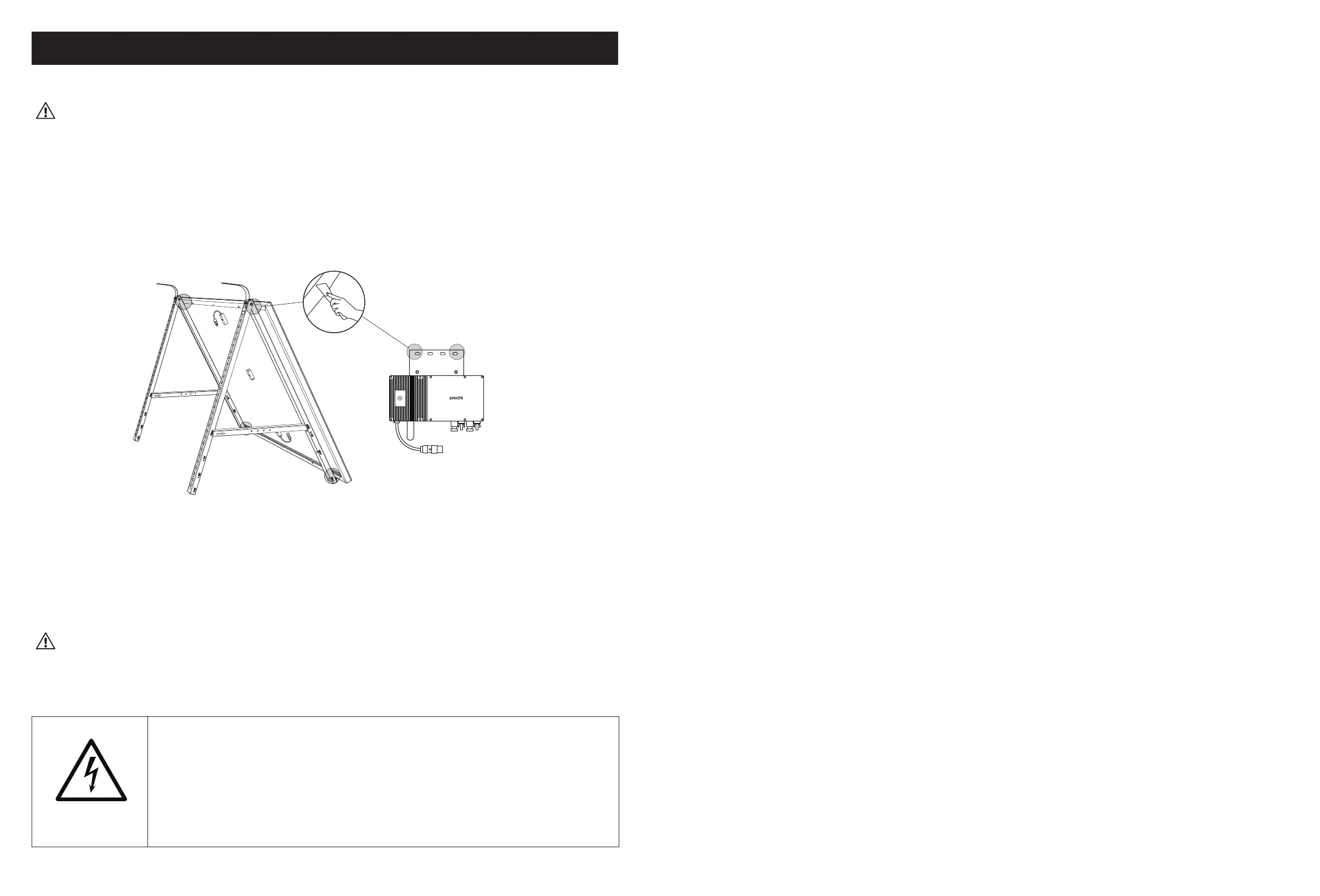
The protective coating of the metal parts (such as the solar panel frame, brackets, the body of microinverter) is insulated:
• Scrape o the protective coating of the contact surface between the solar panel frame and the brackets.
• Scrape o the protective coating of the brackets and the microinverter's contact surface.
• Ensure that the brackets are connected to the microinverter through other conductors, such as metal railings.
• By following the steps above, the solar panel frame, brackets, and the body of the microinverter will be connected and
grounded via the ground wire and the microinterver's AC wire.
The solar system does not need to be struck by lightning to cause damage. A strike nearby often induces voltage spikes in the
electrical grid that can damage equipment. The microinverter has surge protection, but if the surge has sucient energy, the
protection built into the microinverter can be exceeded—causing damage to the equipment.
Any solar installation should include surge protection since the warranty does not cover force majeure such as lightning strikes.
Surge protection devices should be installed according to the vendor's instructions.
Solar Panel
WARNING
Before installing, wiring, operating, or maintaining the solar PV modules, you should read and understand all safety rules.
When the battery surface of the module is directly exposed to sunlight or other light sources, direct current (DC) will be generated.
Regardless of whether the module is connected or not, direct contact with the live parts of the module, such as the terminal, may
cause casualties.
WARNING
Maximum series fuse rating 20A.
Power production tolerance +3%
This module produces electricity when exposed to light.
Follow all applicable safety precautions.
Only qualified personnel should install or perform maintenance work on the modules
Be aware of dangerous high DC voltage when connecting modules.
Do not damage or scratch the rear surface of the modules.
Do not handle or install modules when they are wet.
Follow the battery manufacturer's recommendations if batteries are used with modules.
Safety Instructions
• The installer must abide by all the safety instructions and precautions mentioned in this manual, and at the same time observe
the laws or regulations of authorized agencies and other local requirements. Failure to comply with the relevant safety and
installation specifications described in this manual, or failure to comply with the laws or regulations of authorized agencies and
other local requirements will result in the invalidation of the limited warranty of the purchased solar PV modules.
• Anker's solar PV modules have passed the tests of some of the world's leading certification institutes. Rest assured that it is
suitable for use if it meets the requirements and terms of this manual.
• Before installing the solar photovoltaic power generation system, please contact the relevant local authority to determine the
installation permit and inspection requirements that meet the local requirements.
• Be sure to consider the voltage changes at dierent temperatures when designing a photovoltaic system (when the temperature
drops, the module's variable output voltage will rise).
• As long as there is sunlight, photovoltaic modules can generate electricity normally. Shadow occlusion has a significant impact
on module power generation. Modules should not be covered or placed under shade (buildings, chimneys, and trees) nor should
they be partially shaded (overhead lines, dirt, or snow).
• Ensure the solar PV modules are stored in their original packaging before installation. The modules should be protected from
damage during transportation and storage. Do not open it until the modules arrive at the installation site. Unpack according to
the instructions, and be careful when transporting, opening, and storing. The packaged modules cannot be dropped directly.
• Ensure that the transportation and installation methods are correct. Otherwise, the modules may be damaged.
• Solar PV modules should not be stacked beyond the maximum number of layers listed on the packaging box. Before unpacking,
please place the packing box in a ventilated, dry, and weatherproof place.
• Do not stand, climb, walk, or jump on an unopened packaging or module.
• Objects that are heavy or sharp should not be placed on the front or back of the module. This will prevent damage to the module
and ensure its safety.
• It is recommended that you use disassembling tools and support to prevent the modules from tilting or falling o when
disassembling the carton. Modules should not be placed in unstable or unfixed environments.
• Whenever wires or junction boxes are pulled, modules cannot be carried. The modules should be held by two or more people
wearing non-slip gloves at the same time when being moved. Modules should not be stacked or placed on the head for
transportation.
• If you need to store modules temporarily, they should be stored in a dry and ventilated environment.
• Before installation, please make sure that all modules are in clean and dry conditions when they are in contact with electrical
appliances.
• Do not install any modules when it is raining, snowing, or windy.
• Do not install or use modules under artificial condensing light sources.
• The solar PV module's support structures should be constructed of durable, rust-proof, and UV-resistant materials. Make sure it
is tested, certified, and approved.
• For modules to be installed on columns, the column and module support structures must be wind and snow-resistant. Please
ensure that the wind and snow loads on the modules do not exceed the maximum load allowed by the design.
• Do not use solar photovoltaic modules with broken glass or damaged back sheets during installation. Repairing such modules is
not possible. Touching the aluminum frame or surface will result in an electric shock. You should not attempt to disassemble the
module or damage the nameplate or any other part of the module.
• Do not step on, place heavy objects, or scratch or damage the glass surface of the photovoltaic modules during installation.
• The glass of the module should not be painted or glued.
• When solar photovoltaic modules are being installed, opaque materials can be used to prevent electric shock or burning.
• Refrain from wearing metal rings, watches, earrings, nose rings, or other metal objects during the installation or maintenance of
the photovoltaic system. This will avoid damage to the modules and electric shock.
• In case of circuit overload, do not disconnect any electrical connections or unplug any connectors.
• Ensure that cables and connectors are not scratched or cut to prevent the insulation performance of the modules from
degrading.
• Make sure you use well-insulated tools in accordance with relevant electrical installation standards. Keep your children away
from the area of the installation site during the transportation and installation of modules.
• You must comply with local safety regulations (e.g., safety rules, and power plant operation regulations), including the installation
of wires and cables, connectors, inverters, charge controllers, storage batteries, and rechargeable batteries.
• As per the National Electrical Code, the maximum system voltage cannot exceed 1000V or 1500V. To determine the exact voltage,


 To Next Page
 Loading...