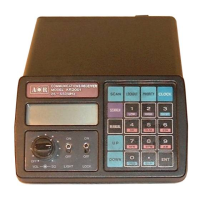
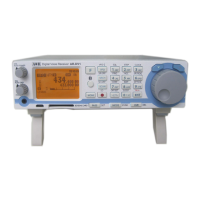
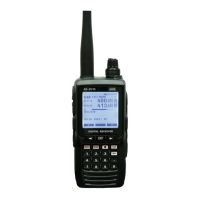
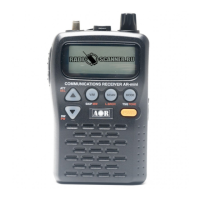
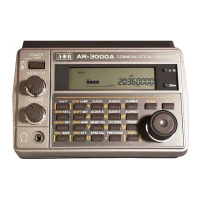
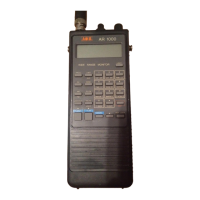
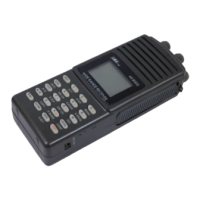
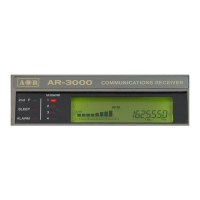
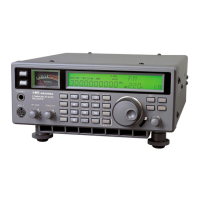
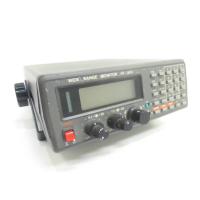
The AOR AR-2002 is a communications receiver designed for wide-range reception, offering continuous coverage from 25MHz to 550MHz and from 800MHz to 1300MHz. It utilizes a PLL synthesizer circuit for accurate receiving frequency. The device is equipped with a multi-functional LCD display that shows receiving frequency, scan status, mode, search status, and other relevant information.
Key Features:
- Frequency Coverage: 25MHz to 550MHz and 800MHz to 1300MHz.
- PLL Synthesizer: Ensures precise frequency tuning.
- LCD Display: Provides comprehensive information on receiver status.
- Keyboard Operation: A new keyboard with push buttons simplifies frequency entry and receiver operation.
- Professional Performance: Offers high receiver sensitivity, selectivity, spurious rejection, and two-signal characteristics.
- Multiple Receiving Modes: Supports Wide FM (for TV and FM broadcasts), Narrow FM (for business band and amateur radio), and AM (for VHF/UHF air band and CB).
- Advanced Design: Incorporates state-of-the-art electronic components and circuitry.
- Portability: Light and compact design for versatile use.
- S-Meter: Features a 10-step LED "S" meter on the front panel.
- Frequency Control: Manual frequency control is available via a shaft encoder, in addition to UP/DOWN buttons.
- RS232 Interface: Includes a socket on the rear panel for an optional RS232 interface board, enabling remote control.
Technical Specifications:
- Receiving Frequency: 25-550 MHz, 800-1300 MHz.
- Receiving Sensitivity (12 dB SINAD):
- Narrow FM: 0.3uV
- Wide FM: 1.0uV
- AM (10 dB S/N): 0.5uV
- Receiving Selectivity:
- NFM: +/-7.5 kHz @ 6 dB, +/-20 kHz @ 70 dB
- WFM: +/-50 kHz @ 6 dB, +/-250 kHz @ 60 dB
- AM: +/-5 kHz @ 6 dB, +/-10 kHz @ 70 dB
- Image and Spurious Rejection: -50 dB.
- Memory Channels: 20 channels.
- Intermodulation: -50 dB.
- Receiver Circuitry: PLL Synthesizer.
- Scanning Rate: 5 channels/sec.
- Searching Rate: 1 MHz/6 sec.
- Audio Output: 1 Watt at 10% distortion.
- Power Requirements: 12-14 V DC.
- Method of Display: LCD.
- Dimensions: 138 x 80 x 200 mm.
- Weight: 1.2 Kg.
Usage Features:
The AR-2002 is designed for ease of operation. It requires a 12V DC power supply, with a regulated AC power supply recommended for home use. Proper connection of positive and negative terminals is crucial.
Front Panel Controls:
- POWER: Power switch.
- SQL: Squelch control.
- VOL: Volume control.
- Earphone Jack: For private listening.
- SIGNAL: Signal strength meter.
- KEY LOCK: Locks keyboard operation when the indicator lamp is on.
- Numeric Keys (1-9): Used for inputting numeral information like frequency and time.
- LCD: Displays frequency, channel number, and other information.
- DOWN/UP: Shifts to lower/higher frequencies.
- CLK SET: Sets the clock time.
- Frequency Spacing Keys (5 kHz, 12.5 kHz, 25 kHz): Selects frequency spacing for search operations.
- AM/WFM/NFM: Selects AM, Wide FM, or Narrow FM reception modes.
- ENTER: Entry key for frequency, channel, and time input.
- DELAY: Holds frequency for a short time after a signal stops during scanning.
- SPEED: Selects scan/search speed.
- SEARCH: Toggles SEARCH on/off.
- MANUAL: Stops various functions and inputs manual channel selection.
- SCAN: Starts scanning.
- PRIORITY: Toggles Priority function on/off.
- LOCK OUT: Deletes unwanted channels for programmed scan.
- CLOCK: Displays clock time.
- LIGHT: Illuminates the LCD display.
- LOWER/UPPER: Sets lower/upper frequencies for programmed search.
- Main Tuning Knob: For manual frequency selection.
Rear Panel Controls:
- ANT: BNC type antenna connector.
- Serial Number Plate: Device identification.
- DC 12V: 12V DC input jack.
- ATT: Attenuator (-10 dB) to reduce strong incoming signal strength.
- EXT SP: External speaker jack.
- RMT: LED indicator for remote control operation.
- REMOTE: Socket for RS232 interface.
Operation Procedures:
- Power On: Connect 12V DC power, turn the squelch control maximum clockwise, then turn on the power switch and rotate squelch to the 10 o'clock position.
- Initial Scan: The unit automatically starts scanning between CH01 and CH20 upon power-on (factory-stored frequencies for test).
- Mode Check: Ensure LOCK OUT, SEARCH, PRIORITY, DELAY are OFF (no LCD indication).
- Squelch Setting: Adjust the squelch control clockwise until background noise from the speaker is cut off. This is the most sensitive setting, but a slight further clockwise adjustment can prevent interference from stopping the scanning.
Storing Frequencies:
To store a frequency (e.g., 128.80 MHz AM into CH01):
- Depress MANUAL (stops scan).
- Depress AM ENTER (LCD shows AM mode).
- Depress 1 2 8 . 8 0 ENTER (LCD shows 128.800 and receives signal, "CH" flashes).
- Depress 0 1 ENTER (frequency stored in CH01, "CH" stops flashing).
- Channel input must be 2 digits (e.g., 01, 02).
Recalling Memory Channels:
To recall a frequency (e.g., channel 15):
- Depress MANUAL.
- Depress 1 5 MANUAL.
- Do not enter 00 or figures between 21 and 99, as this may transfer the frequency to channel 20.
Memory Back-up:
A built-in capacitor preserves frequencies in the memory bank. No battery replacement is needed for memory back-up. However, frequencies will vanish if power is disconnected for approximately one week due to capacitor discharge.
Scanning:
- The AR-2002 can scan frequencies stored in 20 memory channels.
- To start scanning, depress SCAN (PRIORITY must be OFF).
- To stop scanning, depress MANUAL.
- Memory channels can be advanced manually by depressing MANUAL.
- LOCK OUT can be used to program specific channels for scanning.
- A "beep" confirms correct keystroke entry (high tone for correct, low tone for wrong).
Searching:
The AR-2002 can search continuously or within programmed ranges in 5, 12.5, or 25 kHz steps.
-
Continuous Search (e.g., 25-550 MHz, 800-1300 MHz in 5 kHz steps):
- Depress MANUAL.
- Depress 5 kHz ENTER.
- Depress 2 ENTER.
- Depress 1 3 0 0 ENTER.
- Depress SEARCH.
-
Programmed Search (e.g., 360-400 MHz in 12.5 kHz step with NFM):
- Depress MANUAL.
- Depress LOWER.
- Depress 3 6 0 0 ENTER.
- Depress UPPER.
- Depress 4 0 0 0 ENTER.
- Depress NFM ENTER.
- Depress 12.5kHz ENTER.
- Depress SEARCH.
- Search direction can be changed with UP/DOWN keys.
- Search speed can be changed with SPEED key.
- Ensure the HIGHER frequency is always greater than the LOWER frequency.
LOCK OUT:
To delete a channel from scanning (e.g., channel 10):
- Depress MANUAL.
- Depress 1 0 MANUAL.
- Depress LOCK OUT.
- "LOCK OUT" will appear on the LCD, and channel 10 will be skipped.
- Repeat the process to release LOCK OUT.
- If all 20 channels are locked out, scanning will not function, and "PASS" will appear on the LCD.
Main Tuning Knob:
Used for manual frequency selection.
PRIORITY:
- The set has a priority channel (Channel 01).
- Enter the desired frequency into Channel 01 and depress PRIORITY.
- Channel 01 will be monitored at approximately 2-second intervals.
- If a signal appears on Channel 01, the receiver will stop scanning and stay on Channel 01.
- "PRIORITY" will appear on the LCD, and "P" will appear alongside the CH number when a signal is received on the priority channel.
DELAY:
- The DELAY key delays the resumption of scanning for approximately 2.5 seconds during a pause in transmission.
Time Display and Setting:
The AR-2002 has a built-in 24-hour clock.
- To display time: Depress MANUAL, then CLOCK. (Time will not display if PRIORITY is engaged).
- To release time display: Depress any key (ENTER, SCAN, SEARCH) to resume frequency display or scanning/searching.
- To enter time (e.g., 7h 15m 20s AM):
- Depress MANUAL CLKSET ENTER.
- Depress 0 7 1 5 2 0.
- Depress ENTER (synchronize with an official time source).
- Time is retained by the memory back-up system for about one week after power disconnection. The LCD will not display the time until power is reconnected.
Maintenance Features:
- Handling Precautions:
- Avoid direct sunlight or heating instruments where temperatures can exceed 60 degrees Celsius (140 degrees Fahrenheit), as this can cause deformation or damage.
- Avoid places with water splashes, high moisture, and dust.
- Clean with a soft cloth; do not use chemicals like thinner or benzene.
- External Aerial: Recommended for picking up distant or weak signals. Ensure external aerials are not erected near power lines, telephone lines, or buildings.
- Troubleshooting:
- No Power: Check power plug connection, AC adapter connection, and DC polarity.
- No Audio Output: Check volume control (turned down), squelch control (fully clockwise), and if an earphone plug is inserted into the external speaker jack.
- Set Not Functioning During Operation: Depress MANUAL and try entering inputs. If scan and search don't function, turn the squelch knob fully clockwise.
- Internal Beat Frequencies: Some frequencies may not be received due to internal beat, such as 47.000MHz, 94.000MHz, 94.980MHz, 141.000MHz, 159.940MHz, 187.990MHz, 219.980MHz, 234.990MHz, 284.940MHz, 469.980MHz.
- Receiver Desensitization: If excessively strong nearby signals are present, use the ATT switch on the rear panel to reduce incoming signal strength and prevent desired signals from being blocked.
Optional Accessories:
- External Antenna: DA-300.
- Mobile Mount Bracket: MM-1.
- RS232 Remote Control Unit: RC PACK.

 Need help?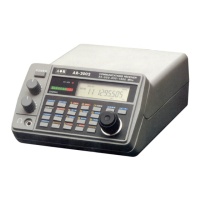

 To Next Page
 General