10
• Always wear suitable working clothes, protective gloves and goggles. Battery acid is corrosive! Immediately
and thoroughly wash o any splashed acid and consult a doctor if necessary. If battery acid gets into the
eyes, immediately rinse under running water for at least 10 minutes and consult a doctor.
• Do not cover the charger, this may lead to overheating and result in damages. Never set the charger up for
operation on a surface that is insulating (e.g. polystyrene). There is a risk of heat build up!
• If you wish to charge a vehicle battery in the installed state, rst park the vehicle safely, put on the parking
brake and switch o the ignition. Cut the battery o from the on-board network of your vehicle. To do this,
consult the manual for your vehicle, or ask your specialist workshop.
• This charger enables you to charge a battery without needing to disconnect it from the on-board network.
If you wish to make use of this option, make sure that your vehicle will not be damaged by this process. For
this purpose, read the manual of your vehicle or ask your specialist workshop.
• When pulling the mains cable out of the socket, only hold the plug.
• Never expose the charger to the vicinity of re, heat and extensive temperatures over +40°C.
• Store these instructions carefully and, if necessary, pass them on to other users.
6. Operating instructions
Before using the device make sure that you have read the operating instructions for the battery and the
vehicle and you have understood all of the safety precautions.
6.1 Overview
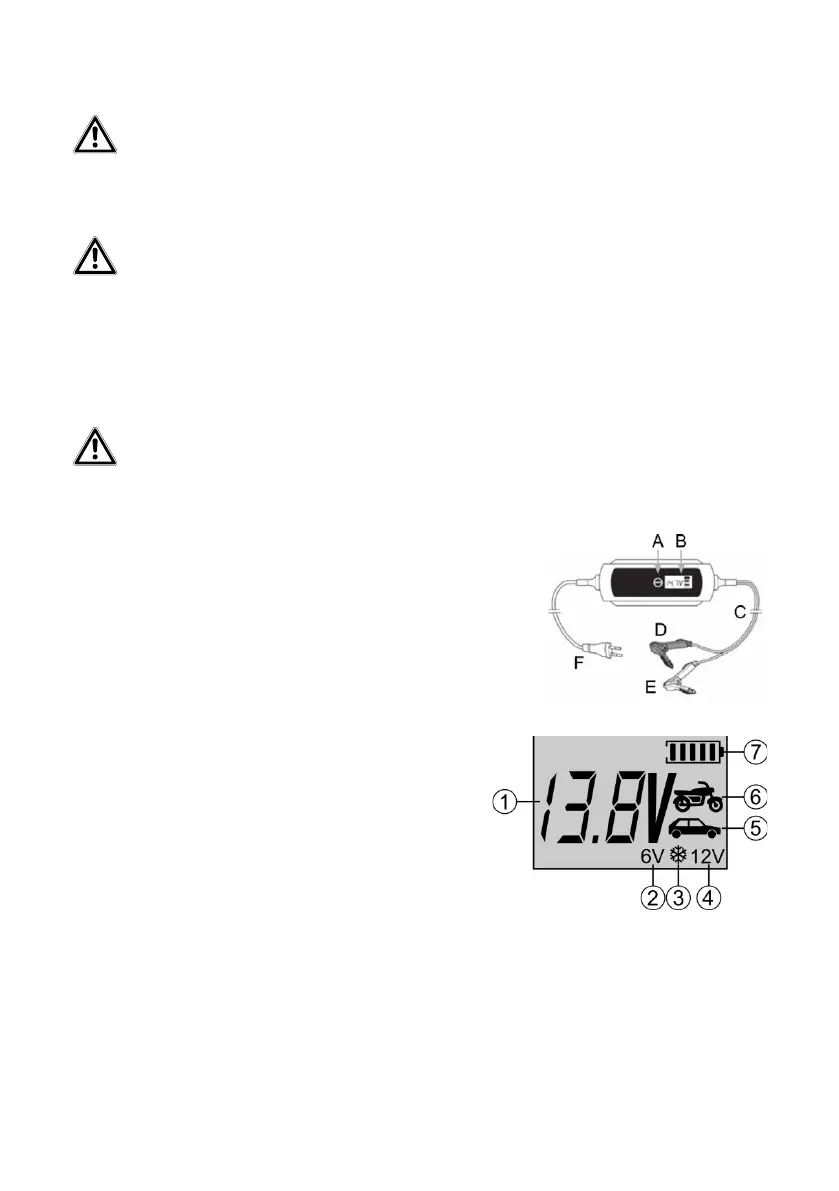
Figure 1: Overview
Figure 2: Display
6.2 Using the adapter charging cable
Element 1.pdf 1 25.01.19 10:55
Element 1.pdf 1 25.01.19 10:55
Element 1.pdf 1 25.01.19 10:55
1. Battery voltage display
2. 6 V charging programme
3. Winter charging programme
4. 12 V charging programme
5. Car charging programme
6. Motorbike charging programme
7. Battery charge status display
A Mains cable
B Mode button
C Display
D Charging cable
E Adapter harging cable with eyes
F Adapter charging cable with pole callipers
The adapter charging cable with pole callipers (Position F in the overview) is used if you wish to connect the charger
in the classic way to the poles of the battery. The adapter charging cable with eyes (Position E in the overview)
is designed to remain rmly attached to a battery which is dicult to access. The charger can be conveniently
connected using the adapter.



 To Next Page