Tires & Tubes
To safely operate your motorcycle, the tires must
be the proper type (off-road) and size, in good
condition with adequate tread, and correctly
inflated.
Using tires that are excessively worn or
improperly inflated can cause a crash in
which you can be seriously hurt or killed.
Follow all instructions in this owner’s
manual regarding tire inflation and
maintenance.
The following pages give detailed information
on how and when to check your air pressure,
how to inspect your tires for wear and damage,
and our recommendations on tire replacement.
Properly inflated tires provide the best
combination of handling, tread life, and riding
comfort. Generally, underinflated tires wear
unevenly, adversely affect handling, and are
more likely to fail from being overheated.
Underinflated tires can also cause wheel
damage on hard terrain. Overinflated tires make
your motorcycle ride harshly, are more prone to
damage from surface hazards, and wear
unevenly.
Make sure the valve stem caps are secure. If
necessary, install a new cap.
Always check air pressure when your tires are
“cold.” If you check air pressure when your tires
are “warm” — even if your motorcycle has only
been ridden for a few miles — the readings will
Service Procedures 26
be higher. If you let air out of warm tires to
match the recommended cold pressures, the tires
will be underinflated.
The correct “cold” tire pressures are:
22 psi (100 kPa, 1.0 kgf/cm
2
)
28 psi (100 kPa, 1.0 kgf/cm
2
)
If you decide to adjust tire pressures for a
particular riding condition, make changes a little
at a time.
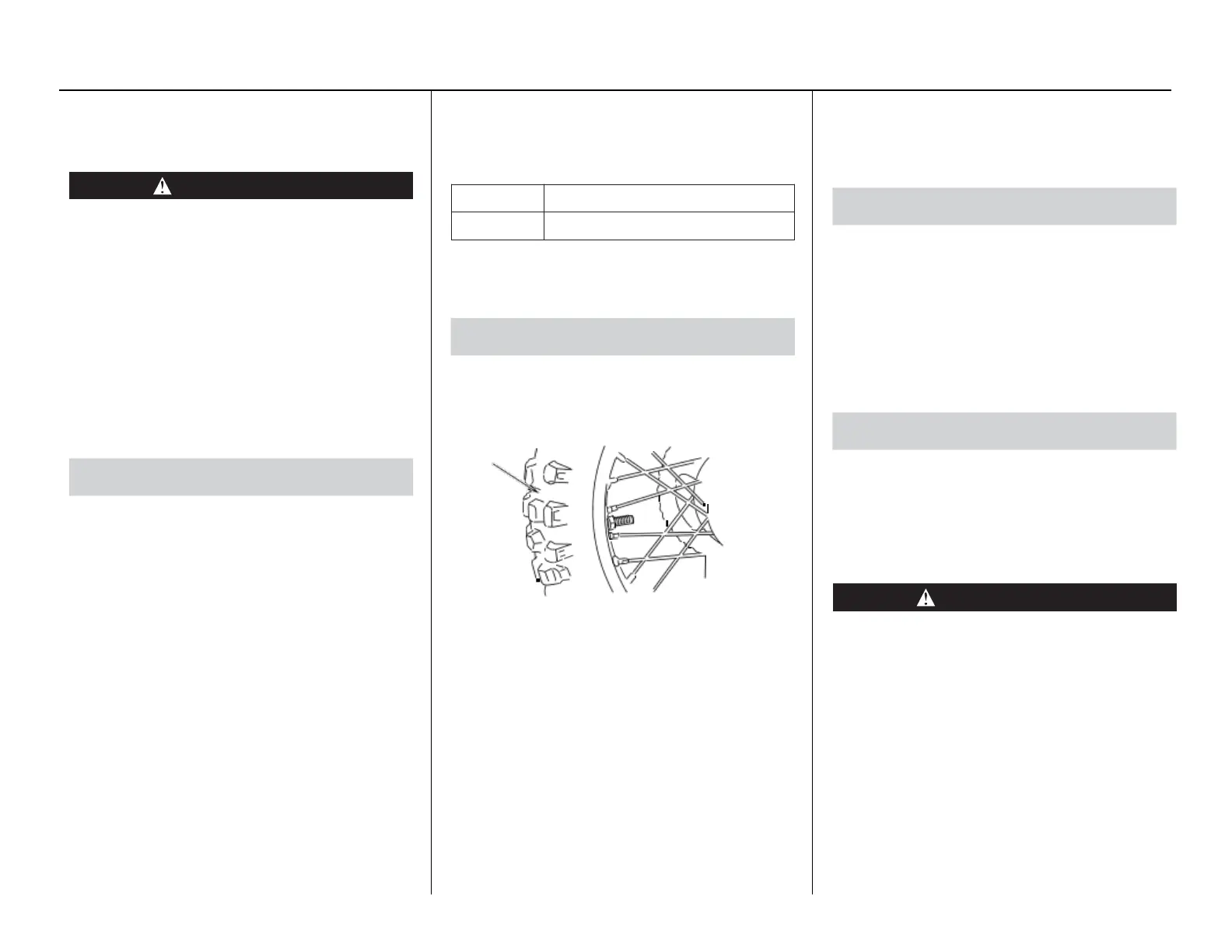
Take time to inspect your tires and wheels before
you ride.
(1)
I (
(1) tire tread depth
• Inspect carefully for bumps or bulges in
the side of the tire or the tread. Replace
any tire that has a bump or bulge.
• Look closely for cuts, slits, or cracks in
the tires. Replace a tire if you can see
fabric or cord.
• Check for rocks or other objects embedded
in the tire or tread. Remove any objects.
• Measure tread depth (1). Replace the tire
before depth at the center reaches 0. 12 in
(3 mm), or any time you notice a
reduction in traction.
• Check the position of both valve stems. A
tilted valve stem indicates the tube is
slipping inside the tire or the tire is slipping
on the rim.
If a tube is punctured or damaged, you
should replace it as soon as possible. A
repaired tube may not have the same
reliability as a new one, and it may fail while
you are riding.
Use a replacement tube equivalent to the
original.
The tires that came on your motorcycle were
designed to provide a good combination of
handling, braking, durability, and comfort
across a broad range of riding conditions.
Installing improper tires on your
motorcycle can affect handling and
stability. This can cause a crash in which
you can be seriously hurt or killed.
Always use the size and type of tires
recommended in this owner’s manual.
.
Use a replacement tire equivalent to the
original.
.
Replace the tube any time you replace a
tire. The old tube will probably be stretched
and, if installed in a new tire, could fail


 To Next Page