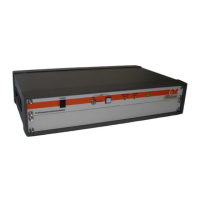
PL7004 Kit
Rev F 15
Axis Offset
The location of the center of each sensor element of three axis (X,Y,Z) field sensors is commonly not
at a single point in space. This fundamentally has to do with the physical constraints of mounting
more that one thing, a sensor and diode, in the same space plus other considerations related to a
specific probe design. However, the projections of the axis of each sensor do commonly intersect at a
single point. The axis offset is defined as the offset of the center of each sensor relative to the
intersection of the three projected element axes.
Sensor Pattern
Sensor pattern is the sensitivity of the sensor as the sensor is positioned at various angles in a known
field. The very short dipole sine shaped pattern is what permits the accurate combining of
measurements from individual sensors to create a composite value. The location of the center of a
dipole sensor is at the center of the dipole element. This is usually where the detector is located. To
check the field pattern of an individual sensor in a field that is not known to be homogeneous over the
test space, the rotation of an individual sensor should be about the center of the sensor.
Isotropy (Isotropic Deviation)
Isotropy (isotropic deviation) is the uniformity, or lack of uniformity, in the composite response of an
isotropic probe over varying angles of probe orientation to a (constant) field.
3.3.2 Guidelines for use of Field Probes.
3.3.2.1 Probe Support Structures
It is very important to keep conductive objects away from a field probe. Any such objects in the proximity of the
probe may distort the near field and compromise measurement accuracy. Always mount a probe on a non
conductive (non metallic) platform using only non conductive (non metallic) hardware, including screws.
3.3.2.2 Probe Location
Probe location is a critical factor in the effective, efficient use of a measurement system. This is particularly
true for the case of non-anechoic chambers, and in some anechoic chambers where the absorbers have limited
effect. Here, high and low field nodes due to reflections and/or standing waves make probe location
important. In such applications, it may be appropriate to dampen the room resonance via the application of
strategically placed absorbers.
3.3.2.3 Probe Location in TEM cells
When used in a TEM cell, the size of a probe should not be large in relation to the dimensions of the TEM
cell. Recommended maximum height for conductive portions of a probe is 1/3 of the TEM height- the
septum to parallel wall surface space in which the probe is located.
3.3.2.4 Multiple probes
In a test environment in which the field around a unit under test (UUT) is to be monitored in an environment
where large field gradients exist, the use of multiple probes can enhance the measurements. For example, two
probes (one on either side of the UUT) or four probes (surrounding the UUT) may be used to increase the
usefulness of the data.


 To Next Page