EasyManua.ls Logo

Arctic Cat Pantera 1978 - Magneto CDI Nippon Denso 150 W; High Voltage Output Test

Arctic Cat Pantera 1978
236 pages
Print Icon
To Next Page IconTo Next Page
To Previous Page IconTo Previous Page
Loading...
3.
Make
a
reference
mark
on the
PTO
cylinder
and
a
corresponding
mark
on
the
drive
clutch.
These
marks
will
be used to
check
the
ignition
timing.
4. Remove
the
dial
indicator
and install
the
spark
plug.
5.
Start
the
engine.
Check
the
timing
with
a
timing
light.
The
timing
marks
must
align
when
the
engine
is at 6000 rpm.
6.
To
change
the
timing,
remove
the
recoil
starter
and
the
starter
pulley;
then
loosen
the
two
hex key
cap
screws
securing
the
mag-
neto
baseplate
to the
magneto
housing.
7.
Rotate
the
baseplate
clockwise
to retard
the
timing
or
counterclockwise
to
advance
the
ignition
timing.
8.
Tighten
the
magneto
baseplate
mounting
screws
and
recheck
timing.
Fig. 8-31
0725-397
Magneto
CDI
Nippon
Denso
150W
Usage: Pantera FC
Panther
Cheetah
The
new
150
watt
Nippon
Denso
COl
ignition
is
used on all 1978 fan
cooled
engines.
With
the
increased
output
from
this
new
lighting
system,
customers
will
now
have
better
lights
at
slow
trail
143
riding
speeds,
plus
improved
battery
charging
capability
when
the
snowmobile
is
equipped
with
electric
start.
Fig. 8-32
.~.
.\?
0725-492
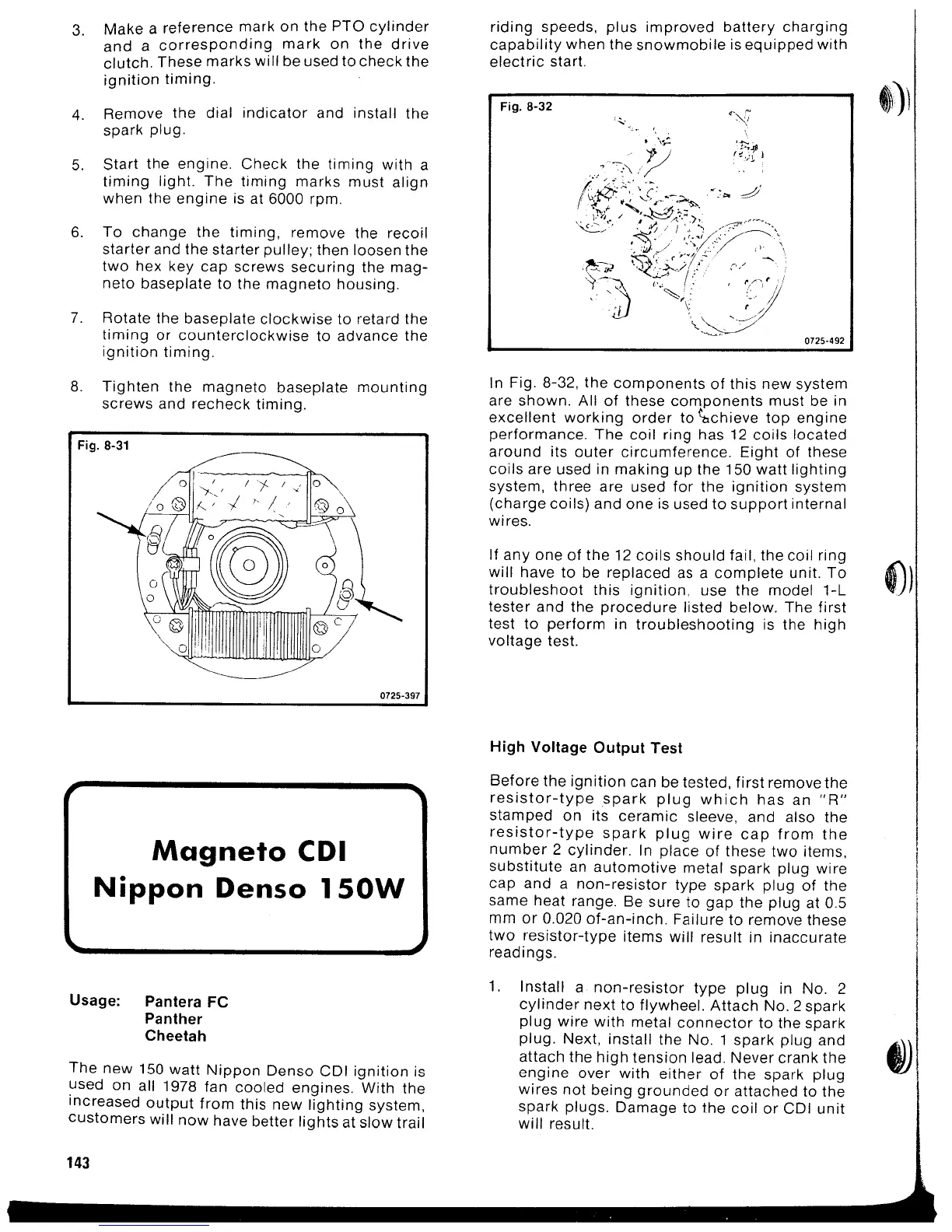
In Fig. 8-32,
the
components
of
this
new
system
are
shown.
All
of
these
components
must
be in
excellent
working
order
to tbchieve
top
engine
performance.
The
coil
ring
has 12
coils
located
around
its
outer
circumference.
Eight
of these
coils
are used in
making
up
the
150
watt
lighting
system,
three
are used
for
the
ignition
system
(charge
coils)
and
one
is used to
support
internal
wires.
If
anyone
of
the
12
coils
should
fail,
the
coil
ring
will
have to be
replaced
as a
complete
unit.
To
Af\)
troubleshoot
this
ignition,
use
the
model
1-L
'l)
tester
and
the
procedure
listed
below.
The
first
test
to
perform
in
troubleshooting
is the
high
voltage
test.
High Voltage Output Test
Before
the
ignition
can be tested,
first
remove
the
resistor-type
spark
plug
which
has
an
"R"
stamped
on its
ceramic
sleeve,
and
also
the
resistor-type
spark
plug
wire
cap
from
the
number
2
cylinder.
In
place
of
these
two
items,
substitute
an
automotive
metal
spark
plug
wire
cap
and
a
non-resistor
type
spark
plug
of
the
same
heat range. Be
sure
to
gap
the
plug
at 0.5
mm or 0.020
of-an-inch.
Failure
to
remove
these
two
resistor-type
items
will
result
in
inaccurate
readings.
1.
Install
a
non-resistor
type
plug
in No. 2
cylinder
next
to
flywheel.
Attach
NO.2
spark
plug
wire
with
metal
connector
to the
spark
plug.
Next,
install
the
NO.1
spark
plug
and
attach
the
high
tension
lead.
Never
crank
the
engine
over
with
either
of
the
spark
plug
wires
not
being
grounded
or
attached
to the
spark
plugs.
Damage
to
the
coil
or
COl
unit
will
result.

Table of Contents

Related product manuals