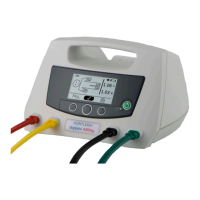
The Sonicaid Team3 FTS-3 Fetal Telemetry System is a wireless transducer system designed for continuous fetal heart rate (FHR), direct electrocardiography (DECG) maternal heart rate (MHR), automatic fetal movement (AFM), and uterine activity (TOCO) monitoring in pregnant women during the antepartum period, labor, and delivery. It is intended for use by trained and qualified personnel in antepartum examination rooms, labor, and delivery rooms, but not in intensive care units (ICU), operating rooms, or for home use.
Function Description:
The FTS-3 system consists of wireless US transducers (US-T transducers), wireless TOCO transducers (TOCO-T or TOCO-E transducers), and a base station. The wireless transducers monitor FHR and TOCO parameters up to 110 meters line of sight. The base station then transfers this data to a compatible fetal monitor via an interface cable. The monitor can display, alarm, print, or review the parameters. The wireless signal is transmitted in the Industrial Scientific Medical Band (ISM) according to local regulations, with transmission range varying depending on the environment (shorter in water than in air). The TOCO-E transducer can monitor DECG or MHR when connected with the respective cables; otherwise, it only monitors TOCO. The system is designed for continuous operation.
Important Technical Specifications:
Base Station:
- Power Supply: 100V-240V~, 50Hz/60Hz, 0.8A-0.3A
- Battery: Rechargeable Lithium-Ion Battery (14.8V, 5000mAh)
- Operating Time (Base Station Battery): ≥ 40 Hours
- Charging Time (Base Station Battery): ≤ 14 Hours
- Cycle Life (Base Station Battery): >300 times
- Weight: About 1.8 kg
- Size: 310mm x 235mm x 81mm
- Wireless Connection Indicator: Green light when transducer connects successfully.
- Channel Range: 1-14 (adjustable via rear panel buttons).
- EMC: CISPR11 Group 1 Class A.
- Operating Temperature: +5 °C ~ +40 °C (+41 °F ~ +104 °F)
- Storage Temperature: -20 °C ~ +55 °C (-4 °F ~ +131 °F)
- Relative Humidity: 15% to 93% (non-condensing)
- Pressure: 86 kPa to 106 kPa (operating), 70 kPa to 106 kPa (storage)
Transducers (US-T, TOCO-T, TOCO-E):
- Transducer Battery: 1600 mAh
- Charge Current (Standard): 700 mA
- Nominal Voltage: 3.7 V
- Charge Voltage (Standard): (4.2±0.1) V
- Operating Time (Transducer Battery): >17h (new battery in transducer), >12h (new battery in TOCO-E with DECG or MECG cable)
- Cycle Life (Transducer Battery): ≥ 500 times
- Weight: About 150 g
- Size: Ø81 mm x 35 mm
- Degree of Protection against Harmful Ingress of Water: IPX8 (continuous immersion in water 1.1m deep for 24 hours).
- Anti-electric Shock Type: Class I equipment with internal power supply (base station), Type BF (Ultrasound, External TOCO), Type CF (DECG), Type CF with defibrillation protection (MECG).
- Transmission Power (Wireless Transducer): < 1mW e.r.p
- Transmission Range (Without Obstacles): >110m (underwater monitoring with US-T and TOCO-T transducers, transducer ≤30cm from water surface and ≤8m from base station).
- Modem Mode: GFSK
- Transmission Rate: About 25kbps
- Transducer Antenna: FM antenna
Ultrasound (FHR):
- FHR Measurement Range: 50 bpm ~ 240 bpm
- Resolution: 1 bpm
- Accuracy: ±2 bpm
- Technique: Ultrasound Pulse Doppler with autocorrelation
- Pulse Repetition Rate: 2 KHz
- Pulse Duration: 92 µs
- Ultrasound Frequency: (1+10%) MHz
- Dielectric Strength: 4000 Vrms
- Mechanical Index (MI): 0.017 (PW1.0MHz)
- Thermal Index (TIS/TIB): TIS 0.0079, TIB 0.064 (PW1.0MHz)
TOCO:
- TOCO Range: 0~100
- Non-linear Error: ±10%
- Resolution: 1
- Baseline Drift due to Temperature Changes: 1 unit/min/°C (free air), 5 units/min/°C (underwater)
- Zero Mode: Automatic/Manual
- Dielectric Strength: 4000 Vrms
DECG:
- DFHR Measurement Range: 30bpm ~ 240bpm
- Resolution: 1bpm
- Accuracy: ±1bpm
- Input Impedance: > 10MΩ (Differential, DC50/60Hz), > 20MΩ (Common Mode)
- CMRR: > 110dB
- Skin Voltage Tolerance: ±500mV
- Fetal Input Voltage Current: 20µV-6mV
- Anti-electric Shock Type: Defibrillating-proof
MHR:
- MHR Measurement Range: 30 bpm ~ 240 bpm
- Input Signal Range: ±8 mV PP
- MHR Measuring Accuracy: ±2 bpm
- MHR Alarm Limits: 30 bpm ~ 240 bpm
Usage Features:
- Wireless Monitoring: Allows patient mobility during monitoring.
- Transducer Display: Shows signal strength, battery level, and working channel.
- Charging: Transducers charge automatically when placed in the docking slots of the base station. A full charge takes approximately 3.5 hours.
- Channel Adjustment: The base station's working channel can be adjusted (range 1-14) to avoid interference from other FTS-3 units in the same ward.
- Underwater Monitoring: Transducers are watertight (IPX8) for underwater use up to 1.1 meters for 24 hours. Less or no coupling gel is needed for US-T transducers in water. The base station is not waterproof.
- Artifacts: The manual describes common artifacts like doubling and halving of FHR, and erratic traces/dropouts, providing guidance for interpretation and transducer repositioning.
- Safety Precautions: Includes warnings against immersing the base station, using damaged transducers, and advises on proper battery handling and charging.
Maintenance Features:
- Visual Inspection: Regularly check the system and accessories for damage, especially cracks on transducers and cables.
- Routine Inspection: Overall check of the base station and accessories, including safety and function checks, should be performed by qualified personnel every 6 to 12 months and after service. Periodic safety testing for leakage currents and insulation is recommended annually.
- Mechanical Inspection: Ensure all exposed screws are tight and check external cables for damage.
- Cleaning and Disinfecting:
- Base Station: Unplug and detach accessories before cleaning. Clean exterior with a soft brush or cloth. The surface can be cleaned with hospital-grade ethanol, 75% ethanol, or 70% isopropanol.
- Transducers: Must be cleaned after each use before docking to remove residual coupling gel. Clean with a lint-free cloth moistened with mild near-neutral detergent, 75% ethanol solution, or 70% alcohol-based solution, then wipe with water and dry. Do not use abrasive cloths or cleaners.
- Leads: Wipe with a soft cloth dampened in recommended cleaning solution, then with water, and air-dry or wipe dry.
- Charging Points: Clean periodically with a dry soft cloth to ensure proper charging.
- Sterilization: Do not sterilize the base station or accessories unless required by hospital regulations.
- Battery Maintenance: Follow instructions for installation, storage, and charging. Charge and discharge wireless transducer batteries every 3 months. Store batteries at low humidity and temperature, charged to 50%. Replace batteries when operating time significantly shortens.
- Troubleshooting: Provides a guide for common issues like no power, no signal, interrupted recording, and charging problems, with suggested solutions.
- Service Returns: Products must be cleaned, suitably packaged, and include a decontamination certificate when returned for service.

 Need help?
 General

 To Next Page