506303-01 Page 3 of 40Issue 0938
INSTALLATION
These instructions must be placed on or near the
furnace in a conspicuous place.
The furnace design is certified by CSA International as a
Category IV furnace in compliance with the latest edition of
American National Standard Z21.47/CSA Standard 2.3 for
Gas-Fired Central Furnaces, for operation with natural gas
or propane. Consult the rating plate on the furnace for gas
type before installing.
The maximum hourly heat loss of space shall be calculated
in accordance with the procedure described in the current
manuals of Air Conditioning Contractors of America, or by
any other recognized method which is suitable for local
conditions, provided the results obtained are in substantial
agreement with, and not less than, those obtained using
the procedure described in the manuals.
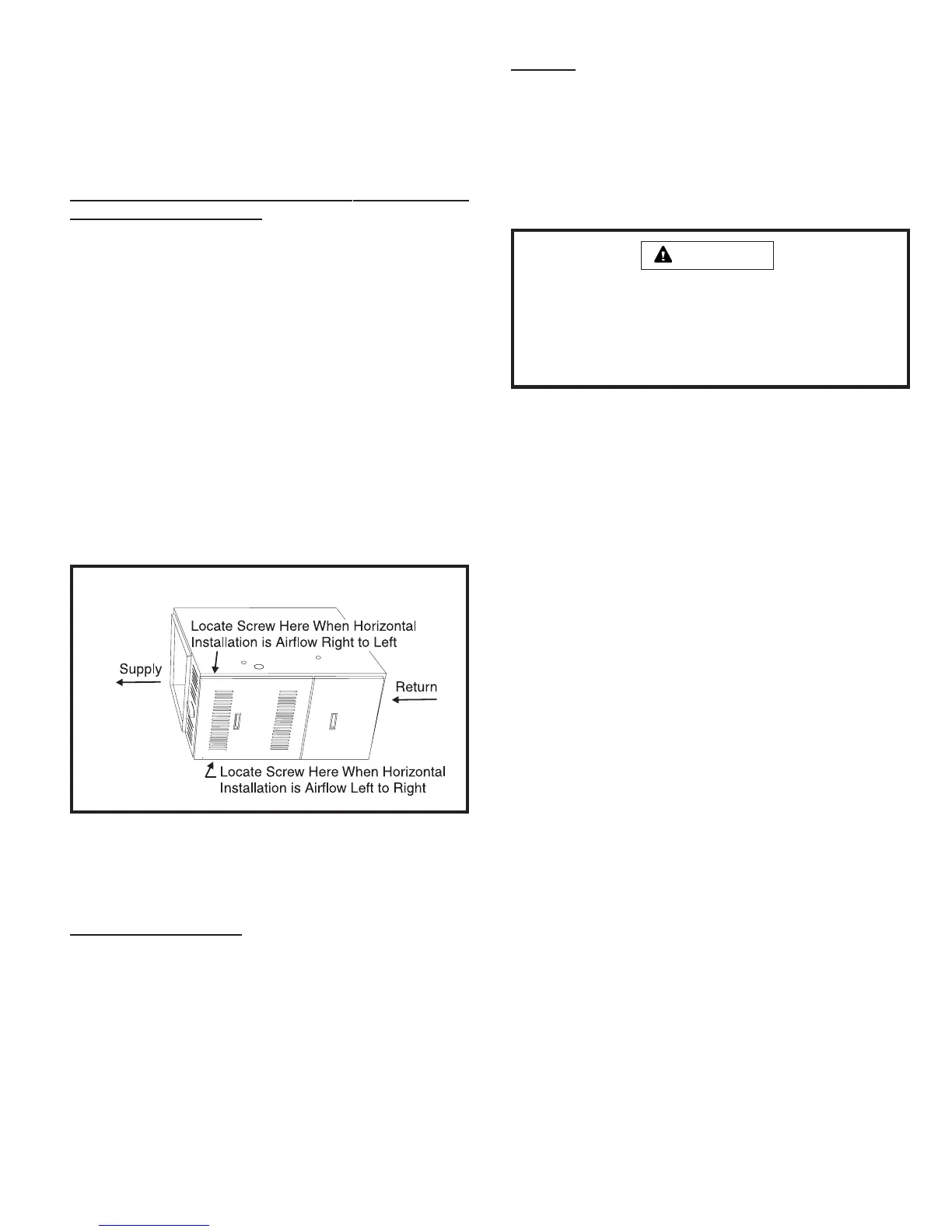
G2D93CT and G2D95CT furnaces may be installed as upflow
or horizontal right to left or left to right ariflow furnaces.
When installed horizontally, the installer must install a sheet
metal screw to retain the upper door as shown in Figure 1.
G2D93CU and G2D95CU furnaces must be installed only as
upflow furnaces.
Never install any furnace on its back.
Inspection of Shipment
This furnace is shipped in one package, completely
assembled and wired. The thermostat is shipped in a
separate carton when ordered.
Upon receipt of equipment, carefully inspect it for possible
shipping damage. If damage is found, it should be noted
on the carrier’s freight bill. Damage claims should be filed
with the carrier immediately. Claims of shortages should
be filed with the seller within 5 days.
Location
To provide proper operation and satisfactory performance,
care must be taken in choosing the location for this furnace.
The atmosphere in which the furnace operates must be free
of contaminants such as chlorides and sulfates.
The furnace must be installed so that electrical components
are protected from water. Unit must be level for proper
condensate drainage.
To avoid property damage caused by condensate drain
blockage, install a field-fabricated auxiliary drain pan with a
separate drain line to the outside under the entire furnace
and drain system. Install according to local codes.
All models are suitable for closet or utility room installation.
The furnace is suitable for installation in buildings
constructed on-site. The furnace should be centralized in
respect to the heat distribution system as much as
practicable. When installed in a utility room, the door
should be wide enough to allow the largest part of the
furnace to enter, or permit the replacement of another
appliance, such as a water heater.
A gas-fired furnace for installation in a residential garage must
be installed so the burner(s) and the ignition source are located
not less than 18" above the floor. The furnace is to be located
or protected to avoid physical damage by vehicles.
This furnace is not recommended to be used as a construction
heater during any phase of construction. Very low return air
temperatures, harmful vapors, and operation of the unit with
clogged or misplaced filters will damage the unit.
The furnace may be used for heating of buildings or
structures under construction, if the following conditions are
met:
• The vent system must be permanently installed per
these installation instructions.
• A room thermostat must control the furnace. The use
of fixed jumpers that will provide continuous heating is
not allowed.
The condensate system must not be exposed to
temperatures under 32°F. The condensate system must
be insulated if exposed to temperatures under 32°F. Use
of heat tape is permissible provided the rate temperature
of the tape does not exceed 155°F.
CAUTION
Horizontal Installations
Figure 1
Horizontal right
to left airflow
shown


 To Next Page
 Loading...