EasyManua.ls Logo

ARP 2600 - Page 105

ARP 2600
118 pages
Print Icon
To Next Page IconTo Next Page
To Previous Page IconTo Previous Page
Loading...
100
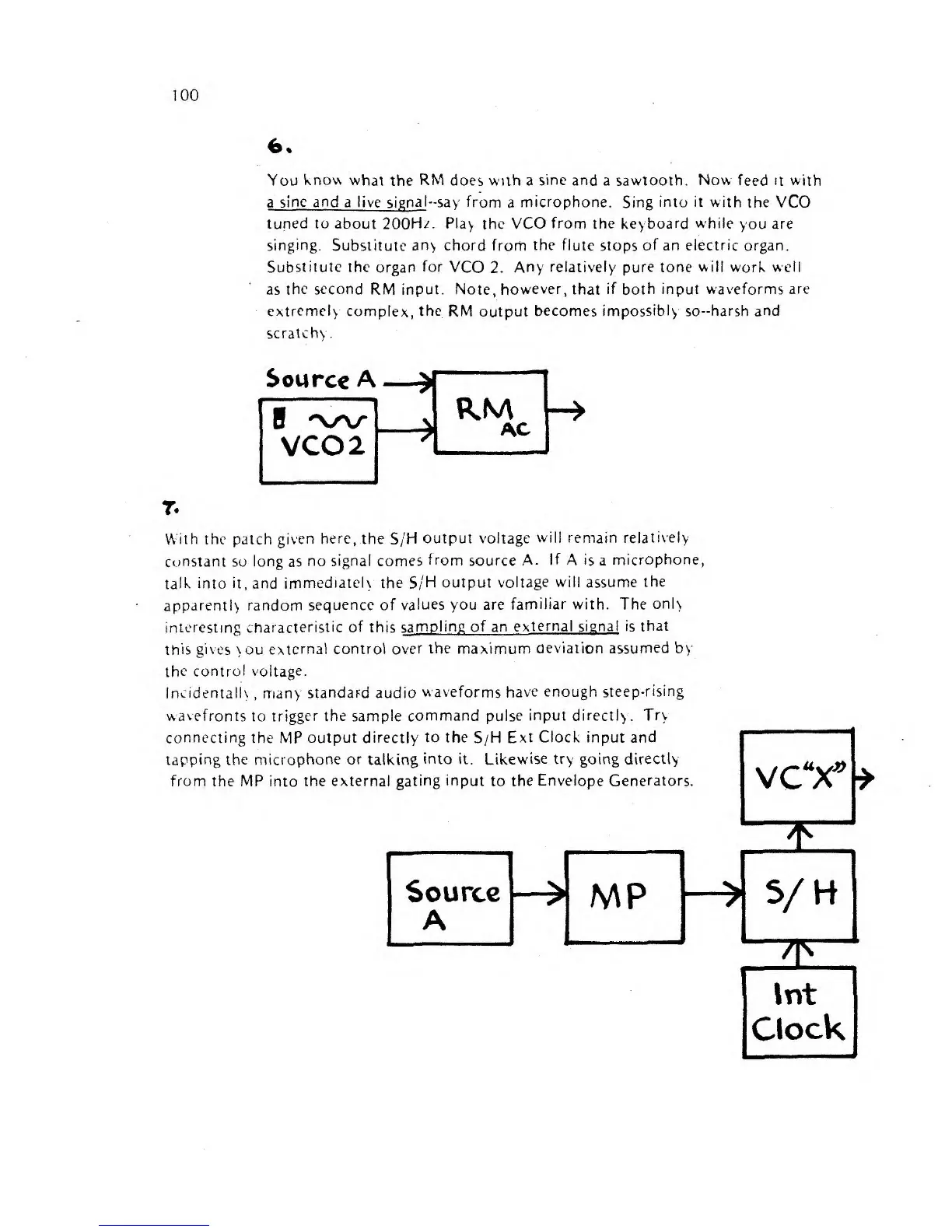
6.
You
know
what
the
RM
does with
a
sine
and
a sawtooth.
Now
feed it with
a
sine
and
a live signal
-say from
a
microphone.
Sing
into
it
with the
VCO
tuned
to
about
200Hz.
Play
the
VCO
from
the keyboard
while
you are
singing.
Substitute
an>
chord from
the
flute
stops
of
an electric
organ.
Substitute the
organ
for
VCO
2.
Any relatively pure tone
will
work
wel
as
the second
RM input. Note,
however,
that
if
both
input
waveforms
are
extremely
complex,
the
RM
output
becomes
impossibly
so--harsh
and
scratchy.
Source A
With
the patch given
here,
the S/H
output voltage
will
remain
relatively
constant
so
long
as
no
signal
comes
from
source A.
If
A
is a
microphone,
talk into
it,
and
immediately
the S/H
output
voltage
will
assume
the
apparently random
sequence of
values
you
are
familiar
with.
The
onl\
interesting characteristic
of
this
sampling
of an
external signal
is
that
this gives
\
ou external
control over
the
maximum
deviation assumed
by
the control voltage.
Incidentally
,
many
standard
audio
waveforms
have
enough steep-rising
wavefronts
to
trigger the sample
command pulse
input directly. Try
connecting the
MP
output directly
to
the
S/H Ext
Clock
input
and
tapping the microphone
or
talking
into
it. Likewise
try
going directly
from the MP into
the external gating input
to
the
Envelope Generators.

Other manuals for ARP 2600

Related product manuals