65
Note that, with the
VCA initial gain at
minimum,
a
low-fre-
quency
square
wave fed to the
control input simply
functions
as
a
kind
of
gate
;
when
the square-wave voltage goes to
+
10V,
the
amplifier
is
driven
upto
its
maximum output, and
when
the voltage
returns
to zero
the
amplifier
is effectively shut off.
Attenuating
this
input voltage
lowers the output
level of the
amplifier.
With
this in mind,
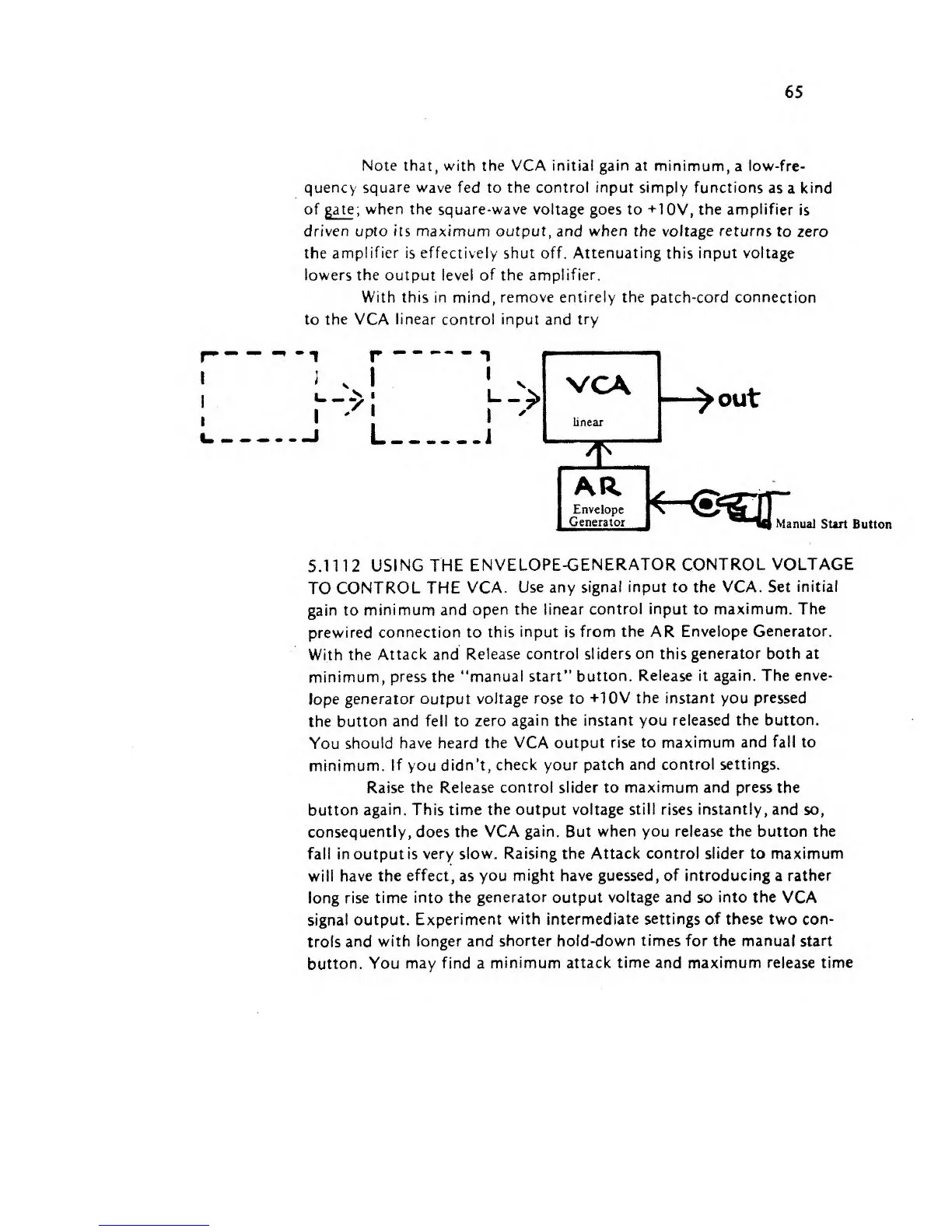
remove entirely the
patch-cord
connection
to the
VCA linear
control
input and
try
-i
r
I
J.I
;
r
Manual
Start
Button
5.1112 USING THE
ENVELOPE-GENERATOR
CONTROL VOLTAGE
TO
CONTROL THE
VCA.
Use any signal
input to the VCA. Set
initial
gain to
minimum and
open
the
linear
control input to maximum.
The
prewired
connection to
this
input
is
from
the
AR
Envelope Generator.
With
the
Attack
and
Release control
sliders
on
this
generator
both at
minimum,
press the
"manual start" button.
Release it again. The
enve-
lope
generator
output
voltage rose
to
+10V
the
instant you
pressed
the
button
and fell to
zero again
the
instant
you released
the
button.
You
should have heard
the VCA
output rise to maximum
and fall to
minimum.
If
you
didn't,
check your patch
and control settings.
Raise the Release control slider
to
maximum and press
the
button
again. This time the
output voltage still rises instantly,
and so,
consequently, does the VCA
gain.
But
when
you
release the
button the
fall in output is very
slow.
Raising
the
Attack control slider
to maximum
4
will
have the effect, as
you might have guessed,
of
introducing
a
rather
long rise
time into the
generator
output voltage and
so
into
the VCA
signal
output.
Experiment with intermediate settings of these two con-
trols
and with longer and
shorter hold-down times for the manual start
button.
You
may find
a
minimum attack time
and
maximum release time


 To Next Page