13
0/s^tuTeP.£
P
p-tuTF
P^ED
L»wpa'>1.
Pu X%&»
**sae~
H^rtPA
4
^
2CHi-
PATTERN
RECOGNITION,
and
has
for many years
been the subject
of intense research
by
computer-program designers.
But the best
they
have
done
so
far
falls
considerably
short
of
what
your
ears
and brain
do
all
the time.
2.1812 In
very
simple cases, frequencies may be
removed
from
a
waveform
by FILTERING
(see
2.182
following),
but
a filter circuit
is a perfect
idiot: it knows
nothing of what
the
frequencies it
is
blocking
or boosting mean,
and
can do
nothing
to
separate two
sounds
of the same pitch.
The
scratch
filter
in
a
stereo
amplifier
cuts
out some
of the
noise
from
a
dirty
or scratched record; but h
also
removes
any
musical sound that fails in
the
same
frequency range as
the scratches.
On
a good
pair
of
speakers this
is
quite audible as
a loss
of sparkle and
airiness in the recording— a
slight muffling of
the
sound.
2.1 81
3 So
one way
of
making more complicated
waveforms out
of
simple
ones is by
MIXING simple
ones together. This
is
also
sometimes
called
additive synthesis. The
drawbars
of
a
Hammond work
by
addi-
tive synthesis.
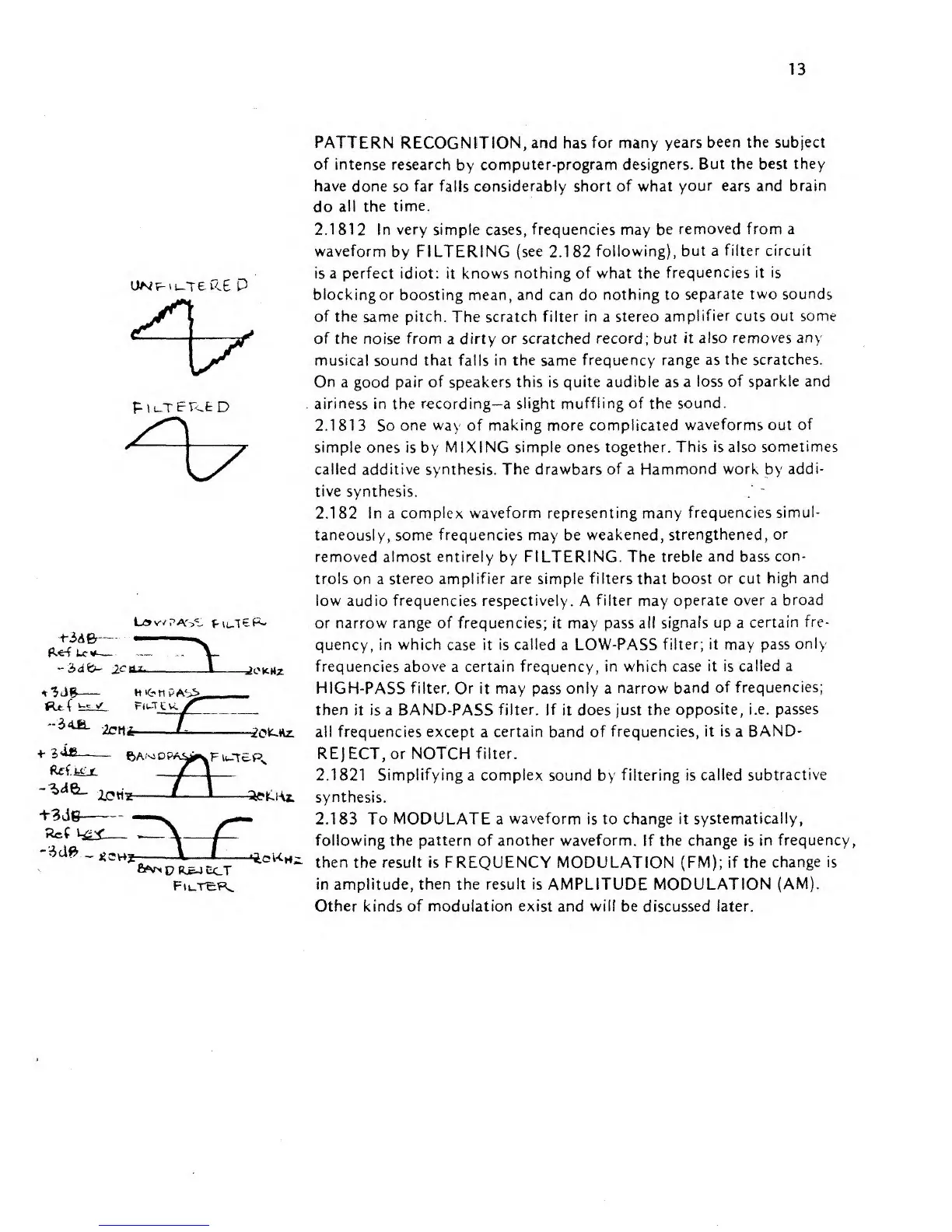
2.182
In
a complex
waveform
representing many frequencies
simul-
taneously, some frequencies may be
weakened,
strengthened,
or
removed almost entirely
by
FILTERING. The treble
and
bass
con-
trols
on a
stereo amplifier are simple filters that boost
or cut
high and
low audio frequencies
respectively.
A
filter
may
operate over a
broad
or narrow
range of frequencies;
it may
pass all
signals up a
certain
fre-
quency, in which case it
is called
a
LOW-PASS
filter; it
may
pass
only
frequencies above a certain frequency, in which
case it
is
called
a
HIGH-PASS filter.
Or
it may
pass only a
narrow
band
of frequencies;
then
it
is a
BAND-PASS
filter.
If
it
does just the
opposite,
i.e.
passes
ie^Hz.
all frequencies except
a
certain
band
of frequencies, it
is
a
B AND-
JOKHz
fte€
QANSDP
+3J8
F
u~rtep
N
ScC
^X.
*'**M*—4S*#3£
REJECT,
or NOTCH filter.
2.1821 Simplifying
a
complex
sound by
filtering is called
subtractive
v
^fr^Hx.
synthesis.
2.183 To MODULATE
a
waveform
is
to change it systematically,
following
the
pattern of another waveform. If the change is in
frequency,
l0Kt#z
then
the result is FREQUENCY MODULATION (FM); if the
change
is
in amplitude, then
the
result is
AMPLITUDE
MODULATION
(AM).
Other kinds of modulation exist and
will
be
discussed
later.


 To Next Page