23
"OPcN/"'
3.1 1
1 THERE ARE EIGHTY-ONE
mini-jacks
on the front
panel.
FORTY-FIVE
are
unequivocally
INPUTS and
TWENTY-NINE
are
un-
equivocally
OUTPUTS.
-
45
29
74
The
remaining seven jacks belong to the
ELECTRONIC SWITCH
and
the MULTIPLE
OUTLET. Because the switch
works
in
either
direc-
tion, it has either
two inputs and
one output or
one
input and two out-
puts
depending
on
which direction you're thinking
of;
the
MULTIPLE
OUTPUT distributes one input
to
1
,
2,
or 3 outputs.
3.112
OF
THE 45 UNEQUIVOCAL INPUTS,
32
are
ali
in a
row run-
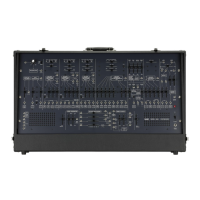
ning across the center of the panel. (There are 34 jacks
in
the
row;
the
two labelled "gate"
and "trig"
are outputs.)
This
row
of
inputs divides
the
control surface almost evenly in
half.
ABOVE THIS
ROW, in the
upper half
of
the control surface,
THERE ARE
ONLY
FOUR:
INPUT
JACKS. One
of them
is the
input
to the
microphone
preamp
in the
extreme upper left corner.
The
other
three
are
at
the upper right
corner, labelled
LEFT INPUT,
PAN,
and
RIGHT
INPUT respectively.
ALL OF THE
OTHER
JACKS
IN
THE
UPPER
HALF OF
THE CON-
TROL
SURFACE ARE
OUTPUTS.
In the lower half of
the
control
surface, the
ja^-.-
numbered 1
through
7 are inputs
to
the
voltage pro-
cessor,
and
of
the column of
four jacks
in the section labelled "sample
and hold", the
upper and
lower
jacks are inputs.
3.113 Ali
the
remaining jacks are
outputs.
Most of them are labelled
as
such; a few are not but
have arrows
pointing
to
them,
e.g.
in the
voltage
processor, the three
jacks
furthest to the
right are
outputs; and
in the envelope generator section of
the
upper half of the panel, the
two
jacks
labelled
gate and trigger are outputs.
3.114 THERE
ARE
FIFTY-SEVEN SLIDER CONTROLS.
3.1141 THIRTY-FIVE
OF
THESE are ATTENUATORS. And of
the
35 attenuators, 26
are
in a row justabove the
row
of jacks.
(There are
28
slider controls
in
the row;
the two
on
either side
of the
box
labelled
ATTACK RELEASE
are
not attenuators.)
3.11411 An
ATTENUATOR is
the
OPPOSITE of
an
AMPLIFIER.
And
much simpler too.
An
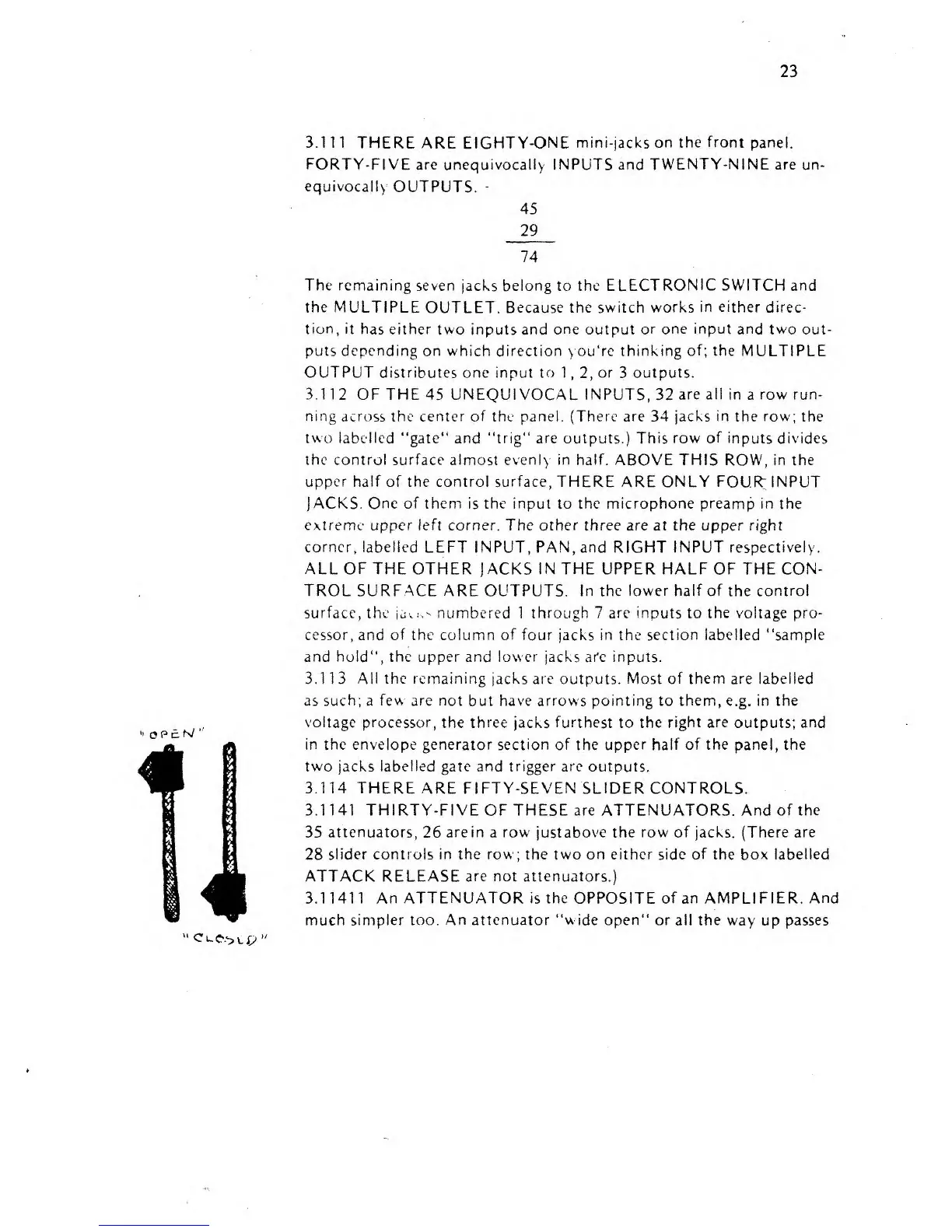
attenuator "wide open" or all the
way up
passes
"CLe^tp*'


 To Next Page