59
U 0OMTHO4.
1)
Instead of leaving the input frequency
constant
and
sweeping the filter frequency,
leave the filter
frequency
constant
and sweep the input frequency.
2)
Depressingjhe
lowest key on
the keyboard, tune
the fil-
ter
at fairly
high resonance
to some
upper
harmonic of
an
input
waveform. Play a
tune
on the keyboard
and note
that,
as
long
as
the filter
is
fed with a keyboard
control
voltage,
it
will
follow the
harmonic you've
tuned
it to.
Now
disconnect
it from the
keyboard voltage
by insert-
ing
a
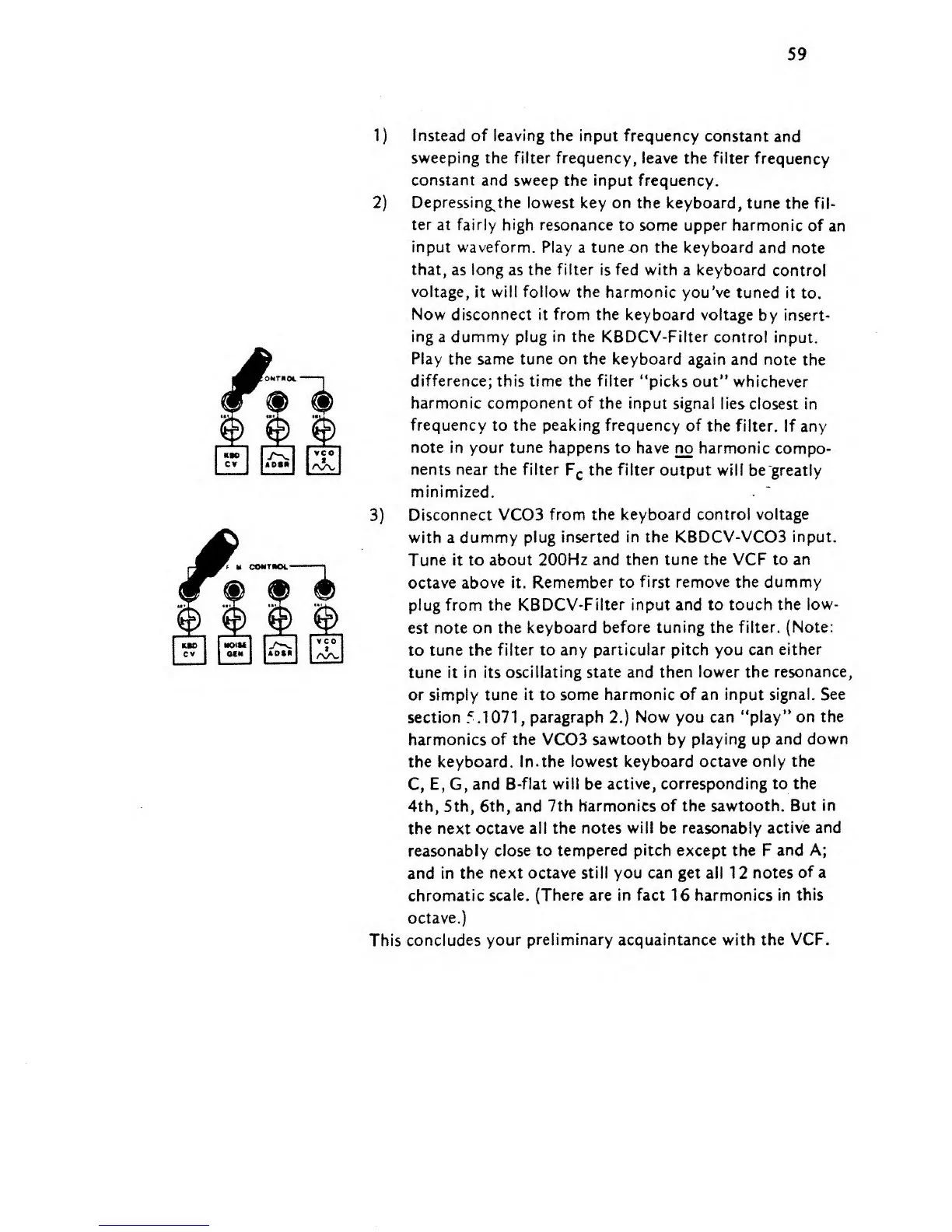
dummy plug in the KBDCV-Filter
control
input.
Play
the same
tune on the keyboard
again and note
the
difference;
this
time the filter
"picks out"
whichever
harmonic component of the input
signal lies
closest
in
frequency
to the peaking frequency of
the filter.
If any
note
in your tune happens
to
have
no harmonic
compo-
nents
near the
filter
F
c
the filter
output
will be "greatly
minimized.
3)
Disconnect VC03
from the keyboard control
voltage
with
a
dummy
plug inserted in
the
KBDCV-VC03 input.
Tune it
to
about
200Hz and then
tune
the VCF to an
octave above it. Remember to
first
remove the dummy
plug
from the KBDCV-Filter
input and to touch the
low-
est
note on the
keyboard before tuning the
filter. (Note:
to
tune the
filter
to
any particular pitch you can
either
tune it
in its oscillating state and
then lower the
resonance,
or
simply tune
it
to
some harmonic of an input signal. See
section
5.1071,
paragraph
2.)
Now you
can "play" on
the
harmonics
of
the VC03 sawtooth by
playing
up
and
down
the keyboard. In. the lowest
keyboard octave only
the
C,
E,
G,
and
B-flat will be active, corresponding
to the
4th, 5th,
6th, and 7th harmonics
of
the
sawtooth. But
in
the
next octave all the notes
will
be reasonably
active
and
reasonably
close to
tempered pitch
except the F
and A;
and in
the next octave still you can get
all
1 2 notes
of
a
chromatic
scale. (There are in fact
16
harmonics
in
this
octave.)
This
concludes
your
preliminary
acquaintance with the
VCF.


 To Next Page