EasyManua.ls Logo

ARP 2600 - Page 74

ARP 2600
118 pages
Print Icon
To Next Page IconTo Next Page
To Previous Page IconTo Previous Page
Loading...
69
(That's
a
complete description
of the patch.
There are briefer
ways of describing
something like this, which
will become more
and
more
useful
to
you
as
you
accumulate more
and
more mental
bag-
gage in
your work
with the 2600. Here's one
way. "Pink noise
is
passed through
a
low-pass filter of
F
c
440and
4.
F
c
is
modu-
lated
by
a sine wave
at 6
Hz
to a
depth of—
1/12
octave(s),
or
a
factor
of
(x
times F
c
)."
It's
all there,
as
you'll
find
by
reading
it
carefully. Only
a
few things
need to
be
commented on.
1)
"Q"
is
an
abbreviation
for
resonance. It can
be given a numerical
value
but you
needn't
do
that;
just
"low-Q", "medium-Q",
and
"hi-Q"
will
probably
do
for
a
long time.
2)
"depth"
refers
to
the
maxi-
mum
deviation (from
an
initial setting) caused by
the control vol-
tage.
It's
a convenient term
for by-passing the
need for
talking about
the
strength of
the control
voltage itself,
or
even referring to
it
at
all.
In
referring
to
the "depth" of
modulation, you
are
talking only
of
the
effects
of
a
control
voltage.)
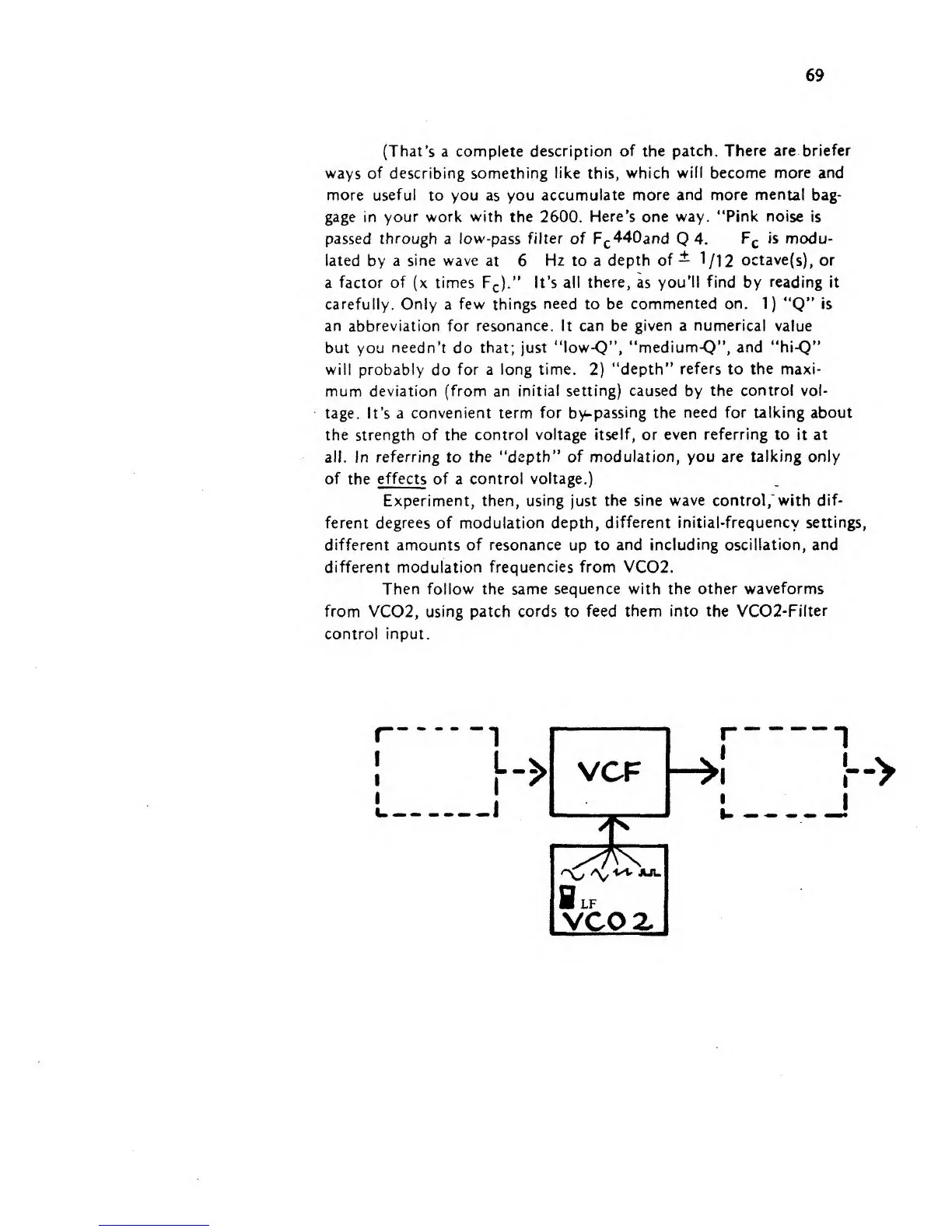
Experiment,
then,
using just the sine
wave
control,~with
dif-
ferent
degrees
of modulation
depth, different
initial-frequency
settings,
different amounts
of resonance
up
to and
including
oscillation, and
different modulation
frequencies from
VC02.
Then follow
the same
sequence with
the
other
waveforms
from VC02, using patch
cords
to
feed them into the VC02-Fiiter
control
input.
r
!
I
I
1
I
~>

Other manuals for ARP 2600

Related product manuals