EasyManua.ls Logo

ARP 2600 - Page 9

ARP 2600
118 pages
Print Icon
To Next Page IconTo Next Page
To Previous Page IconTo Previous Page
Loading...
3
fcuninc
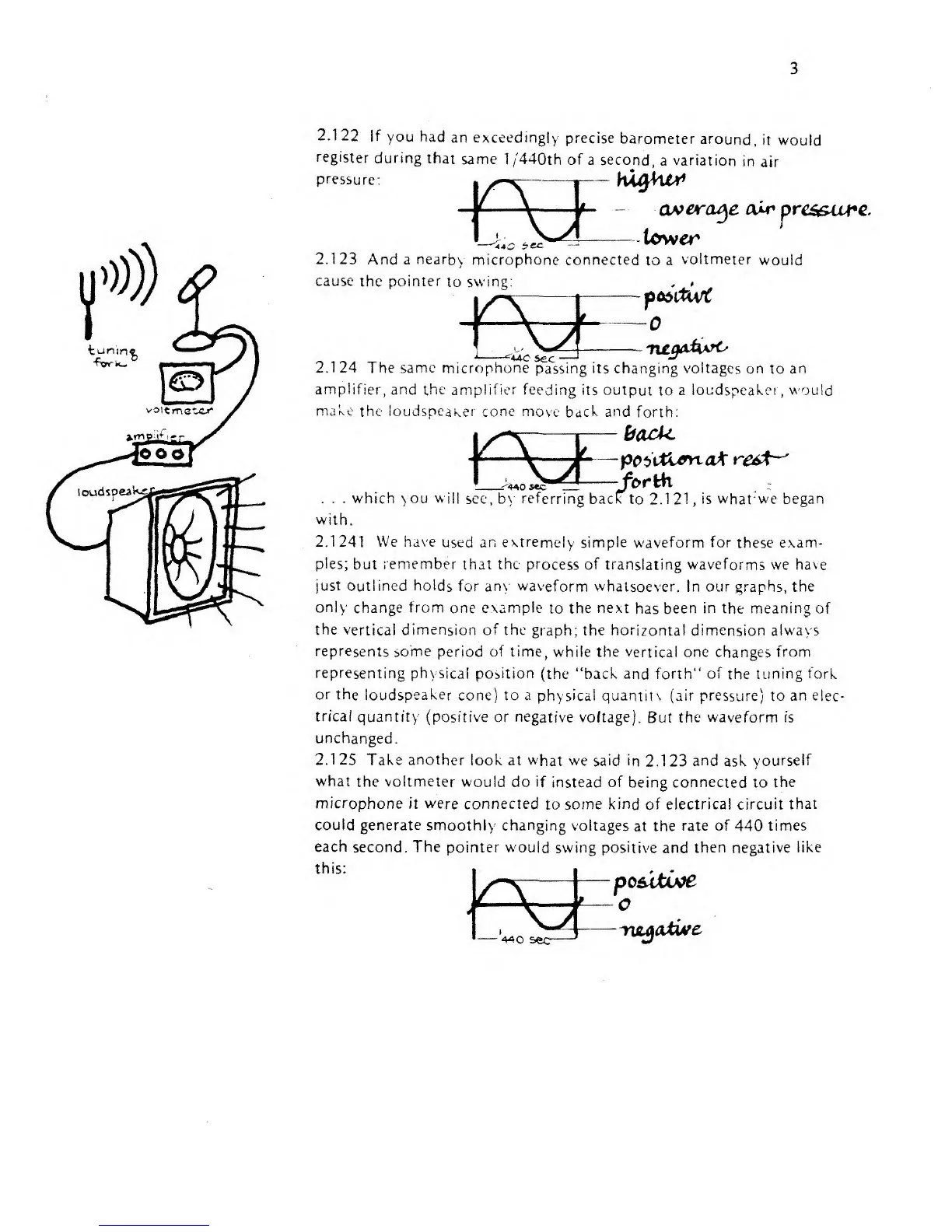
2.122 if
you had
an exceedingly
precise
barometer
around,
it
would
register
during that
same
1
/440th
of
a second,
a
variation
in
air
pressure:
fc
^-^
1
kXtyHttf
UaO
5CC
average air
pressure
tower
2.123
And
a nearby
microphone
connected
to
a
voltmeter
would
cause
the
pointer
to swing:
ptotfwc
titgaM^o
2.124
The
same microphone
passing
its changing voltages on
to an
amplifier,
and
the
amplifier
feeding its output
to a
loudspeaker,
would
make
the loudspeaker cone
move back
and
forth:
back.
440 S*C
brkh
to 2.1
21
, is what'we began
. . .
which
you will
see, by
referring
bac
with.
2.1241
We have
used
an extremely
simple waveform for
these
exam-
ples;
but
remember
that the
process
of
translating waveforms we have
just
outlined holds
for
any
waveform
whatsoever. In our graphs, the
only
change
from
one example
to
the next
has
been
in
the meaning of
the
vertical
dimension of the
graph; the horizontal
dimension
always
represents some
period of
time,
while the
vertical
one
changes
from
representing
physical position
(the
"back
and
forth" of
the
tuning fork
or the
loudspeaker
cone)
to
a physical
quantin (air pressure) to
an
elec-
trical
quantity
(positive or
negative
voltage).
But the waveform
is
unchanged.
2.125
Take another look at
what
we
said
in 2.123
and
ask
yourself
what
the voltmeter
would do if
instead
of
being
connected to
the
microphone it were
connected
to some kind
of
electrical circuit
that
could generate
smoothly changing voltages
at the
rate of 440 times
each
second.
The
pointer
would
swing
positive and
then
negative
like
this:
i
positive
440
sec
TVtgatwe

Other manuals for ARP 2600

Related product manuals