En
SAFE EMBEDDING:
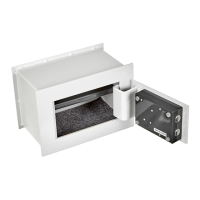
Proper and correct installation of the safe to be embedded is
essential for the security of the product.
• Before embedding, the safe’s correct functioning must be
checked by carrying out door opening and closing tests (see
the set of operating instructions).
• The safe must be installed with the door opening from left
to right (except for left-sided opening models). It must
never be installed turned around, or be placed on the oor.
The guarantee cover is invalid if these conditions are not
complied with.
• The safe must be installed maintaining a 2-cm gap towards
the inside of the wall in which it is being installed..
1. It is advisable to position the safe in places where access
with large size tools such as picks, hammers, cudgels and
spikes etc., but where access to the door is easy for the
user.
2. Choose a Wall at least 10 cm thicker than the depth of
the safe. Avoid walls with condensation or moisture
problems in order to prevent damage to the locking system
mechanisms.
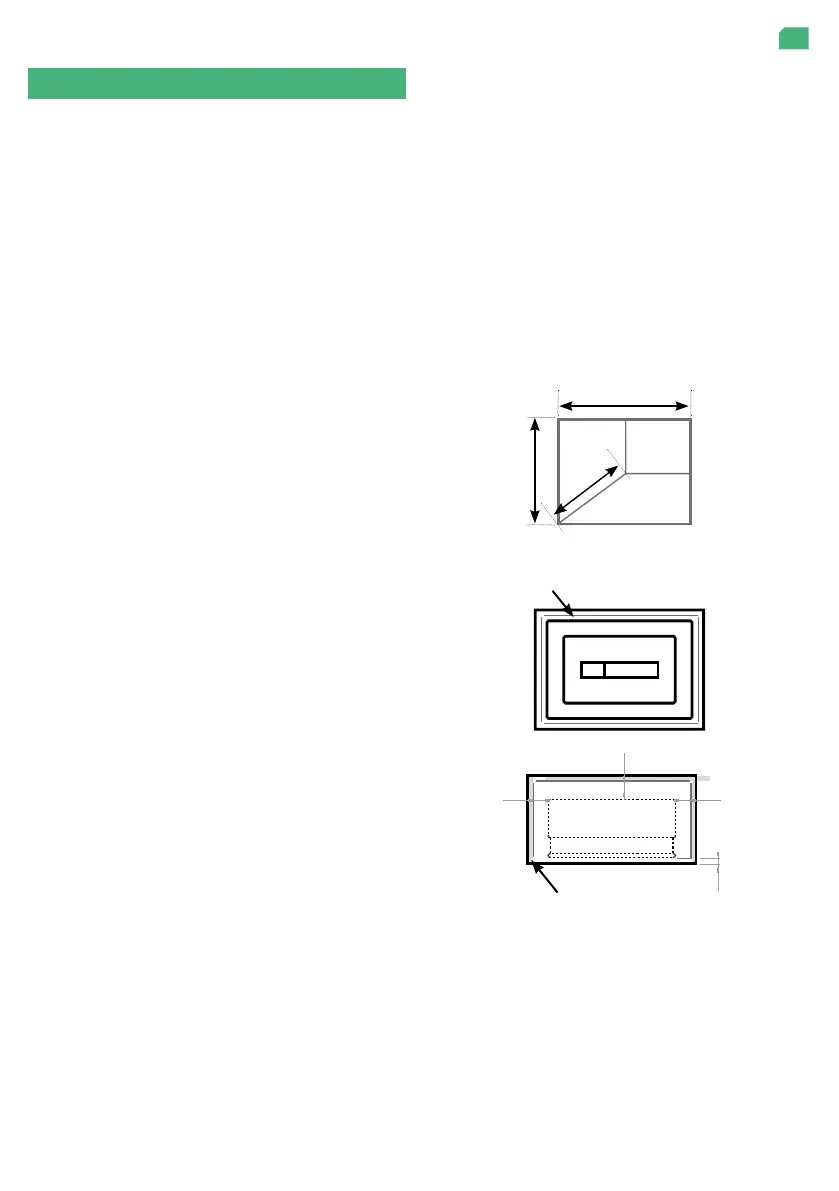
3. Drill a bore hole on the chosen Wall of 15cm greater in
width and height than the acquired safe’s dimensions, and
to a depth 7cm greater than the depth of the safe.
4. Provide suitable protection to the safe door area using
plastic sheeting to avoid moisture and mortar damage to
the locking system areas.
5. A lath with a grid size of 50 x 50 mm should be placed
around the four side faces and the rear face using diameter
8 rods. There should be a 3-cm gap to the walls.
6. Produce a wooden panel in the form of shuttering to cover
the front part, leaving a useful space for the application of
the mortar required to ll the gap left.
SAFE RIM LOCKS:
1. Drill holes for the expansion bolts (or fastening screws) in
the appropriate location.
2. Use the expansion bolts (or fastening screws) to secure the
safe to the wall or oor.
3. Ensure the safe is mounted in the desired location and
tighten all bolts or screws.
Security Warning:
• Use the expansion bolt when the wall surface is concrete.
• Use the fastening screw when the wall surface is wood.
7. Fill up the embedding area with high-resistance cement
composed of type CEM II A-LL 42.5R according to BS
(British Standards) UNE EN 197-1, using sand and water,
carefully lling and compacting the mortar evenly over the
area without leaving unlled areas. The use of quick-try
cement is advised.
8. Once the applied mortar has set and hardened, leave the
door open for 5 days to get rid of residual moisture from
the casing. Finish off the wall with a coat of plaster or other
coverings. Take special care to avoid contamination with
any residual element or dirt, etc., during casing procedures,
mortar lling, plastering, painting or the application of
other types of nal nishes by ensuring these do not get
into door surround areas, in key holes, keypads or other
elements and locking systems (keypads, external battery
connections...)
9. INSTALLING THE SAFE
Attention: Safes, whether they are desktop or wall safes, should
be installed such that the door is vertical and opens to the right,
except for specic models whose door opens to the left.
L+10 cm
Mesh- Diameter 8
Grid 50x50mm.
Mortar type
50
50
50
20
H+10 cm
P+5 cm


 To Next Page