OPERATION
TROUBLE SHOOTINGS
GENERAL POWER TOOL SAFETY WARNINGS
65
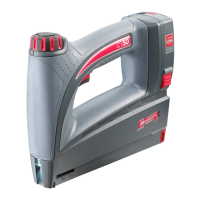
Press the Power Switch (2) to the “ON” position.
Hold the unit with a firm grip on the Handle (4) and place in the
desired location on the work surface
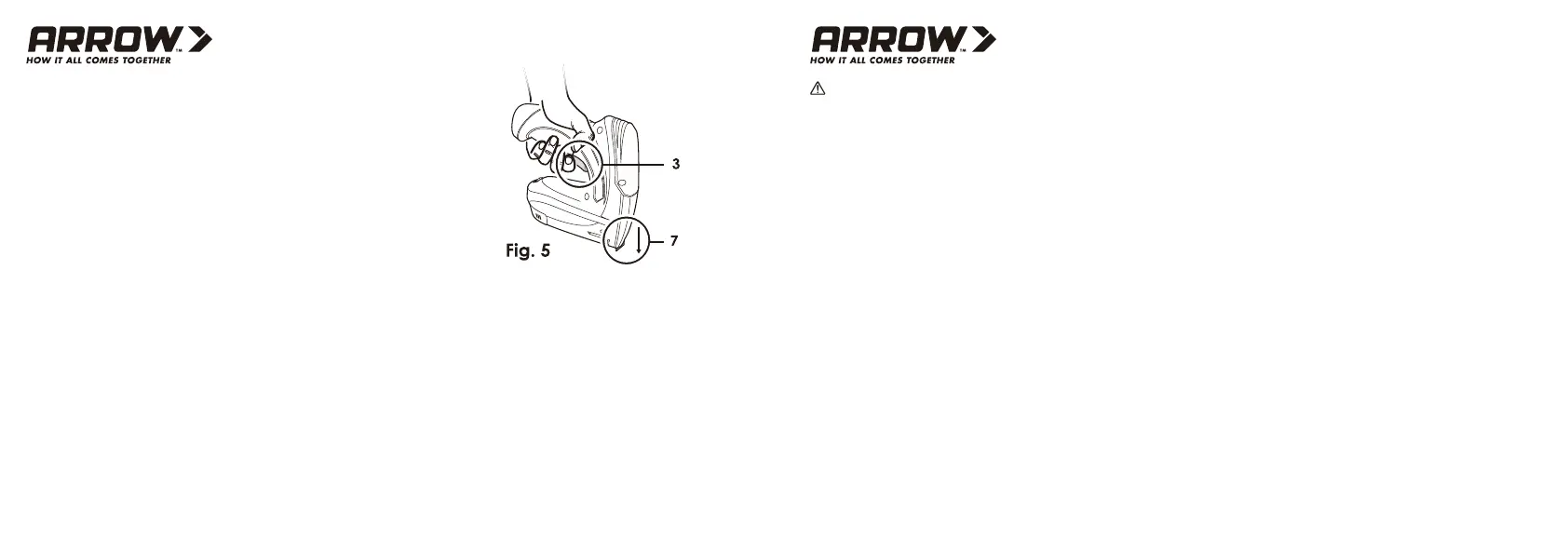
Firmly press down so that the Tacker Head (7) is depressed against
the work surface.
Squeeze the Trigger (3) to deliver a staple into work surface. (Fig.5)
Once a staple has been delivered, release the trigger, lift the tool off
the work surface and press the Power Switch to the “OFF” position
NOTE: The unit will not operate unless both the Tacker Head and
the Trigger are pressed at the same time. This is a safety feature.
Problem
No Power Or
Tool Not Firing
Cleaning Jams
Solution
• Make sure the battery is charged.
• Make sure the trigger & the tacker head
are being pressed at the same time.
• Check for staple jams.
• Remove jams by putting the unit in the
“OFF” position, opening the magazine
and clearing any obstructed staples.
Work area safety
Read all safety warnings and all instructions. Failure to follow the
warnings and instructions may result in electric shock, fire and/ or
serious injury.
Save all warnings and instructions for future reference.
WARNING:
• Keep work area clean and well lit. Cluttered or dark areas invite
accidents.
• Do not operate power tools in explosive atmospheres, such as in
the presence of flammable liquids, gases or dust. Power tools
create sparks which may ignite the dust or fumes.
• Keep children and bystanders away while operating a power tool.
Distractions can cause you to lose control.
Electrical safety
• Power tool plugs must match the outlet. Never modify the plug in
any way. Do not use any adapter plugs with earthed (grounded)
power tools. Unmodified plugs and matching outlets will reduce
risk of electric shock.
• Avoid body contact with earthed or grounded surfaces such as
pipes, radiators, ranges and refrigerators. There is an increased
risk of electric shock if your body is earthed or grounded.
• Do not expose power tools to rain or wet conditions. Water
entering a power tool will increase the risk of electric shock.
• Do not abuse the cord. Never use the cord for carrying, pulling or
unplugging the power tool. Keep cord away from heat, oil, sharp
edges or moving parts. Damaged or entangled cords increase the
risk of electric shock.
• When operating a power tool outdoors, use an extension cord
suitable for outdoor use. Use of a cord suitable for outdoor use
reduces the risk of electric shock.
• If operating a power tool in a damp location is unavoidable, use a
residual current device (RCD) protected supply. Use of an RCD
reduces the risk of electric shock.
NOTE The term "residual current device (RCD)" may be replaced
by the term "ground fault circuit interrupter (GFCI)" or "earth
leakage circuit breaker (ELCB)".



 To Next Page