© 2021 United States Stove Company
7
ANY KIND. Only Listed Factory-Built Residential
Type and Building Heating Appliance Chimneys
or masonry chimneys constructed to N.F.P.A.
standards should pass through a oor or ceiling.
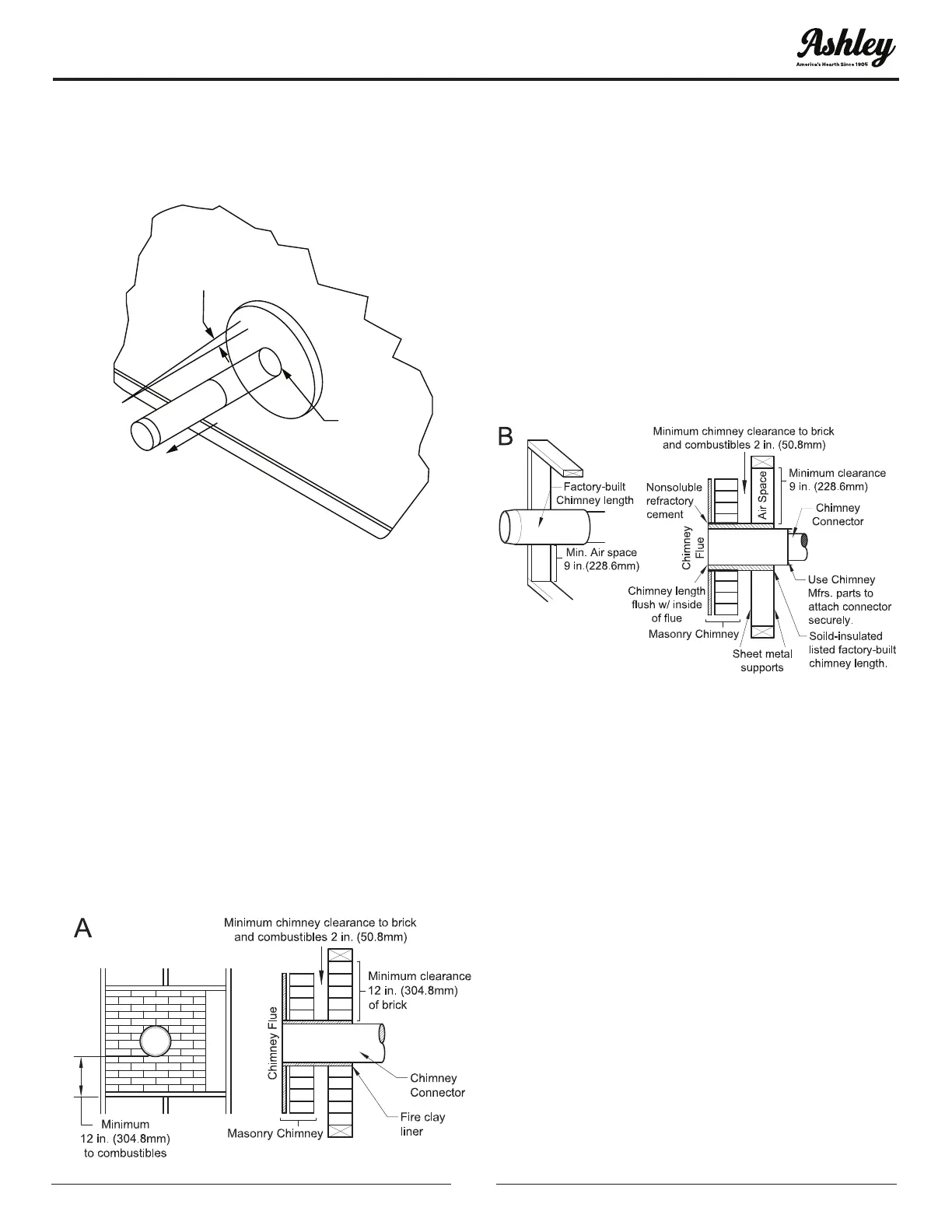
PIPE ANGLE UP
HORIZONTAL
RISE OF HORIZONTAL
CHIMNEY CONNECTOR PIPE
TO CHIMNEY
RISE: 1/4” FOR EACH FOOT
OF CONNECTOR LENGTH
There are ve allowable ways that a chimney
connector can be connected to a masonry chimney
by passing through a combustible wall. NFPA
Standard 211 allows the following wall pass-through
systems.
1. Use a minimum 3-1/2” thick brick masonry wall
framed into the combustible wall. A reclay liner
(ASTM C315 or equivalent) having a 5/8” minimum
wall thickness must be used and it must be at
least 12” away from any material that could catch
re. The inside diameter of the reclay liner shall
be sized for the proper snug t of a 6” diameter
chimney connector pipe. The reclay liner shall
run from the outer surface of the brick wall to,
but not beyond, the inner surface of the chimney
ue and shall be rmly cemented in place.
2. Use a solid insulated listed factory-built chimney
(UL 103 HT) length having an inside diameter of
6” and having 1” or more of solid insulation. There
must be at least a 9” air space between the outer
wall of the chimney length and any combustible
materials. The inner end of the chimney length
shall be ush with the inside of the masonry
chimney ue shall be sealed to the ue and to
the brick masonry penetration with non water-
soluble refractory cement. Sheet steel supports
which are at least 24 gauge(0.024”) in thickness
shall be securely fastened to wall surfaces on
all sides. Fasteners between supports and the
chimney length shall not penetrate the chimney
liner.
3. Use a 10” diameter ventilated thimble made
of at least 24 gauge(0.024”) steel having two
1” air channels. The ventilated thimble must
be separated from combustible materials by
a minimum of 6” glass ber insulation. The
opening in the combustible wall shall be covered
and the thimble supported with sheet steel
supports which are at least 24 gauge (0.024”)
in thickness. The sheet steel supports shall be
securely fastened to wall surfaces on all sides and
shall be sized to t and hold the chimney section.
Fasteners used to secure chimney sections shall
not penetrate chimney ue liner.
INSTALLATION


 To Next Page