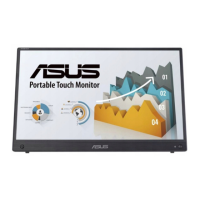
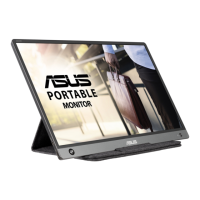
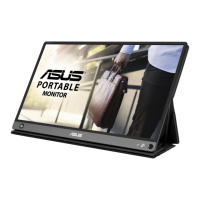
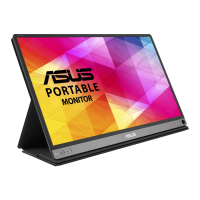
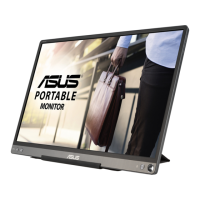
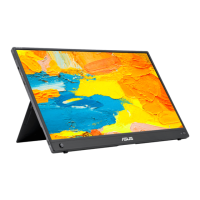
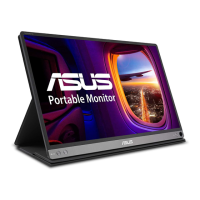
This document serves as a user guide for the ASUS MB16AHG Portable USB Monitor, providing essential information for its setup, operation, and maintenance.
Function Description
The ASUS MB16AHG is a portable USB monitor designed to enhance productivity and viewing experience. It functions as an external display that can be connected to a system via USB Type-C or Mini-HDMI. The monitor supports various display modes and features to optimize visual output for different tasks, including document editing, photo viewing, movie watching, and gaming. It incorporates ASUS's SPLENDID™ Video Intelligence Technology, which offers eight sub-functions to cater to user preferences. Additionally, it includes ASUS EYE CARE Monitors technologies, such as Blue Light Filter and Flicker-free, to promote eye health during prolonged use. The monitor is powered via a USB port, complying with LPS and SELV circuit standards.
Usage Features
The MB16AHG offers a range of features to enhance its usability:
- Connectivity: The monitor can be connected to a system using a USB Type-C cable or a Mini-HDMI to HDMI cable. It also supports USB Type-C to A adapters and cables for broader compatibility. For HDMI connections, an inbox adapter is required to power the monitor. If the input power is insufficient for full brightness, the user is prompted to plug in the adapter.
- Power Button/Power LED: A dedicated button allows users to turn the monitor on/off. The Power LED indicates the monitor's status: blue for power on, dark for off, and orange for standby mode.
- 5-Way Key: This intuitive control allows users to navigate the On-Screen Display (OSD) menu. It functions to turn on the menu, enact selected OSD items, increase/decrease values, and move selections up/down/left/right.
- Earphone Jack Port: An earphone jack is provided for audio output.
- OSD (On-Screen Display) Menu: The OSD menu is the primary interface for configuring monitor settings.
- Navigation: Pressing the central 5-way button displays the OSD menu. The Up and Down keys switch options, with the selected option highlighted. The Right key or central button selects a highlighted item. The Up or Down keys adjust parameters within a slide bar. The Left key returns to the previous menu.
- Splendid Function: This feature offers eight preset modes: Standard, sRGB, Scenery, Theater, Game, Night View, Reading, and Darkroom. Each mode is optimized for specific content types, leveraging SPLENDID™ Video Intelligence Technology. For instance, Standard Mode is best for document editing, sRGB for photos and graphics, Scenery for landscapes, Theater for movies, Game for gaming, Night View for dark scenes, Reading for text, and Darkroom for low ambient light. Note that certain functions like Saturation, SkinTone, Sharpness, ASCR, and Color Temp may not be user-configurable in some Splendid modes.
- Blue Light Filter: This function allows users to adjust the level of blue light emitted from the LED backlight, ranging from "Min" (no changes) to "Max" (highest reduction). Activating the blue light filter automatically imports default settings from Standard Mode. The maximum level is optimized and complies with TUV low blue light certification. While the brightness is user-configurable in most cases, it is not when the blue light filter is at its maximum level.
- Color Settings: Users can adjust Brightness, Contrast, Saturation (all from 0 to 100), Color Temp (Cool, Normal, Warm, and User Mode), and Skin Tone (Reddish, Natural, and Yellowish). In User Mode, individual R, G, and B color values can be configured from 0 to 100.
- Image Settings: This section allows adjustments for Sharpness (0-100), Trace Free (response time from 0-100), Aspect Control (Full, 4:3 – with 4:3 only available for 4:3 input sources), VividPixel (0-100, for enhanced visuals), ASCR (ON/OFF for dynamic contrast ratio), and FreeSync Premium (dynamically adjusts refresh rate for smoother display).
- Input Select: Users can manually select the input source from HDMI, Type-C 1, or Type-C 2.
- System Setup: This menu provides various system configurations.
- Splendid Demo Mode: Activates a demonstration mode for the Splendid function.
- Auto Rotation: Enables or disables automatic image rotation. This feature functions only under Windows OS with DisplayWidget Lite software installed.
- Volume: Adjusts the earphone output volume.
- GamePlus: Offers a toolkit for gamers, including Crosshair (Practice Mode), Timer, FPS Counter, and Display Alignment. These functions can be activated and navigated using the 5-way key.
- QuickFit: Provides grid patterns (Alignment Grid 1, Alignment Grid 2) and photo sizes (4x6, 3x5) to assist designers and photographers with content organization and accurate viewing. Alignment grid 1 automatically rotates if auto-rotation is enabled.
- ECO Mode: Activates power-saving mode.
- OSD Setup: Configures OSD Timeout, DDC/CI, and Transparency.
- Language: Selects the OSD language from a wide range of options including English, French, German, Spanish, Italian, Dutch, Russian, Polish, Czech, Croatian, Hungarian, Romanian, Portuguese, Turkish, Simplified Chinese, Traditional Chinese, Japanese, Korean, Persian, Thai, Indonesian, and Ukrainian.
- Key Lock: Disables all key functions. Pressing the button for more than five seconds disables the key lock.
- Power Key Lock: Disables/enables the power key.
- Information: Displays monitor information.
- Power Indicator: Turns the power LED indicator on/off.
- All Reset: Reverts all settings to factory default.
- Shortcut: Allows users to assign frequently used functions (Blue Light Filter, Splendid, Brightness, Contrast, Auto Rotation, Input Select, Volume, GamePlus) to a shortcut key for quick access.
- MyFavorite: Enables users to load and save all monitor settings.
- DisplayWidget Lite Software: This software, downloadable from the MB16AHG official website, provides an alternative interface for configuring monitor settings. It is recommended to connect the MB16AHG to the input device first, then turn on DisplayWidget Lite. Creating a desktop shortcut for easier activation is also suggested.
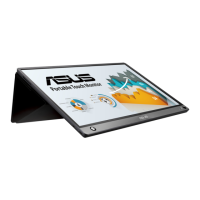
- Adjusting the Monitor: The monitor can be adjusted to an angle between 35° and 70° for optimal viewing.
Maintenance Features
Proper care and cleaning are essential for the longevity and performance of the ASUS MB16AHG monitor:
- Cleaning:
- Always turn off and unplug the monitor before cleaning.
- Use a lint-free, non-abrasive cloth to clean the monitor surface.
- For stubborn stains, a cloth dampened with a mild cleaner can be used.
- Avoid cleaners containing alcohol or acetone.
- Use cleaners specifically intended for LCDs.
- Never spray cleaner directly onto the screen, as it may drip inside and cause electrical shock.
- General Care:
- Read all documentation carefully before setup.
- To prevent fire or shock hazards, do not expose the monitor to rain or moisture.
- Never attempt to open the monitor cabinet.
- Ensure all cables are correctly connected and undamaged before use. Contact the dealer immediately if any damage is detected.
- Avoid dust, humidity, and extreme temperatures. Do not place the monitor in wet areas.
- Place the monitor on a stable surface.
- Never push objects or spill liquids into the monitor's slots.
- If technical problems arise, contact a qualified service technician or retailer.
- Power Adapter Usage:
- Use only the bundled power adapter and USB cable to charge the monitor. Using different adapters or cables may cause damage.
- For best performance, use the power adapter with the MB16AHG.
- The adapter may become warm during use; do not cover it or keep it close to your body when connected to a power source.
- If the device becomes unusually hot, disconnect the USB cable and send the device, including the power adapter and USB cable, to an ASUS qualified service personnel.
- Eye Care:
- Take regular breaks (at least 5 minutes after 1 hour of continuous work) from the display to alleviate eye strain.
- Periodically rest eyes by focusing on distant objects to minimize strain and dryness.
- Perform eye exercises (looking up/down, rolling eyes, moving eyes diagonally) regularly. Consult a physician if eye strain persists.
- The Blue Light Filter helps reduce harmful high-energy blue light, which can contribute to eye strain and AMD (Age-Related Macular Degeneration).
- Troubleshooting (FAQ): The manual provides solutions for common issues such as the power LED not turning on, no screen image, screen image being too light/dark, screen image bouncing or showing a wave pattern, and color defects. It also addresses issues related to insufficient power supply from USB Type-C source devices, guiding users through a "safe mode" procedure to adjust brightness and determine the power limit.
- Takeback Services: ASUS offers recycling and takeback programs for products, batteries, and packaging materials. Users can find detailed information on the ASUS website.
- Warranty: Product warranty or service will not be extended if the product is repaired, modified, or altered without written authorization from ASUS, or if the serial number is defaced or missing.

 Need help?
 General

 To Next Page