Need help?
Do you have a question about the ATAGO PAL-3 and is the answer not in the manual?
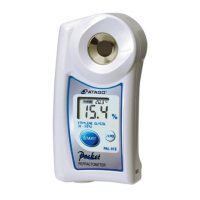
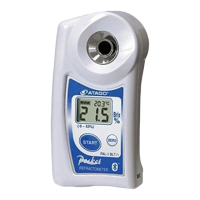
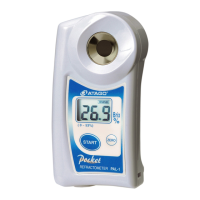
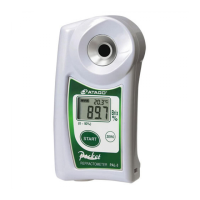
Apply water and samples on the glass prism located in the center.
Shows measurement results, prism temperature, and remaining battery charge.
Press to take measurements; hold down to turn off the display.
Place and remove batteries from here.
For attaching a lanyard.
Ensure safety when handling hazardous materials; use protective equipment.
Do not drop, modify, or disassemble the instrument; avoid strong physical shock.
Avoid direct sunlight, heat, dust, rapid temperature changes, and strong vibration.
The instrument is water-resistant, not waterproof, and should not be submerged.
Body case is resin; avoid water vapor and solvents that may compromise integrity.
Zero-set the instrument with water on the prism at the beginning of each day.
Apply sample, press START, and read displayed measurement and prism temperature.
The instrument turns itself off after 2 minutes of inactivity.
Stir the sample on the prism while measuring to improve repeatability.
Indicates that the battery power is low.
Occurs when ZERO button is pressed with non-water on the prism.
Occurs when START button is pressed with no/insufficient sample.
The sample measured is outside the instrument's measurement range.
Too much light entering prism; shade the sample stage with your hand.
Prism temperature is below or above the operational temperature range.
The instrument may be faulty; replace batteries or contact ATAGO.
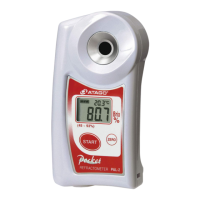
The ATAGO PAL-3 is a digital hand-held "Pocket" Refractometer designed to measure Brix, which represents the weight of sucrose in 100 grams of sucrose solution as a percentage by weight. While primarily used for sucrose, Brix conversion can also be applied when other dissolved solids are present in a solution, as it measures the total dissolved solids and indicates the combined concentration of all soluble substances like sugar, salt, protein, and acids.
The PAL-3 features automatic temperature compensation, correcting readings based on the prism's temperature within its specified range. This ensures accurate measurements even with varying sample temperatures. The device displays measurement results, prism temperature, and remaining battery charge on its LCD screen. It includes a START button to initiate measurements and a ZERO button for zero-setting. The START button also doubles as a power button when held down. For data management, the START and ZERO buttons can be pressed together to set the date and time or delete data history. The device is equipped with NFC Forum Type 4 Tag and ISO/IEC 14443 Type A output capabilities, allowing for data transfer, including date, time, Brix percentage, and temperature. The warranty period can be extended from one year to two years by registering customer information, and the ATAGO Logger NFC app can be downloaded simultaneously.
To use the PAL-3, first wipe the prism clean and apply approximately 0.3mL of tap water to the sample stage. Press the START button, and after "---" appears, the measurement and prism temperature will be displayed. For zero-setting, if the measurement is not 0.0%, press the ZERO button while water is on the prism. Zero-setting is complete when "000" blinks twice and then stops. After zero-setting, wipe the prism clean with tissue paper. For sample measurement, apply approximately 0.3mL of the sample to the prism and press the START button. The measurement and prism temperature will then be displayed.
It is crucial to allow hot or cold samples to acclimate to the instrument's temperature for about 20 seconds before pressing the START button, or press the START button multiple times until measurements stabilize. When measuring hot samples, apply only the necessary amount to prevent overflow from the sample stage well. If hot water is needed to clean hardened samples, use water-soaked gauze around the prism area, keeping hot water away from the body case. The displayed temperature is that of the prism and may not necessarily match the sample's temperature. For oily or fatty samples, stirring the sample on the prism during measurement can improve repeatability. The instrument has an auto shut-off feature, turning itself off after 2 minutes of inactivity. To manually turn it off, hold down the START button for more than 2 seconds.
The device provides error messages to alert the user to various issues. "Lo" indicates a low battery. "AAA" means the ZERO button was pressed with nothing or something other than water on the prism. "LLL" signifies that the START button was pressed with nothing or an insufficient amount of sample on the prism. "HHH" indicates that the sample measured is outside the measurement range. "ΠΠΠ" suggests too much light is entering the prism, and the instrument cannot measure accurately, advising the user to shade the sample stage. "LLLC" means the prism temperature is below the temperature range, while "XXX°C" indicates it is above the range. "FFF" signifies a faulty instrument, prompting battery replacement or contacting ATAGO if the error persists.
The PAL-3 is designed for durability and ease of maintenance. It is water-resistant (IP65) but not waterproof and should not be submerged. The body case is made of resin and should not be exposed to water vapor, as some solvents may compromise its structural integrity.
For cleaning, wipe off the sample, then clean the prism and sample stage using a mild soap and thoroughly rinse with water, finally drying the area with tissues. It is important not to scratch the prism or use metal tools, such as spoons, as they may damage the prism and lead to erroneous measurements. Avoid using water above 50°C to rinse the instrument.
For battery replacement, ensure the battery compartment cover is fastened tightly to prevent water ingress or poor connection. If the O-ring on the cover is dirty or damaged, the water resistance may be compromised. When the battery icon indicates a low power level, replace both batteries with a brand new set of AAA alkaline batteries (1.5V). Always check the expiration dates on batteries before purchase. After replacing batteries, perform a zero-setting.
The instrument should be stored in a dry place away from direct sunlight, as exposure to humidity and heat can damage it. It should also be stored at a stable temperature with minimal fluctuations. The sample stage should be cleaned and dried thoroughly after each use.
The instrument is warranted for one year from the date of purchase. The warranty is void if the instrument shows evidence of disassembly by unauthorized personnel, damage to the prism and/or sample stage, water damage, being dropped, misuse, operation outside environmental specifications, or leakage from batteries other than those included with the unit. Repair services are available for a fee after the warranty expires, and users should contact an ATAGO authorized service center with the serial number information.
 General
| Model | PAL-3 |
|---|---|
| Scale | Brix |
| Brix Range | 0.0 to 93.0% |
| Resolution | 0.1% |
| Accuracy | ±0.2% |
| Ambient Temperature | 10 to 40°C |
| Power Supply | 2 x AAA batteries |
| Protection Class | IP65 |
| Sample Volume | 0.3 mL |
| Light Source | LED |
| Battery Life | Approx. 11, 000 measurements |
| Dimensions | 5.5 × 3.1 × 10.9 cm |
| Weight | 100 g (main unit only) |

 To Next Page