EasyManua.ls Logo

ATAGO PAL-89S - User Manual

ATAGO PAL-89S
2 pages
Print Icon
To Next Page IconTo Next Page
Loading...
Measurement Value
The main scale indicates the concentration of Propylene glycol and the secondary scale indicates the freezing point of Propylene
glycol.
Freezing point changes depending on the concentration of the Propylene glycol in the solution.
Automatic Temperature Compensation
The readings are corrected, based on the temperature of the prism, within the automatic temperature compensation range.
【Caution】
Measurements may fluctuate with hot or cold samples. Wait for approximately 20 seconds to press the START button.
Measurements will stabilize once the instrument acclimates to the sample temperature.
Storage and Maintenance
Store the instrument in a dry place away from
direct sunlight. Exposure to humidity and heat
may damage the instrument.
Clean and dry the sample stage thoroughly,
following the Cleaning instructions.
Store the unit away from direct sunlight at a
stable temperature with as little fluctuation as
possible.
Repair and Warranty
The instrument is warranted for one year from the date of purchase. This warranty is void if the instrument shows evidence of the
following. Send the included batteries as well if they are still in use.
Having been disassembled by unauthorized personnel
Damages to the prism and/or sample stage
Water damage or having been dropped
Having been misused and/or operated outside the environmental specifications
Leakage from batteries other than those included with the unit
Repair services are available for a fee after the warranty expires.s
Contact an ATAGO authorized service center for service and support.
Please have the serial number information ready when contacting a service center.
Specifications
Measurement range Main scale : Propylene glycol 0.0 to 90.0% (V/V)
Maximum number 100
Secondary scale : Freezing point 32 to -60
o
F
of data history
Resolution Main scale : Propylene glycol 0.2% (V/V)
Output NFC Forum Type 4 Tag
Secondary scale : Freezing point 1
o
F
ISO/IEC 14443 Type A
Output category :
Accuracy Main scale : Propylene glycol ±0.4%
Date Time, Propylene glycol [mL/100mL],
Freezing point [degF], Temp [degC]
Secondary scale : Freezing point ±1
o
F
Automatic temperature 50 to 104
o
F (10 to 40℃)
(e.g.) 2017/08/17 09:30:45, 12.4, -6, 20.4
compensation range Power supply Two (2) AAA alkaline batteries
Ambient temperature 50 to 104
o
F (10 to 40℃) Battery life Approx. 11,000 measurements
range (when using alkaline batteries)
Sample volume At least 0.3mL International IP65
Measurement time Approx. 3 seconds Protection class
Backlight The backlight stays on for 30 Dimensions 55 (W) x 31 (D) x 109 (H)mm,
seconds after any button is pressed. and weight 100g (main unit only)
Patent Granted in Japan, United States, Germany, China and Taiwan.
Headquarters: The Front Tower Shiba Koen,
23rd Floor 2-6-3 Shiba-koen, Minato-ku,
Tokyo 105-0011, Japan
TEL: 81-3-3431-1943 overseas@atago.net
http://www.atago.net/
TEL: 1-425-637-2107
customerservice@atago-usa.com
TEL: 91-22-2854-4915 / 4071-3232
customerservice@atago-india.com
TEL: 66-21948727-9 ,66-21171549
customerservice@atago-thailand.com
TEL: 55 16 3913-8400
customerservice@atago-brasil.com
TEL: 39 02 36557267
customerservice@atago-italia.com
TEL: 86-20-38108256
info@atago-china.com
TEL: 7-812-777-96-96
info@atago-russia.com
TEL: 234-707-558-1552
atagonigeria@atago.net
TEL: 7-727-257-08-95
info@atago-kazakhstan.com
2108K Printed in Japan
4489-E09
Instruction Manua
“Pocket Coolant Refractometer
PAL-89S Cat.No.4489
Parts
Contents
Main unit ......... 1 Instruction Manual (this book) ..... 1 Calibration Report .. 1 AAA batteries ........... 2
AAA alkaline batteries are included. Remove the tape from the battery compartment before inserting the batteries.
ATAGO instruments are rigorously inspected to ensure each unit meets the highest standards of quality assurance.
Introduction
Thank you for purchasing the instrument. Carefully read and follow all instructions. Keep this manual for future reference.
Safety Instructions
Read and follow all safety instructions before operating the instrument. Failure to comply with the following instructions may result in personal injury or
property damage.
Ensure safety when handling hazardous materials. Observe precautionary measures and use protective equipment, Be aware of the hazards of such
chemicals and emergency response guidelines.
ATAGO may not be held liable for any injury or damage arising in connection with handling of hazardous materials during the use of the instrument.
Do not drop the instrument or subject it to strong physical shock.
Do not attempt to repair, modify, or disassemble the instrument.
Carefully read this manual to have basic knowledge of the function of each component.
ATAGO is not liable for any loss and damage caused by the measurement and use of this instrument.
Some acids may corrode the glass prism and/or metal sample stage, which may cause erroneous measurements.
Do not use metal tools, such as a spoon, as they may scratch the prism, resulting in erroneous measurements.
Do not use water above 50℃ to rinse the instrument.
Only use the specified battery type. Observe proper polarities, properly aligning the anodes and cathodes.
Store the instrument away from direct sunlight/heat sources and excessive amounts of dust/debris.
Do not expose the instrument to a rapid change in ambient temperature.
Do not subject the instrument to strong vibration.
Do not subject the instrument to extreme cold temperature.
Do not place the instrument under anything heavy.
Loosen the battery compartment cover for air transportation.
<International Protection Classification IP65>
The instrument is water-resistant, not waterproof, and should not be submerged.
<Chemical Resistance of Body Case>
The body case is made of resin. Do not expose it to water vapor. Some solvents may compromise the structural integrity of the instrument.
Press to take
measurements and
hold down to turn off
the display.
START button
(Power botton)
Place and remove
batteries from here.
Battery
compartment
ZERO button
Press to perform
zero-setting.
START button &
ZERO button
Press to set date, time,
and delete data history.
Lanyard hole
Sample stage
Apply water and
samples on the glass
prism located in the
center of the sample
stage.
Image is for explanation purposes only. It may be
different than the actual product purchased.
LCD
Measurement results,
prism temperature,
remaining battery
charge, etc., are
displayed.
The displayed value
is an example.
The warranty period will
be extended from 1 year
to 2 years when you
register customer
information.
ATAGO Logger NFC
can also be downloaded at the same
time.
Trouble scanning the code? Access
this link
https://www.atago.net/ur/
index.php?l=en
QR code
The warranty period
extension method
1 year 2 years
Question and Answer IconNeed help?

Do you have a question about the ATAGO PAL-89S and is the answer not in the manual?

Summary

Automatic Temperature Compensation

Temperature Compensation Caution

Measurements may fluctuate with hot or cold samples. Wait for approximately 20 seconds before pressing the START button for stabilization.

Storage and Maintenance

Proper Storage Conditions

Store in a dry place away from direct sunlight, humidity, and heat. Maintain a stable temperature with minimal fluctuation.

Repair and Warranty

Warranty Coverage and Limitations

One-year warranty void if disassembled, misused, or damaged. Repair services available after warranty expires.

Parts

Instrument Components Overview

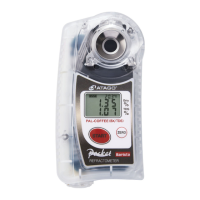
Identifies key parts including LCD, START button, Battery compartment, Sample stage, and ZERO button for operation and maintenance.

Introduction

Safety Instructions

Read and follow all safety instructions before operating the instrument to prevent personal injury or property damage.

Summary

Automatic Temperature Compensation

Temperature Compensation Caution

Measurements may fluctuate with hot or cold samples. Wait for approximately 20 seconds before pressing the START button for stabilization.

Storage and Maintenance

Proper Storage Conditions

Store in a dry place away from direct sunlight, humidity, and heat. Maintain a stable temperature with minimal fluctuation.

Repair and Warranty

Warranty Coverage and Limitations

One-year warranty void if disassembled, misused, or damaged. Repair services available after warranty expires.

Parts

Instrument Components Overview

Identifies key parts including LCD, START button, Battery compartment, Sample stage, and ZERO button for operation and maintenance.

Introduction

Safety Instructions

Read and follow all safety instructions before operating the instrument to prevent personal injury or property damage.

Overview

The ATAGO PAL-89S "Pocket" Coolant Refractometer is a portable instrument designed to measure the concentration of Propylene glycol and its freezing point. The main scale displays the Propylene glycol concentration, while the secondary scale shows the freezing point. The device features automatic temperature compensation, which corrects readings based on the prism's temperature within a specified range, ensuring accuracy even with varying sample temperatures. However, users should be aware that measurements might fluctuate with hot or cold samples, and it's recommended to wait approximately 20 seconds for the instrument to acclimate to the sample temperature before pressing the START button.

To begin using the refractometer, zero-setting is required. This should be performed daily and after replacing batteries. The process involves cleaning the prism, applying about 0.3mL of tap water, and allowing it to acclimate to the instrument's temperature. Then, with the water on the prism, the ZERO button is pressed. The display will show "000" blinking twice before stopping, indicating successful zero-setting. If "AAA" is displayed, the prism needs to be cleaned again, water reapplied, and the ZERO button pressed. After zero-setting, the prism should be wiped clean with tissue paper, and the device is ready for measurement.

For measurement, approximately 0.3mL of the sample is applied to the prism. The START button is then pressed, and after "---" appears, the measurement and prism temperature are displayed on the LCD. Initial measurements with hot or cold samples may fluctuate, so it's advisable to wait for the instrument to acclimate to the sample temperature or press the START button multiple times until stable readings are achieved. The displayed temperature reflects the prism's temperature, which may not always match the sample's temperature. For oily or fatty samples, stirring the sample on the prism during measurement can improve repeatability.

The PAL-89S is designed for ease of use and durability. It is water-resistant (IP65), meaning it can withstand splashes but should not be submerged. The body case is made of resin, so it should not be exposed to water vapor, and some solvents may compromise its structural integrity. The device is powered by two AAA alkaline batteries. When the battery icon indicates a low power level, both batteries should be replaced with new ones. Battery replacement involves using a coin to turn the battery compartment cover counterclockwise, inserting the new batteries with correct polarity, aligning the cover, pushing it down, and turning it clockwise until it stops. Over-tightening should be avoided to prevent malfunction.

Maintenance of the refractometer is straightforward. After each use, the sample should be wiped off, and the prism and sample stage cleaned with a mild soap and thoroughly rinsed with water, then dried with tissues. It's crucial not to scratch the prism, and metal tools should not be used for cleaning or applying samples. Water above 50°C should not be used for rinsing, as it may warp the plastic and compromise water resistance. When measuring hot samples, only the necessary amount should be applied, preventing overflow. If hot water is needed to clean hardened samples, water-soaked gauze should be used around the prism area, keeping hot water away from the body case.

For storage, the instrument should be kept in a dry place, away from direct sunlight, humidity, and heat, as these can damage it. It should also be stored at a stable temperature with minimal fluctuations. The LCD features an auto shut-off function, turning off after 2 minutes of inactivity. To manually turn it off, the START button should be held down for more than 2 seconds.

The device also provides error messages to alert users to potential issues. "Lo" indicates a low battery. "AAA" means the ZERO button was pressed with nothing or something other than water on the prism. "XXX" signifies that the START button was pressed with nothing or an insufficient amount of sample. "LLL" indicates that the sample measured is outside the measurement range, or too much light is entering the prism (in which case, shading the sample stage with a hand is recommended). If "EEE" is displayed, the instrument is faulty, and batteries should be replaced. If the error persists, ATAGO should be contacted. The device also indicates if the prism temperature is below or above the acceptable range.

The instrument comes with a one-year warranty from the date of purchase. This warranty is void if the instrument has been disassembled by unauthorized personnel, misused, operated outside environmental specifications, if the prism or sample stage is damaged, if there is water damage, if it has been dropped, or if there is leakage from non-included batteries. Repair services are available for a fee after the warranty expires, and users should have the serial number ready when contacting a service center. The warranty period can be extended from one year to two years by registering customer information.

ATAGO PAL-89S Specifications

General IconGeneral
ModelPAL-89S
Ambient Temperature10 to 40°C
Sample Volume0.3 mL
Light SourceLED
Power Supply2 x AAA batteries
Battery LifeApprox. 11, 000 measurements
IP RatingIP65
Resolution0.1%
Accuracy±0.2%
Dimensions55 x 31 x 109 mm (2.2 x 1.2 x 4.3 in)
Weight100 g (3.5 oz)

Related product manuals