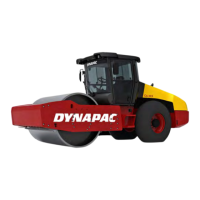
This document is an instruction manual for the Dynapac CC900G-CN1EN2 vibratory roller, a self-propelled tandem roller designed for smaller compaction works such as minor roads, sidewalks, cycle ways, and parking places. The machine is equipped with drive, brakes, and vibration on both drums.
Function Description:
The Dynapac CC900G-CN1EN2 is a vibratory roller used for compacting various surfaces. Its operation involves driving the roller, engaging vibration, and stopping. The machine is controlled from an operator station, which includes an ignition key, speed control, reserve/parking brake, vibration on/off switch, hydraulic fluid temperature gauge, forward/reverse lever, horn, and an hourmeter. The reserve/parking brake is a crucial safety feature, engaging automatically when the engine is switched off or when the lever is pressed. Vibration can be manually switched on or off, but it should not be active when the roller is stationary to prevent damage to the surface and the machine. The steering is articulated, allowing for maneuverability. The machine is equipped with a sprinkler system for watering the drums during operation.
Important Technical Specifications:
- Model: Dynapac CC900G-CN1EN2
- Engine: Honda GX620K1/GX620U1
- Output at 3,000 rpm (SAE J1995): 13.4 kW / 18 Hp
- Engine revs during operation: 3000 rpm
- Electrical System:
- Battery: 12V 60Ah
- Charging coil: 12V 3A
- Hydraulic System (Opening Pressure):
- Drive system: 27.0 MPa (3915 Psi)
- Supply system: 2.0 MPa (290 Psi)
- Vibration system: 22.0 MPa (3190 Psi)
- Control systems: 7.0 MPa (1015 Psi)
- Brake disengagement: 2.0 MPa (290 Psi)
- Weights and Volumes:
- Service weight with ROPS (EN500): 1335 kg (2943 lbs)
- Drum fluid volume: 3.5 liters (3.7 qts)
- Ballast static drum fluid volume: 65 liters (68.7 qts)
- Hydraulic reservoir volume: 12 liters (3.2 gal)
- Fuel tank volume: 23 liters (6.0 gal)
- Water tank volume: 175 liters/tank (46.2 gal)
- Petrol engine oil volume (without filter replacement): 1.5 liters (1.6 qts)
- Petrol engine oil volume (with filter replacement): 1.8 liters (1.9 qts)
- Compaction Data:
- Static linear load, front: 6.6 kg/cm (37 pli)
- Static linear load, rear: 8.2 kg/cm (45.9 pli)
- Amplitude: 0.4 mm (0.016 in)
- Vibration frequency: 70 Hz (4200 rpm)
- Centrifugal force: 17 kN (3820 lb)
- Propulsion:
- Speed range: 0-8 kph (0-5 mph)
- Climbing capacity (theoretical): 35%
- Noise and Vibration:
- Guaranteed sound power level, LWA: 102 dB (A)
- Sound pressure level at the operator's ear (platform), LpA: 84 ±3 dB (A)
- Measured whole-body vibrations (operator's seat): below the action value of 0.5 m/s² as specified in Directive 2002/44/EC (Limit is 1.15 m/s²)
- Measured hand/arm vibrations: below the action level of 2.5 m/s² specified in the same directive (Limit is 5 m/s²)
- Dimensions (Side View):
- A: 1350 mm (53.1 in)
- D: 580 mm (22.8 in)
- H1: 2297 mm (90.4 in)
- H2: 1536 mm (60.5 in)
- K1: 455 mm (17.9 in)
- K2: 261 mm (10.3 in)
- L2: 2107 mm (83.0 in)
- P: 661 mm (26.0 in)
- S: 12 mm (0.47 in)
- Dimensions (Top View):
- B: 974 mm (38.3 in)
- O: 37 mm (1.46 in)
- R1: 2700 mm (106.3 in)
- R2: 2660 mm (104.7 in)
- W: 900 mm (35.4 in)
Usage Features:
- Operator Safety: The manual emphasizes the importance of safety, including wearing personal protective equipment (helmet, steel-toed boots, ear protectors, reflective clothing, gloves), using the seat belt, and ensuring the Roll Over Protective Structure (ROPS) is in the raised position.
- Driving: Operators must be trained and experienced. Driving near edges requires caution, maintaining a minimum 2/3 of the drum width on solid ground. On slopes, it's recommended to drive straight up and down.
- Starting: Before starting, the operator's seat should be adjusted, and the sprinkler checked. The reserve/parking brake knob must be pressed in. The engine is started by turning the ignition key and adjusting the RPM control. Choke is used for cold starts.
- Stopping: Normal braking involves pressing the switch to turn off vibration and moving the forward/reverse lever to neutral. For emergency braking, the reserve/parking brake knob should be pushed in while holding the steering wheel firmly.
- Parking: When parking, the roller should be on a safe, level surface, and the drums should be chocked. In winter, the water tank, pump, and lines should be drained to prevent freezing.
- Transport: The articulation must be locked before lifting and transporting. Wooden wedges and straps are used to secure the roller during transport.
- Towing/Recovering: A towing bar must be used, and the roller can only be towed slowly (max. 3 km/h or 2 mph) for short distances (max. 300 m or 330 yards). The brakes in each propulsion motor must be mechanically disengaged before towing.
Maintenance Features:
The manual provides a detailed maintenance schedule with actions to be performed at various intervals:
- Daily/Before Starting: Inspect the machine for leakages, check the oil level in the engine and hydraulic reservoir, refuel, check the sprinkler system, air circulation, scrapers, warning lamps, and air cleaner.
- After the first 20 hours: Change the engine oil and engine's oil filter.
- Every 50 hours: Test the brakes, clean the air cleaner, and check rubber elements and bolted joints.
- Every 100 hours: Change the engine oil and oil filter, check and adjust the spark plug, and check the fuel filter.
- Every 200 hours: Check lubrication of controls and pivots.
- Every 300 hours: Replace the air cleaner insert, replace spark plugs, check idling revs, check valve play, replace the fuel filter, and clean the hydraulic fluid cooler (if applicable).
- Every 500 hours: Clean the combustion chamber, check the oil level in the front drum, check the hydraulic reservoir cover/breather, and check the condition of the articulation.
- Every 900 hours: Change the hydraulic fluid filter.
- Every 2000 hours or Every year (whichever comes first): Change the hydraulic fluid, change the oil in the front drum, change the water in the rear drum, drain and clean the water tank, drain and clean the fuel tank, and check the fuel line.
General Maintenance Instructions:
- Always use high-quality lubricants and the amounts recommended.
- Refer to the engine manual for detailed instructions on engine-specific maintenance.
- Dispose of used filters, drain oil, and fuel remnants in an environmentally correct manner.
- Ensure the engine cover is fully open before working underneath it.
- Park the roller on a level surface, switch off the engine, and apply the emergency/parking brake before checking and making adjustments.
- Wear protective gloves and eye protectors when working with fluids or compressed air.
- Do not over-tighten the hydraulic fluid filter seal.

 Need help?
 General



 To Next Page