System Characteristics
System Description, Autroprime Interactive Fire Detection System, 116-P-APRIME-SYSTEMD/XGB 2007-10-10,
Autronica Fire and Security AS
Page 10
2.10.4 Parent Alarm Zone
The top-level Alarm Zone is called the Parent Alarm Zone. A system
can consist of a Parent Alarm Zone with several “sub-level” alarm
zones in an hierarchy. Each “sub-level” alarm zone is related to a
specific area of, for example, a building. If an alarm occurs in a Parent
Alarm Zone, all Fire Alarm Devices (FADs) within the Parent Alarm
Zone, plus all FADs belonging to all “sub-level” alarm zones will be
activated.
2.10.4.1 Neighbour Alarm Zone
Geographically associated alarm zones can be defined as neighbour
alarm zones, such that these can operate outputs for alarm zones
adjacent to the incident.
Defining neighbour zones allows the fire alarm control panel to
activate the sounders in alarm zones that are neighbours. This means
that areas that are adjacent to each other – and may therefore be at
risk – are warned in the event of a fire alarm.
2.11 Configuration / Service
2.11.1 Ready-to-use in a Pre-configured State
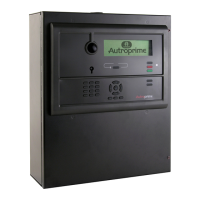
Autroprime is provided to the user in a pre-configured state, in this
state the panel is set to recognize detectors and other loop units
connected to the detection loops and the availability of routing
equipment, etc. As such, the system is fully functional and ready-to-
use simply by turning ON the power, but not configured to respond in
any non-default way. A functional verification of the panel is run to
assure the panel itself is fully functional.
2.11.2 Site-specific configuration
Basic site-specific configuration can be performed by means of the
panel buttons (access level 3/service), typically including:
• naming and assigning detectors to Detection Zones
• naming and defining the number and type of Detection Zones
(Immediate Action, Dependency Action, Delayed Action, Delayed
Dependency Action, SOLAS)
• assigning Fire Alarm Devices to Alarm Zones
• specifying the Detections Zones that can activate selected Alarm
Zones
• configuring “conditions” for outputs, for example, dependency
action; meaning that at least two detectors in the same detection
zone must be in alarm state before actions are initiated
• assigning Detection Zones to Disable devices (BW-200)


 To Next Page
 Loading...