Venting Requirements
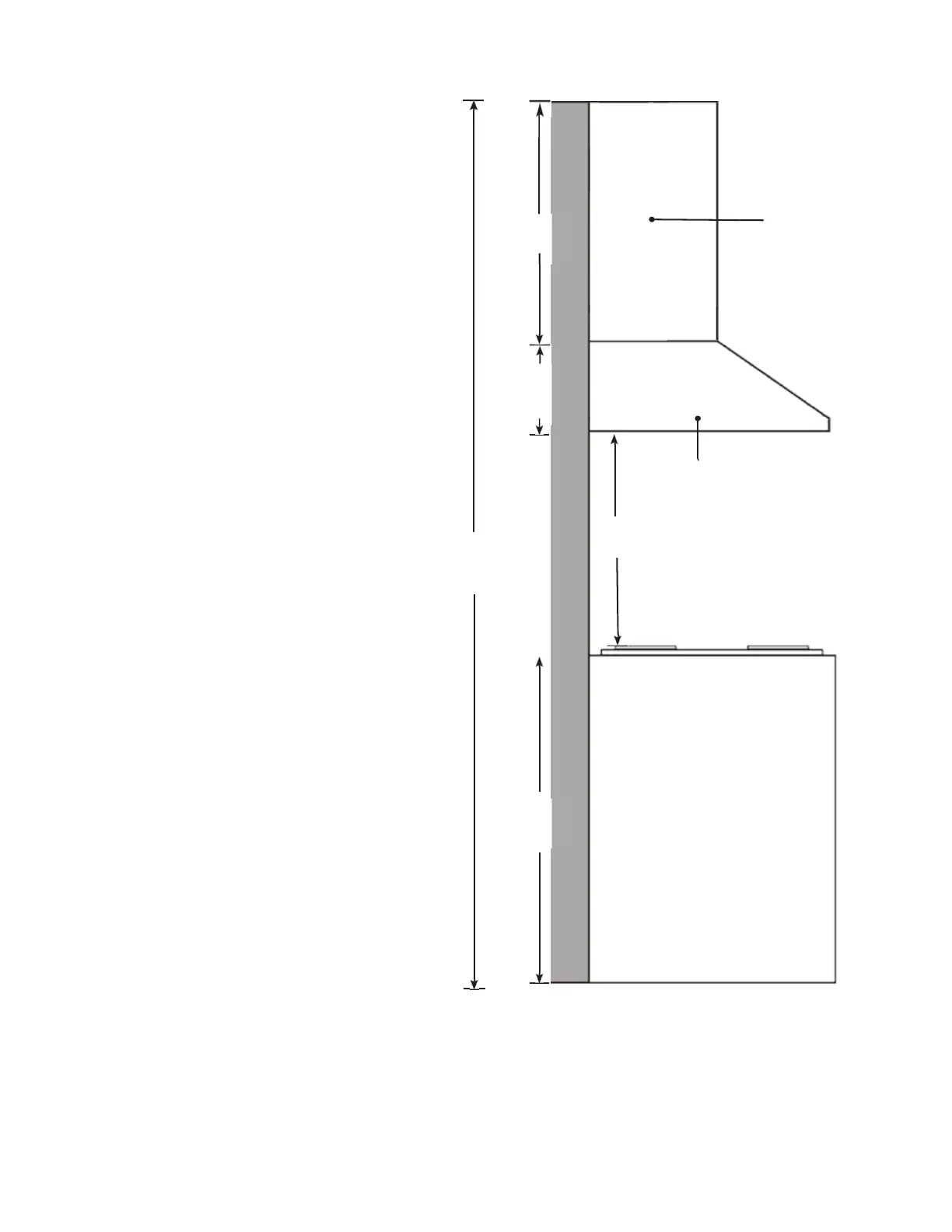
Height & Clearance
•
Vent system must evacuate to the exterior –
Outside(throughtherooforsidewall).
•
DONOTterminatetheventsysteminanatticor
otherenclosedarea.
•
Userigidmetal/aluminumventonly.
•
NEVERuseplasticventorplasticventcover.
•
Always keep the duct clean to ensure proper
airflow.
•
Calculate the following figures before
installation:
1. Distancefromthefloortotheceiling.
2. Distance between the floor and the
countertop/cookingelement.
3. Distancebetweentherangehoodandthe
countertop/cooking element which is
recommendedat28”to30’’.
4. Height of hood and duct cover with the
cabinet
.
Forthemostefficient&quietoperation:
•
It is recommended that the range hood be
ventedverticallythroughtheroofthrough6”
(15.3 cm) round metal/aluminum vent or
ventedhorizontally through the wall through
arectangularventmeasuring3¼’’x10’’.
•
Thesizeoftheventshouldbeuniform.
•
If venting vertically, do not use more than
three 90° elbows.Donot install two elbows
together.
•
Makesurethereisaminimumof24”(61cm)
of straight vent between the elbows if more
thanoneelbowisused.
•
The length of vent system and number of
elbows should be kept to a minimum to
provideefficientperformance.
•
Theventsystemmusthaveadamp er. Ifroof
orwallcaphasadamper,DONOTusedamper
(whichissupplied)ontopoftherangehood.
•
Use duct tape to seal all joints in the vent
system.
•
Use caulkin g to sealthe exteriorwall or roof
openingaroundthecap.
Ceiling
heigh
t
Cabinet
height
Cabinet
Range
hood
height
Rangehood
Min:28”
Max: 30”
Countertop/
Cookingelement
stan
ar
counter
height
24


 To Next Page