Need help?
Do you have a question about the Axis P3367-VE and is the answer not in the manual?
Defines different levels of hazard warnings like DANGER, WARNING, CAUTION, NOTICE for user safety.
Explains the meaning of Important and Note messages for product operation and user guidance.
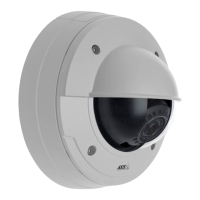
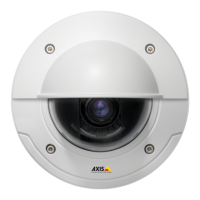
Provides a visual overview of the camera's components with numbered labels for identification.
Step-by-step guide to accessing the product's interface using a web browser and IP address.
Explains requirements for remote access via the internet, involving router configuration.
Details on setting a secure password for the administrator root user to prevent unauthorized access.
Overview of the live view window controls and layout, which may vary based on customization.
Explanation of audio controls for speakers and microphone within the AXIS Media Control interface.
Information about Pan, Tilt, and Zoom controls, including joystick emulation and viewer control.
Explanation of the H.264 video compression standard, its benefits, and usage with different protocols.
Description of the Motion JPEG format, its bandwidth usage, image quality, and recommended access method.
Details on other ways to access video and images, including still JPEG images and Windows Media Player.
Provides shortcuts to essential initial setup steps like users, TCP/IP, and video settings.
Step-by-step guide for configuring video streams, covering image, audio, H.264, and MJPEG settings.
Defines capture modes, affecting resolution, frame rate, and field of view, with important notes on changing them.
Configuration of focus and zoom levels, including autofocus and manual adjustment methods.
Details on connecting and configuring external microphones or line sources for audio input.
Instructions for connecting external speakers and configuring audio output gain and settings.
Selecting the preferred viewer (AMC, QuickTime, Still image) for different browsers.
Configuration of viewer options like toolbar display, PTZ crosshair, recording button, and decoder installation.
How to save and access specific camera views using preset positions for quick steering.
How to set up and manage guard tours, which cycle through preset positions automatically.
Configuring advanced PTZ options, including movement speed and panel shortcut command buttons.
How to configure camera tampering detection to generate alarms for repositioning or lens obstruction.
Setting up audio detection to trigger alarms based on sound levels rising above or falling below a threshold.
Step-by-step guide for uploading, installing, and starting applications on the Axis product.
Detailed steps for creating action rules, defining triggers, conditions, and actions like recording video.
Overview of available actions when an event is triggered, such as setting vision modes or sending notifications.
Steps to create schedules that can be used as triggers or additional conditions for action rules.
Guide to accessing and filtering stored recordings based on time, event, or storage location.
How to set up continuous video recording to a storage device, including stream profile selection.
Information on installing and switching between multiple languages for the product's web interface and online help.
Configuration of security settings, including user access control, password policies, and anonymous login options.
How to enable and configure HTTPS for secure, encrypted browsing and device authentication.
Settings for synchronizing and displaying date and time, including overlay text formats.
Configuration of network settings, including TCP/IP versions, DHCP, static IP, and ARP/Ping.
Configuring NAT traversal to allow external access to the product through a router, often using UPnP.
Details on supported SD card types, file systems (ext4, vFAT), and recommendations.
Accessing maintenance functions like restarting the product and calibrating optics.
Instructions on how to reset the product to its original factory default settings, caution advised.
Steps to check the installed firmware version, which is crucial for troubleshooting.
Detailed instructions for downloading and installing the latest firmware to improve functionality and fix issues.
Procedure to recover the product if it becomes unresponsive after a failed firmware upgrade.
Solutions for issues related to setting the IP address, including ARP/Ping, subnet conflicts, and DHCP.
Troubleshooting steps for issues preventing access to the product via a web browser, including login problems.
Tips for improving frame rate, such as reducing applications, limiting viewers, and checking bandwidth.
Troubleshooting steps for hardware failures indicated by flashing red LEDs.
Basic troubleshooting for the product not starting up, involving power and network connections.
Troubleshooting issues related to storage devices, including disruption alarms and recording failures.
Description of the status and network LED indicators, their colors, and what they signify.
Information about the SD card slot, supported card types, and important notices regarding usage.
Description of the product's connectors, including network (RJ45 PoE) and audio (3.5mm) connectors.
Information about the I/O connector for external devices, including digital inputs and outputs.
Factors affecting product performance, such as image resolution, compression, bandwidth, and client load.
 General
| Total megapixels | 5 MP |
|---|---|
| Maximum resolution | 2592 x 1944 pixels |
| Supported video modes | 1080p |
| Video formats supported | H.264, M-JPEG |
| Supported graphics resolutions | 1440 x 900 (WXGA+) |
| Pan range | 0 - 360 ° |
| Tilt angle range | 0 - 160 ° |
| Camera shutter type | Electronic |
| Camera shutter speed | 1/28000 - 2 s |
| Minimum illumination | 0.04 lx |
| Field of view (FOV) angle | 340 ° |
| Sensor type | CMOS |
| Progressive scan | Yes |
| Optical sensor size | 1/3.2 \ |
| Optical zoom | - x |
| Focal length range | 2.5 - 6 mm |
| Built-in HDD | No |
| Flash memory | 512 MB |
| Internal memory | 128 MB |
| Compatible memory cards | SD, SDHC |
| LED type | IR |
| Form factor | Spherical |
| Mounting type | Ceiling |
| Product color | White |
| International Protection (IP) code | IP66 |
| Type | IP security camera |
| Placement supported | Outdoor |
| Connectivity technology | Wired |
| Interface | RJ-45 |
| Ethernet LAN (RJ-45) ports | 1 |
| Sample rate | 16 kHz |
| Audio system | 2-way |
| Cabling technology | 10/100Base-T(X) |
| Supported network protocols | IPv4/v6, HTTP, HTTPS**, QoS Layer 3 DiffServ, FTP, SMTP, Bonjour, UPnP, SNMPv1/v2c/v3(MIB-II), DNS, DynDNS, NTP, RTSP, RTP, TCP, UDP, IGMP, RTCP, ICMP, DHCP, ARP, SOCKS |
| Power source type | PoE |
| Storage temperature (T-T) | -40 - 55 °C |
| Operating temperature (T-T) | 0 - 50 °C |
| Storage relative humidity (H-H) | 15 - 100 % |
| Operating relative humidity (H-H) | 15 - 85 % |
 Weight and Dimensions
| Height | 103.25 mm |
|---|---|
| Weight | 700 g |


 To Next Page