
 Need help?
Do you have a question about the Axminster AWVSL1000 and is the answer not in the manual?
Read the manual to understand tool applications, limitations, and hazards.
Avoid using power tools in wet areas or exposing them to rain. Keep work area lit.
Do not use power tools near flammable substances or in areas with explosive gases.
Maintain a clean, uncluttered, and well-lit workspace. Avoid slippery floors.
Keep bystanders, especially children, at a safe distance from the operating work area.
Do not force the tool to perform tasks it was not designed for.
Wear appropriate clothing; avoid loose items. Wear non-slip footwear and tie back long hair.
Wear a mask to protect against dust produced during wood lathe operation.
Unplug the tool before making adjustments, changing parts, or cleaning.
Ensure the power switch is OFF before plugging in the power cord.
Ensure all tools are removed from the lathe before turning it on.
Never leave a running lathe unattended. Turn it off and wait for it to stop.
Never stand on the tool. Avoid storing items above or near the lathe.
Maintain footing and balance; wear oil-resistant footwear. Keep floor clear.
Keep tools clean and in good working order. Follow lubrication and accessory change instructions.
Check for part alignment, binding, breakage, or improper mounting before use.
Use padlocks, master switches, and remove starter keys to childproof the workshop.
Do not operate the tool if impaired by drugs, alcohol, or medication.
Operate lathe in a well-ventilated area and use dust collection systems for hazardous dust.
Always wear safety goggles to protect eyes from thrown objects; ordinary glasses are insufficient.
Diagram illustrating the electrical wiring connections for the wood lathe.
Ensure the wood lathe is fully assembled and installed according to instructions before operation.
Read the entire manual for safety and operational information before using the lathe.
Always wear appropriate eye protection when operating the wood lathe.
Avoid wearing gloves, neckties, or loose clothing that can get caught in moving parts.
Ensure all locking mechanisms are securely tightened before starting the lathe.
Avoid mounting workpieces that are split or compromised.
Begin with the lowest speed setting when starting a new workpiece.
Pay attention to and read any warning labels present on the wood lathe itself.
Rough wood to a round shape at slow speed to prevent vibration and workpiece ejection.
Manually rotate the workpiece before motor activation to check for tool rest interference.
Prevent turning tools from biting into the wood to avoid splitting or ejection.
Position the tool rest above the lathe's centerline when shaping stock.
Ensure the workpiece rotates towards you; do not operate if direction is incorrect.
Rough out workpieces to be as round as possible before faceplate attachment to minimize vibration.
Position your hands carefully to prevent them from accidentally slipping onto the rotating workpiece.
Remove loose knots from stock before mounting to prevent issues during turning.
Do not leave the work area until the lathe motor has completely stopped.
Store turning tools safely on the wall, away from the revolving workpiece area.
Maintain a firm grip and control of the cutting tool throughout the operation.
Prioritize safety in all actions and operations with the wood lathe.
Finish hand-sanding workpieces while they are still mounted on the lathe.
Provides essential information on proper grounding to prevent electric shock during operation.
Ensure the electrical receptacle is properly grounded; consult an electrician if unsure.
Provides instructions and a table for selecting the correct gauge extension cord based on length and rating.
Instructions for assembling the lathe's leg set using provided bolts, washers, and nuts.
Steps for positioning and securing the lathe bed assembly onto the assembled leg set.
Details on how to locate, assemble, and use the headstock locking handle.
Instructions for inserting and removing the headstock spur and tailstock center.
Steps for threading and mounting the faceplate, and securing the workpiece.
Guidance on attaching the extension bed for outboard faceplate turning.
Information on the headstock's 5 preset positions and how to set them using the locking handle.
How to turn the lathe on, off, and use the emergency stop feature.
Instructions for adjusting the lathe's speed using the control lever and index plate.
How to move the tailstock along the bed and extend its spindle.
Instructions for positioning and adjusting the tool rest, with or without the arm.
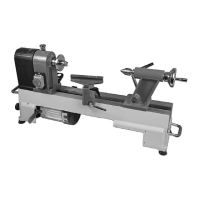
Detailed list of parts for the AWVSL900, organized by number and description.
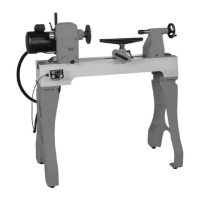
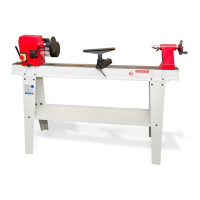
Detailed list of parts for the AWVSL1000, organized by number and description.


 To Next Page
 General