
 Need help?
Do you have a question about the Bajaj Pulsar 150 2019 and is the answer not in the manual?
Explains the meaning of warning and caution symbols used in the manual for safety.
Provides notices regarding manual binding, manufacturer rights, and modification policies.
Indicates the location of the vehicle's frame serial number.
Indicates the location of the vehicle's engine serial number.
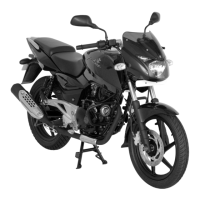
Lists detailed technical specifications of the Pulsar 150 motorcycle.
Identifies external parts like grab handle, speedometer, brake lever, front fork, etc.
Identifies external parts like grab handle, speedometer, brake lever, front fork, etc.
Identifies external parts like grab handle, speedometer, brake lever, front fork, etc.
Details the meaning of indicators like Side Stand, Fuel Level, Engine Rev, Odometer, Neutral, Speedometer, Trip Meter, Battery, and Beam indicators.
Details the three positions of the steering lock and how to lock/unlock the steering.
Explains how to open/close the fuel tank cap and the positions of the fuel tap.
Details the Dipper Switch, Turn Signal Switch, Horn Button, and Pass Switch.
Details the Starter Button and Engine Kill Switch operations.
Provides instructions for removing and fitting the side covers.
Describes the battery location and essential care for its maintenance.
Provides step-by-step instructions for removing and installing the motorcycle seat.
Guides on how to start the engine using the ignition, kill switch, and starter button.
Details the procedure for upshifting and downshifting gears smoothly.
Guides on how to start moving the motorcycle from a stop.
Covers helmet use, manual reading, traffic rules, and control familiarization for safe riding.
Advises on proper braking, speed management, and avoiding aggressive maneuvers.
Specifies the recommended engine oil grade and capacity for the Pulsar 150.
Details the procedure for checking and topping up engine oil.
Guides on using front and rear brakes simultaneously for safe deceleration.
Instructions on how to safely stop and park the motorcycle.
Advises on smooth riding, consistent speed, and proper gear usage for fuel economy.
Outlines checks for Fuel, Spark plug, Air filter, Engine oil, Brakes, Clutch, Tyre pressure, and Carburettor.
Explains how to adjust and maintain drive chain slackness and lubrication.
Details battery location, electrolyte level, charging, and disposal, with a caution.
Explains how to remove, clean, and adjust the spark plug gap.
Instructs on checking the brake fluid level and topping up with the correct type.
Provides recommendations for vehicle care during the rainy season to prevent rust and damage.
Details checks for Fuel, Steering Lock, Brakes, Drive Chain, Lighting, Horn, Steering, Clutch, Side/Center Stand, Throttle, Tyres, and Mirrors.
Outlines the frequency of servicing and lubrication for various parts.
Lists specific maintenance tasks like valve clearance, chain cleaning, brake lining check, and fluid replacement.
Details maintenance for cables, switches, steering bearings, stands, fasteners, and general lubrication.
Guides on cleaning, emptying fuel, cylinder lubrication, and protecting surfaces before storage.
Advises on proper removal, storage, and reinstallation of the battery.
Details checks for cleaning, spark plug, fuel, engine oil, daily checks, and tyre pressure.
Covers advice for rainy seasons, cautious driving, document carriage, and clothing safety.
Emphasizes concentrating on riding and avoiding hazardous conditions like loose surfaces.
Tips on smooth riding, consistent speed, and gear selection for fuel efficiency.
Guidance on punctures and recommended tyre pressures for optimal performance.
Explains how to adjust and maintain drive chain slackness and lubrication.
Lists checks for Fuel, Spark plug, Air filter, Engine oil, Brakes, Clutch, Tyre pressure, and Carburettor.
Details proper chain lubrication intervals and slackness adjustment procedures.
Details battery care, charging, electrolyte level, and proper disposal methods.
Explains the process of cleaning spark plugs and adjusting their gap correctly.
Instructs on checking the brake fluid level and topping up with the correct type.
Provides recommendations for vehicle care during the rainy season to prevent rust and damage.
Details checks for Fuel, Steering Lock, Brakes, Drive Chain, Lighting, Horn, Steering, Clutch, Side/Center Stand, Throttle, Tyres, and Mirrors.
Outlines the frequency of servicing and lubrication for various parts.
Lists specific maintenance tasks like valve clearance, chain cleaning, brake lining check, and fluid replacement.
Details maintenance for cables, switches, steering bearings, stands, fasteners, and general lubrication.
Covers maintenance for engine bushes, idle speed, fork seals, SAI hoses, EVAP system, and lubrication.
Guides on cleaning, emptying fuel, cylinder lubrication, and protecting surfaces before storage.
Advises on proper removal, storage, and reinstallation of the battery.
Details checks for cleaning, spark plug, fuel, engine oil, daily checks, and tyre pressure.
 General
| Displacement | 149.5 cc |
|---|---|
| Max Power | 14 PS @ 8000 RPM |
| Max Torque | 13.4 Nm @ 6000 RPM |
| Compression Ratio | 9.5:1 |
| Fuel System | Carburetor |
| Clutch | Wet Multi Plate |
| Fuel Tank Capacity | 15 L |
| Kerb Weight | 144 kg |
| Seat Height | 785 mm |
| Ground Clearance | 165 mm |
| Wheelbase | 1320 mm |
| Battery | 12V, 8 Ah |
| Ignition | Digital |
| Starting | Electric Start |
| Transmission | 5 Speed |
| Frame Type | Double Cradle Frame |
| Front Suspension | Telescopic |
| Rear Suspension | Nitrox Gas Filled Shock Absorbers |
| Front Brake | Disc |
| Rear Brake | Drum |
| Rear Tyre | 100/90 - 17 |
| Headlamp | 12V 35/35W |



 To Next Page