
 Need help?
Do you have a question about the Bajaj Pulsar 180 CC DTS-i and is the answer not in the manual?
Indicates potential hazard or injury if advice is not followed.
Indicates potential hazard resulting in vehicle damage.
Booklet content is not binding; manufacturer reserves right to change.
Details the three positions and operation of the steering lock.
Instructions for fuel tank cap and fuel tap operation.
Describes functions of left and right handle bar switches.
Step-by-step guide for removing and fitting the side covers.
Identifies battery, tool kit, and explains seat removal/fitment.
Instructions for removing and installing the rear seat.
Guidelines for the initial running-in period to ensure vehicle longevity.
Steps for starting the motorcycle engine correctly.
Procedures for starting to move and changing gears.
Techniques for safe braking, stopping, and parking the motorcycle.
Advice on driving techniques to improve fuel efficiency.
Information on checking, topping up, and changing engine oil.
Recommended tyre pressures for front and rear wheels.
Advice on handling wheel punctures and tyre removal/fitment.
Maintenance of the drive chain, including lubrication and adjustment.
Details on battery care, spark plug maintenance, and gap adjustment.
How to check and maintain the front brake fluid level.
Specific care instructions for riding and maintaining the vehicle during the rainy season.
Steps to prepare the vehicle for use after a period of storage.
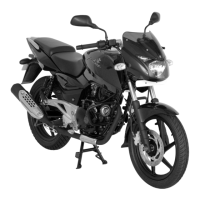
This document is a user manual for the Bajaj Pulsar 180 CC DTS-i motorcycle, providing comprehensive information on its operation, maintenance, and safety. It is designed to help owners understand their vehicle better and ensure a long, trouble-free ownership experience.
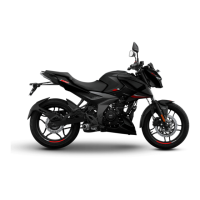
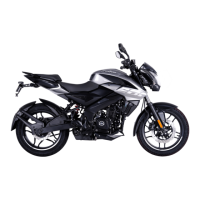
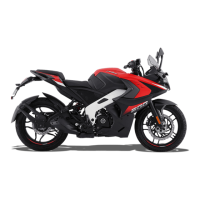
The Bajaj Pulsar 180 CC DTS-i is a high-performance motorcycle designed for everyday commuting and longer rides. It features a digital CDI ignition system and a 5-speed constant mesh transmission, offering a balance of power and efficiency. The motorcycle is equipped with both front hydraulic disc brakes and rear mechanical expanding shoe & drum type brakes for effective stopping power.
The instrument cluster provides essential information to the rider, including a digital speedometer, an odometer to track total distance, and two trip meters for short-distance tracking. A tachometer dial displays engine speed in RPM. Indicators for battery charge, fuel level, reserve fuel, engine rev, neutral gear, side stand, high beam, and turn signals keep the rider informed about the vehicle's status. The battery indicator glows when charging is needed, while the fuel level indicator shows available fuel and blinks when the tank reaches reserve level or the engine RPM crosses 9000.
The motorcycle's controls are intuitively placed. The steering cum ignition lock has three positions: "LOCK" for steering lock and ignition off, "OFF" for steering unlock and ignition off, and "ON" for steering unlock and ignition on. A common key is used for the ignition, fuel tank cap, and side cover lock.
On the left handlebar, the dipper switch allows selection between high and low beam when the headlight is on, with a corresponding indicator on the speedo console. The turn signal switch activates the left or right turn pilot indicators, which flash until the knob is pushed in to stop. The horn button is also located here. On the right handlebar, the head light switch has three positions: all lamps off, tail and pilot lamps on (while engine running), and headlamp, pilot, tail, and meter lamps on (while engine running). The starter button operates the electric starter when the clutch lever is depressed. An engine kill switch is provided for emergency use, allowing the rider to quickly turn off the engine.
The manual provides detailed instructions on how to ride the bike, starting with a crucial "Running In" period for the first 2000 kms to ensure optimal performance and longevity. During this period, specific speed limits are recommended for different mileage intervals. Riders are advised to avoid racing the engine, starting immediately after ignition, or excessive idling.
Starting the engine involves ensuring the fuel tap is in the "ON" or "RES" position, turning the ignition switch to "ON," and the engine kill switch to "ON." The transmission should be in neutral. For cold starts, the choke lever, located on the left side of the carburetor, should be used. Once the engine is warm, the choke should be returned to the "OFF" position.
Moving off requires checking that the center/side stand is up, depressing the clutch lever, shifting into 1st gear, and then slowly opening the throttle while simultaneously releasing the clutch lever. Shifting gears involves closing the throttle, depressing the clutch, shifting to the next higher or lower gear, and then slowly opening the throttle while releasing the clutch.
Braking instructions emphasize closing the throttle completely, shifting down one gear at a time to reach neutral, and applying both brakes simultaneously. Riders are cautioned against locking the brakes to avoid skidding, especially when cornering. For parking, the motorcycle should be in neutral, ignition off, and supported on a firm, level surface using the center or side stand.
Fuel-saving tips include driving smoothly and steadily between 40-50 km/h, avoiding sudden accelerations and harsh braking, planning trips to minimize start-stops, changing gears judiciously, traveling light, and cutting off the engine for intermediate stoppages longer than two minutes.
Safety riding tips highlight the importance of wearing helmets, reading the manual thoroughly, avoiding unnecessary accessories, familiarizing oneself with traffic rules and signs, and practicing starting, acceleration, and braking. It also advises using both front and rear brakes simultaneously, driving cautiously in rainy seasons, carrying necessary documents, avoiding loose sand or stones, securing loose clothing, and concentrating on riding.
The manual outlines various maintenance procedures to keep the motorcycle in optimal condition. Daily safety checks are crucial before each ride, covering fuel level, engine oil level, throttle play, brake pedal play, brake lining wear, drive chain slack, lighting, horn, steering smoothness, clutch lever play, side and center stand position, tire pressure, and mirror position.
Engine oil maintenance is critical, with daily checks recommended before starting the vehicle. The oil level should always be maintained between the upper and lower marks on the inspection gauge. The manual specifies Bajaj Genuine Engine Oil (Bajaj DTS-i 10000, SAE 20W50 API 'SL' or JASO 'MA' Grade) for optimum performance. Oil replacement frequency is 1st service and then every 10,000 km, or every 5000 km if other oils of the same specifications are used.
Spark plug maintenance involves removing, cleaning, and adjusting the gap (0.6 to 0.8 mm) of the two Champion RG 4 HC spark plugs.
Battery maintenance for the 12V - 9 Ah, MF battery includes checking the electrolyte level between max and min marks and topping up with distilled water if needed. The manual warns against using tap water and advises charging the battery immediately if discharged. It also cautions against driving with a disconnected battery to prevent damage to electrical components.
Front brake fluid level should be checked regularly, ensuring it is above the 'MIN' mark. Only DOT 3 or DOT 4 equivalent brake fluid from a sealed container should be used for topping up, with replenishment recommended every 30,000 km or once every two years.
Drive chain slackness should be adjusted as needed, and the chain lubricated with SAE 90 oil every 500 kms, taking care that the 'O' ring design chain never runs dry.
Rainy season care includes applying a preventive coat to avoid rusting, cleaning the vehicle with a soft, wet cloth, lubricating important parts, avoiding direct water jets on painted/electrical parts, and not obstructing engine cooling.
Non-use maintenance for periods longer than 15 days involves thoroughly cleaning the vehicle, emptying the fuel tank and carburetor float bowl, adding 2T oil to the cylinder via the spark plug hole and kicking the engine over to coat the cylinder wall, raising both wheels off the ground, spraying oil on unpainted metal surfaces, lubricating control cables, and covering the vehicle in a well-ventilated area. Battery removal and storage on a wooden plank in a ventilated area are also recommended. Before regular use after storage, the vehicle should be cleaned, spark plug tightened, fuel tank filled, engine oil changed, daily safety checks performed, and tires inflated to proper pressure.
The manual also includes a detailed periodic maintenance and lubrication chart, specifying checks, adjustments, cleaning, replacements, and lubrication tasks at various mileage intervals for components like engine idling speed, valve tappet clearance, oil strainer, paper oil filter, air cleaner element, fuel cock, carburetor, fuel pipes, brake lining, brake fluid, steering, fasteners, and drive chain. It emphasizes the use of Bajaj Genuine Parts for optimal performance, prolonged life, economical maintenance, and rider safety, providing a "Genuinity Test" with a golden hologram and price label to identify authentic parts.
 General
| Displacement | 178.6 cc |
|---|---|
| Max Torque | 14.22 Nm @ 6500 rpm |
| Bore x Stroke | 63.5 mm x 56.4 mm |
| Compression Ratio | 9.5:1 |
| Fuel System | Carburetor |
| Front Suspension | Telescopic Forks |
| Front Brake | 260 mm Disc |
| Front Tyre | 90/90 - 17 |
| Rear Tyre | 120/80 - 17 |
| Fuel Tank Capacity | 15 liters |
| Ground Clearance | 165 mm |
| Wheelbase | 1345 mm |
| Max Power | 17.02 PS @ 8500 rpm |
| Transmission | 5-speed |
| Clutch | Wet multi plate |
| Frame Type | Double cradle |
| Engine Type | 4-stroke, DTS-i, air-cooled, single cylinder |
| Ignition | Digital CDI |
| Starting | Electric & Kick |



 To Next Page