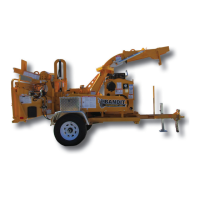
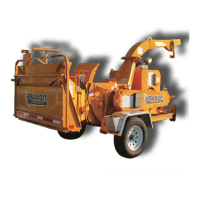
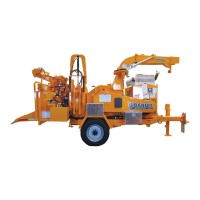
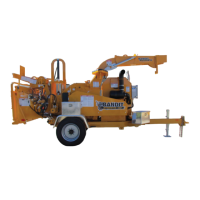
Need help?
Do you have a question about the Bandit INTIMIDATOR 12XPC and is the answer not in the manual?
Details required for ordering chipper, engine, and clutch replacement parts.
Explains the manual's purpose and the use of signal words for safety.
Diagrams illustrating where to find serial and work order numbers on the chipper.
Technical specifications including dimensions, weight, and tank capacities.
Important warnings regarding potential health hazards as per California Proposition 65.
Emphasizes preventing accidents through operator training and safety policies.
Details on safety features like infeed pan extension, push paddle, hood pin, and disable plug.
Step-by-step instructions for safely clearing blockages in the chipper.
Covers safety words, operator responsibilities, and general safety precautions.
Critical safety rules for machine condition, material feeding, and hazard avoidance.
Correct operation of the feed control bar and its tension adjustments.
Safety measures for transporting the chipper and stabilizing it.
Guidelines for safe operation on ascending, descending, and side slopes.
Instructions for site preparation, engine startup, and core machine operations.
Diagrams showing machine orientation and the basic layout of controls.
Detailed procedures for operating the feedwheel control bar and trap door.
Explanation of the chipper hood engine disable plug's safety function.
Operation, safety, and troubleshooting for the optional hydraulic bump bar.
Guidance on consulting engine manufacturer manuals for specific controls.
A checklist of steps to complete before transporting the machine.
Daily checks for safety decals, equipment, fasteners, guards, and hood hinge.
Schedules for various maintenance tasks including weekly, monthly, and quarterly.
Bolt torque specifications and basic wheel torque requirements.
Essential maintenance items for optimal chipper performance and longevity.
Chart detailing lubrication points, frequency, and procedures for machine components.
Guidance on diagnosing and resolving issues like poor chip quality and knife problems.
Guidelines for safely and effectively sharpening chipper knives.
Step-by-step instructions for safely changing chipper knives.
Procedures for adjusting the anvil and checking anvil to knife clearance.
Checking and adjusting the rope/line shear clearance.
Guidelines for adjusting belt tension on main and pump drive belts.
Instructions for installing and removing couplers and feedwheel motors.
Procedures for servicing or replacing feedwheel bearings.
Detailed steps for safely clearing blockages in the chipper.
Instructions for adjusting spring tension on the Easy Climb feed system.
Details on bump bar protrusion, activation force, and troubleshooting.
Instructions for manually lifting the yoke and top wheel for maintenance.
Guide to identifying tire wear patterns and recommended brake adjustment.
Important warnings regarding hydraulic leaks, pressure, and control operation.
Recommended hydraulic fluids, specifications, and viscosity grades.
Typical hydraulic relief pressure settings and flow rates at full engine RPM.
General information on the hydraulic system's efficiency and maintenance.
Instructions for using a pressure check kit to verify hydraulic pressure settings.
Procedures for checking relief valves and other optional hydraulic components.
Common hydraulic problems and their possible causes and solutions.
Steps to check the hydraulic motor's performance and identify potential issues.
Procedures for testing the hydraulic pump's output.
Instructions for disassembling and reassembling the control valve detent assembly.
Schematic illustrating the hydraulic system layout for machines without options.
Wiring diagrams for standard 6-prong plug and 6-wire main cable.
Information on ordering parts and machine orientation reference.
Exploded view and part list for the infeed hopper components.
Exploded view and part list for the main chipper components.
Part numbers and diagram for chipper knives and their mounting hardware.
Part numbers and torque specifications for anvil hardware.
Parts included in the Knife Saver Kit for knife maintenance.
Part lists and diagrams for standard and height-adjustable discharge assemblies.
A log to record maintenance and service dates, descriptions, and amounts.
Schematic diagram of the hydraulic system for machines without options.
Parts and diagrams for the chipper's frame and various accessory components.
Parts lists and diagrams for fuel and hydraulic tank assemblies.
Parts and diagrams for the optional hydraulic bump bar system.
Introduction to the Bandit control system for hand-fed chippers.
Instructions for using the main page and starting the engine via the control panel.
How to select operating modes like Manual, Radio, or Tether.
Instructions for navigating to maintenance status and diagnostic information screens.
How to perform function checks on radio and tether inputs for proper operation.
Instructions for adjusting parameters and settings on the setup page.
Configuration of Autofeed system based on engine RPM settings.
Explanation of how Fuel Saver mode affects engine throttling and operation.
Operation of push button and manual winch feed assist functions.
Adjusting display settings like brightness, contrast, and language.
Information on Diesel Particulate Filter (DPF) options and regeneration modes.
How to view and interpret system faults and diagnostic messages.
Setting and managing service reminders for engine maintenance.
Viewing other engine monitoring parameters on the display.
Information on disconnecting the main controller for engine service tools.
Accessing factory settings and information on the Bump Bar option.
Notes on system communication, engine faults, and their implications.
Details on system inputs, error counts, and FuelSaver time settings.

 To Next Page
 General